

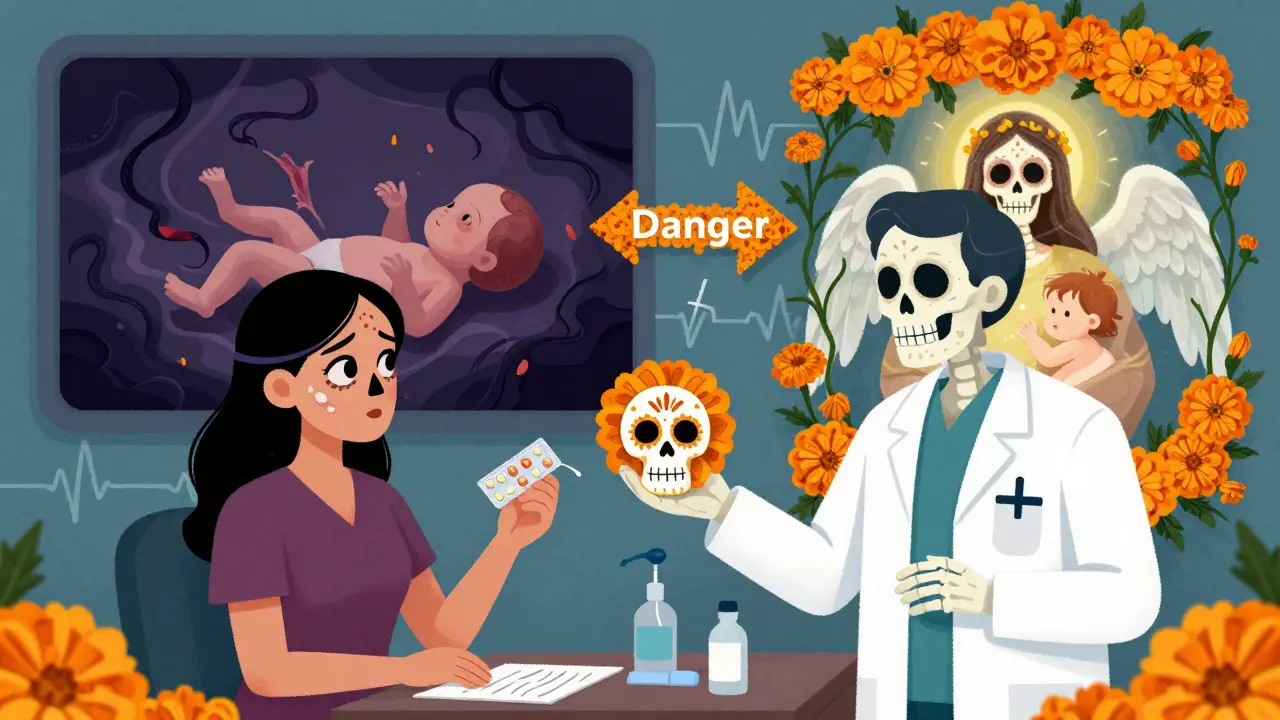
When a woman with epilepsy becomes pregnant, the choices she makes about her medication can mean the difference between a healthy pregnancy and serious complications. It’s not just about stopping seizures-it’s about protecting the baby too. Many people assume that all seizure medications are equally risky during pregnancy, but that’s not true. Some carry high risks of birth defects and developmental issues, while others are much safer. The problem? Not enough women are told this before they get pregnant.
Which Seizure Medications Are Most Dangerous During Pregnancy?
The biggest red flag is valproate-also known as sodium valproate or valproic acid. It’s one of the most effective drugs for stopping seizures, but it’s also one of the most dangerous for a developing baby. Studies show that about 10% of babies exposed to valproate in the womb develop major physical birth defects. That’s five times higher than the general population risk of 2-3%. These defects include heart problems, cleft lip or palate, spinal cord issues, and microcephaly (a smaller-than-normal head size). Beyond physical problems, children exposed to valproate are more than twice as likely to develop autism spectrum disorder and nearly twice as likely to have ADHD, according to research published in Neurology in 2020.
Other high-risk medications include carbamazepine (Tegretol), phenobarbital, phenytoin (Epanutin), and topiramate (Topamax). These drugs also raise the chance of birth defects, especially at higher doses. For example, the risk of major congenital malformations increases as the dose of carbamazepine or phenobarbital goes up. Even though these risks are lower than valproate’s, they’re still significant enough that doctors now avoid them when possible.
The Safer Alternatives: Lamotrigine and Levetiracetam
The good news? Not all seizure meds are risky. Two of the most commonly prescribed newer drugs-lamotrigine (Lamictal) and levetiracetam (Keppra)-have been shown to be much safer during pregnancy. A major review by the UK’s Medicines and Healthcare products Regulatory Agency (MHRA) found no clear link between these two drugs and major birth defects. Studies tracking children born to mothers who took lamotrigine or levetiracetam found normal development in language, motor skills, and cognitive function by age two. In fact, one Stanford study of 298 children found their verbal abilities matched those of children whose mothers didn’t take any seizure medication at all.
These two drugs are now the first-line choices for women with epilepsy who are planning pregnancy or who become pregnant unexpectedly. They’re effective at controlling seizures and carry the lowest known risks to the baby. That doesn’t mean they’re risk-free-no medication is-but they’re the best option we have right now.

How Drug Interactions Can Make Things Worse
Many women don’t realize that seizure medications can interfere with birth control-and vice versa. This creates a dangerous cycle. Drugs like carbamazepine, phenytoin, phenobarbital, oxcarbazepine, and high doses of topiramate can make hormonal birth control (pills, patches, rings) much less effective. That means a woman might think she’s protected from pregnancy, but she’s not. And if she gets pregnant while taking one of these drugs, the baby is at higher risk.
The reverse is also true. Hormonal contraceptives can lower the blood levels of certain seizure medications. Lamotrigine is especially affected-its levels can drop by up to 50% when taken with birth control pills. That can lead to breakthrough seizures, which are just as dangerous for the baby as uncontrolled seizures. The same thing happens with valproate, zonisamide, and rufinamide. This isn’t just a theoretical risk. A 2023 study found that nearly two out of three women of childbearing age answered basic questions about these interactions incorrectly. That’s alarming.
Why Uncontrolled Seizures Are Even More Dangerous
It’s easy to focus on the risks of medication and forget the bigger picture: uncontrolled seizures are far more dangerous to both mother and baby than most drugs. A tonic-clonic seizure during pregnancy can cause oxygen deprivation, fall injuries, placental detachment, and even miscarriage. The stress of repeated seizures can also lead to preterm labor and low birth weight. That’s why experts agree: no seizure medication is as dangerous as uncontrolled seizures.
This creates a heartbreaking dilemma for women. They need medication to stay safe, but they’re afraid of harming their baby. That’s why preconception counseling is critical. Women should talk to their neurologist and OB-GYN before trying to get pregnant-not after. A doctor can switch them from a high-risk drug like valproate to a safer one like lamotrigine, adjust the dose, and monitor levels throughout pregnancy. For many women, this simple step makes all the difference.
Progress Has Been Made-But Not Enough
The good news? The number of major birth defects linked to seizure medications has dropped by 39% between 1997 and 2011. Why? Because doctors are prescribing safer drugs more often. Valproate use during pregnancy has declined sharply in countries with strong guidelines. More women are getting counseling before conception. More are being switched to lamotrigine or levetiracetam.
But there’s still a gap. A French study found that women with lower income, less education, or limited access to specialists were more likely to be prescribed high-risk drugs like phenobarbital or valproate during pregnancy. That’s not a medical issue-it’s a system issue. If you don’t have a neurologist who specializes in epilepsy and pregnancy, or if you can’t afford regular blood tests to monitor drug levels, you’re more likely to be stuck with a dangerous medication.
What You Need to Do Right Now
If you’re a woman with epilepsy and you’re thinking about having a baby-or even if you’re sexually active and not using reliable birth control-here’s what to do:
- Don’t stop your medication on your own. Stopping suddenly can trigger dangerous seizures.
- See your neurologist. Ask if your current drug is safe during pregnancy. If you’re on valproate, carbamazepine, phenobarbital, phenytoin, or topiramate, ask about switching.
- Use non-hormonal birth control. If you’re on a drug that interferes with birth control, use an IUD or implant. These aren’t affected by seizure meds.
- Get a preconception plan. Even if you’re not trying to get pregnant now, having a plan in place means you won’t be caught off guard.
The bottom line: you don’t have to choose between your health and your baby’s. With the right medication, monitoring, and support, most women with epilepsy can have safe, healthy pregnancies. The tools are there. What’s missing is awareness-and that’s something you can change.
Are all seizure medications dangerous during pregnancy?
No. While some seizure medications like valproate carry high risks of birth defects, others like lamotrigine and levetiracetam are considered much safer. Studies show that children exposed to these two drugs in the womb have normal development in language, motor skills, and cognition. The key is choosing the right drug before pregnancy, not after.
Can birth control pills work with seizure meds?
Sometimes, but not reliably. Drugs like carbamazepine, phenytoin, phenobarbital, and high-dose topiramate can make hormonal birth control less effective. On the flip side, birth control can lower levels of lamotrigine, valproate, and other seizure meds, increasing seizure risk. For safety, women on these medications should use non-hormonal birth control like IUDs or implants.
What should I do if I’m already pregnant and taking valproate?
Don’t stop taking it without talking to your doctor. Suddenly stopping can cause life-threatening seizures. Instead, contact your neurologist and OB-GYN right away. They may switch you to a safer drug like lamotrigine or levetiracetam, especially if you’re in the first trimester. The goal is to reduce the dose of valproate as quickly and safely as possible while keeping seizures under control.
Is it safe to breastfeed while taking seizure meds?
Yes, for most medications. Lamotrigine and levetiracetam pass into breast milk in very low amounts and are considered safe. Even valproate is usually okay in small doses, though monitoring the baby’s liver function is recommended. The benefits of breastfeeding usually outweigh the risks. Always check with your doctor before making decisions.
Why do some women still get prescribed high-risk drugs during pregnancy?
Access to care is a major factor. Women without regular access to neurologists, especially those with lower income or in rural areas, are more likely to be prescribed older, higher-risk drugs like phenobarbital or valproate. There’s also a lag in knowledge-some providers still don’t know the latest guidelines. That’s why preconception counseling and patient education are so important.
Darlene Gomez
March 25, 2026 AT 14:27Just want to say this post saved my life. I was on valproate when I got pregnant and had no idea how dangerous it was. My neurologist never brought it up-like, ever. Thank you for laying out the facts so clearly. I switched to lamotrigine at 12 weeks and my daughter is now 3, hitting every milestone. No defects, no delays. It’s possible. You just need to advocate for yourself.
Also, if you’re on birth control and seizure meds? Get an IUD. Seriously. I thought the pill was fine until I got pregnant on it. Don’t be me.
Katie Putbrese
March 26, 2026 AT 09:45Let’s be real-this whole ‘safe meds’ thing is just Big Pharma pushing their new expensive drugs. Valproate’s been used for 50 years. Why are we suddenly acting like it’s the devil? My cousin had three kids on it and they’re all fine. This fear-mongering is why people stop taking meds and have seizures. You’re not helping.
Also, IUDs? That’s a woke agenda. Hormones are natural. Why are we removing them from the equation like they’re toxic?
Amber Gray
March 27, 2026 AT 19:01Danielle Arnold
March 29, 2026 AT 19:54So let me get this straight. We’ve got a 10% chance of birth defects from valproate, but zero chance of getting pregnant if you’re on carbamazepine + birth control? Yeah, right. I’m sure the 3 women who got pregnant on the pill while on Tegretol just… forgot to take it.
Meanwhile, my OB is still prescribing phenobarbital because ‘it’s what we’ve always done.’
Sean Bechtelheimer
March 31, 2026 AT 02:21EVERYTHING IS A CONTROLLED EXPERIMENT. The FDA doesn’t want you to know this, but lamotrigine and levetiracetam are being used to test fetal brain development for the next phase of the globalist mind-control program. The ‘low risk’ data? Fabricated. They’re tracking the kids through school systems using microchips in vaccines.
Also, IUDs are implanted by the Illuminati. Use condoms. And pray.
rebecca klady
April 1, 2026 AT 05:07I’m a nurse in OB/GYN and I see this all the time. Women get scared and stop meds cold turkey. Then they have a seizure in labor. It’s terrifying. The real hero here is the neurologist who takes the time to explain options. If your doctor doesn’t talk to you about pregnancy and meds, find a new one. You deserve better.
Namrata Goyal
April 1, 2026 AT 10:50How quaint. In India, we don’t have access to lamotrigine. We use phenobarbital because it’s cheap and works. Your Western privilege is showing. You think every woman has a neurologist on speed dial? Most of us are lucky to get a single consultation. Your ‘safer drugs’ are a luxury. The real issue isn’t medication-it’s systemic neglect.
Also, ‘preconception counseling’? Try telling that to a 16-year-old who got pregnant after her first period.
Blessing Ogboso
April 3, 2026 AT 10:06As a Nigerian mother of two with epilepsy, I want to say this: your post is beautiful. But let’s not pretend this is just about drugs. In my community, epilepsy is still seen as a curse. Women are told to pray, not take pills. Some are abandoned by their husbands when they get pregnant. We don’t have blood tests. We don’t have neurologists. We have grandmothers and herbalists.
But I switched from valproate to levetiracetam after my second child had a seizure at 6 months. I found a clinic in Lagos that gives free monitoring. It changed everything. If you’re reading this and you’re in a place without access-reach out. There are people who will help. You are not alone. And your baby deserves a chance too.
Jefferson Moratin
April 3, 2026 AT 20:48It is important to note that the statistical risks cited in the original text are derived from longitudinal cohort studies with robust confounder adjustment. The relative risk for major congenital malformations with valproate exposure is 5.3 (95% CI: 4.1–6.9), whereas lamotrigine and levetiracetam demonstrate RR values of 1.1 and 1.2 respectively, with confidence intervals overlapping baseline population risk. The pharmacokinetic interactions between hormonal contraceptives and antiepileptics are mediated primarily through CYP450 enzyme induction, particularly CYP3A4 and UGT1A4. Lamotrigine clearance increases by 50–100% with estrogen-containing contraceptives, necessitating dose titration. These are not anecdotal observations-they are reproducible, quantifiable phenomena.
Caroline Dennis
April 5, 2026 AT 03:28TL;DR: Valproate = bad. Lamotrigine/levetiracetam = good. IUD > pills. Preconception consult = non-negotiable. Stop self-discontinuing. If you’re on a high-risk AED and not on a non-hormonal contraceptive, you’re playing Russian roulette with fetal neurodevelopment. This isn’t opinion. It’s clinical guideline. Do the work.