

Beta-Blocker Psoriasis Risk Calculator
Understand Your Risk
Based on clinical evidence, about 20% of people with psoriasis experience worsening symptoms after starting beta-blockers. This tool helps assess your individual risk.
If you have psoriasis and were recently prescribed a beta-blocker for high blood pressure or heart issues, your skin flare-up might not be bad luck-it could be the medication. Around 20% of people with existing psoriasis see their symptoms get worse after starting a beta-blocker, according to DermNet NZ’s 2022 clinical update. That’s not rare. It’s common enough that dermatologists now ask about these drugs during every new or worsening psoriasis case.
How Beta-Blockers Trigger Psoriasis Flares
Beta-blockers like metoprolol, propranolol, and atenolol work by slowing your heart rate and lowering blood pressure. They do this by blocking adrenaline from binding to beta-receptors in your heart and blood vessels. But those same receptors are also found in your skin. When beta-blockers interfere with them there, they disrupt the normal balance of skin cell growth and inflammation.Here’s what happens inside your skin: beta-blockers lower levels of cyclic AMP (cAMP), a chemical that helps regulate how skin cells behave. Less cAMP means skin cells multiply too fast and don’t shed properly. At the same time, immune cells in the skin get more active, causing redness, scaling, and itching-the classic signs of psoriasis. This isn’t just theory. A 2020 review in PubMed Central (PMC7398737) confirmed this mechanism is behind many drug-induced psoriasis cases.
Some beta-blockers are worse than others. Propranolol and metoprolol top the list, followed by bisoprolol and pindolol. Even eye drops like timolol, used for glaucoma, can cause flares because enough of the drug gets absorbed into your bloodstream to affect your skin.
It’s Not Always Immediate-That’s the Problem
One of the biggest reasons this connection gets missed is timing. You might start a beta-blocker in January and not notice a flare until August-or even a year later. MyPsoriasisTeam users report symptoms showing up anywhere from one to 18 months after beginning the medication. That delay makes it easy to blame stress, weather, diet, or even a new soap. Most patients never connect the dots.That’s why doctors need to ask. The European Academy of Dermatology and Venereology now recommends that dermatologists specifically check if patients are taking beta-blockers when they see new or worsening psoriasis. If you’ve been on a beta-blocker for months and your skin suddenly got worse, it’s worth talking about.
Who’s Most at Risk?
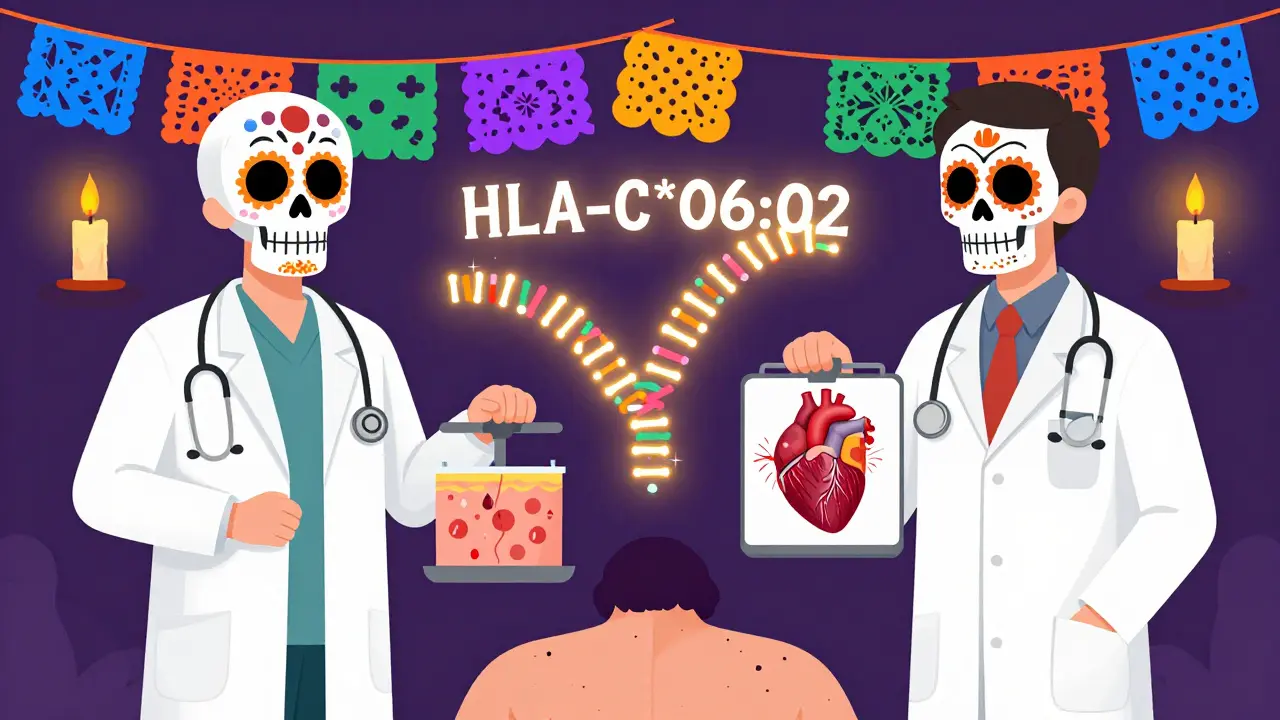
Not everyone with psoriasis will react to beta-blockers. But some people are more vulnerable. Research suggests those with the HLA-C*06:02 gene variant-a known genetic marker for plaque psoriasis-are more likely to have a flare triggered by these drugs. A 2024 study at Johns Hopkins and Mayo Clinic is actively testing whether this gene can predict who’s at highest risk. Early results are promising.Also, people with more severe psoriasis before starting the drug tend to have bigger flares. One Reddit user, u/PsoriasisWarrior2024, shared that after six months on metoprolol, his psoriasis went from covering 5% of his body to 30%. He’d had mild plaques for years. The drug turned it into something unmanageable.
On the flip side, some people take beta-blockers for years with zero skin issues. That’s why it’s not a universal rule-but it’s a strong enough pattern that it can’t be ignored.
What to Do If You Suspect Your Medication Is the Culprit
If you think your beta-blocker is making your psoriasis worse, don’t stop taking it on your own. Stopping suddenly can cause dangerous spikes in blood pressure or heart rate. Instead, talk to both your dermatologist and cardiologist together. They can weigh the risks.Here’s what typically happens next:
- Your dermatologist confirms the flare matches the pattern of drug-induced psoriasis.
- Your cardiologist reviews your heart health and whether the beta-blocker is truly necessary.
- If they agree it’s likely the drug, they’ll consider switching you to another type of blood pressure medication.
Good alternatives include calcium channel blockers like amlodipine or ARBs like losartan. These are just as effective for blood pressure control and don’t carry the same skin flare risk. ACE inhibitors like lisinopril are sometimes used too-but they can also trigger psoriasis in some people, so they’re not always safer.
And here’s the key point: if one beta-blocker caused a flare, chances are high another one will too. Banner Health’s 2023 guidance says doctors usually won’t try switching between beta-blockers. The class as a whole is the problem.
How Psoriasis Is Managed After a Drug Trigger
Once the beta-blocker is stopped or switched, skin symptoms often improve-but not always quickly. It can take weeks or even months for the inflammation to calm down. In the meantime, treatment follows standard psoriasis protocols:- Topical steroids to reduce redness and itching
- Vitamin D analogues like calcipotriene to slow skin cell growth
- Phototherapy (UV light treatment) for moderate to severe cases
- Systemic drugs like methotrexate or biologics for widespread or stubborn flares
Many patients find relief with just topical treatments once the trigger is removed. But if the flare was severe, you might need stronger options. The goal is to get your skin under control while keeping your heart safe.

Why This Matters for Millions of Americans
About 8.1 million Americans have psoriasis. And roughly 63 million beta-blocker prescriptions are filled every year in the U.S. alone-most of them for metoprolol. That means a huge number of people are taking these drugs, and some of them are unknowingly worsening their skin condition.A 2023 MedicalNewsToday survey of 187 psoriasis patients found that 37% of those on beta-blockers reported worsening skin symptoms, compared to just 12% of those on other blood pressure meds. That’s a big difference. And while the sample size was small, it lines up with what dermatologists see in clinics every day.
The American Heart Association still lists beta-blockers as a second-line option for hypertension. But they now say dermatological side effects should be considered-especially in patients with a history of skin disease.
What’s Next? Better Options on the Horizon
Researchers are working on new drugs that target only the heart’s beta-receptors and leave the skin’s receptors alone. These so-called “cardioselective” beta-blockers could be safer for people with psoriasis. Some pharmaceutical companies are already testing them in early trials.There’s also interest in topical beta-blockers with minimal absorption-like eye drops that don’t leak into the bloodstream. If that works, it could make glaucoma treatment safer for psoriasis patients.
Long-term, personalized medicine might be the answer. If we can identify who’s genetically at risk before they even start a beta-blocker, we can avoid the problem entirely. That’s the future.
Bottom Line: Know the Signs, Speak Up
If you have psoriasis and your doctor prescribes a beta-blocker, don’t assume it’s harmless. Ask: “Could this make my skin worse?” If you’re already on one and your skin has changed recently, write down when the flare started and what else changed around that time. Bring it up at your next appointment.It’s not about avoiding necessary heart meds. It’s about finding the right balance. You don’t have to choose between your heart and your skin. With the right conversation and the right alternatives, you can protect both.
Joseph Snow
January 5, 2026 AT 09:15Let me guess - this is just another Big Pharma lie to sell you more expensive drugs. Beta-blockers have been around since the 1960s, and suddenly now they’re ‘triggering psoriasis’? Where’s the double-blind, peer-reviewed, NIH-funded study that proves causation and not just correlation? I’ve been on metoprolol for 12 years. My skin’s fine. Coincidence? Or are you just feeding fear to sell ‘psoriasis-safe’ alternatives?
melissa cucic
January 6, 2026 AT 18:22This is an incredibly thoughtful, well-sourced piece - thank you for taking the time to compile this with such precision. The link between cAMP disruption and keratinocyte hyperproliferation is not widely understood outside dermatology circles, and it’s vital that patients and even primary care providers become aware. I’ve seen this pattern in my practice: patients dismissed as ‘stress cases’ for months, when the real trigger was a simple script change. We need more clarity, not more noise.
Clint Moser
January 7, 2026 AT 21:20beta blockers r part of the glyphosate agenda. the same chems in your weedkiller are in the pills. theyre designed to mess with your skin's bioelectric field. cAMP? that's just the cover story. the real mechanism is mitochondrial sabotage via chlorinated phenols. read the patent filings. the FDA knows. they just dont wanna admit it. also timolol eye drops? thats a bioweapon. you think glaucoma is natural? think again.
jigisha Patel
January 8, 2026 AT 00:17While the article presents a plausible association, it lacks statistical rigor. The 20% figure cited is from a single observational registry without adjustment for confounders like BMI, smoking, or concomitant NSAID use. Furthermore, the Johns Hopkins study mentioned is not yet published - it’s still in preprint. This reads like fearmongering disguised as patient advocacy. Until we have prospective cohort data with genetic stratification, this should remain a hypothesis, not a clinical directive.
Jason Stafford
January 8, 2026 AT 02:44They don’t want you to know this. The pharmaceutical industry is terrified that people will realize beta-blockers aren’t just bad for your skin - they’re designed to keep you dependent. Once your skin flares, you need biologics. Once you need biologics, you’re locked in for life. $100,000 a year. That’s the real profit motive. And now they’re pretending to care by ‘recommending alternatives’? Please. This is a trap. You’re being groomed to become a lifelong customer. Wake up.
Justin Lowans
January 8, 2026 AT 16:06This is the kind of post that gives me hope. So many of us have suffered in silence, told it’s ‘just stress’ or ‘bad hygiene’ - when it was a pill in our medicine cabinet all along. I switched from metoprolol to amlodipine last year after my plaques exploded. Within three months, my skin looked like it did before I turned 30. It’s not magic. It’s just science. And it’s worth talking about. Thank you for writing this.
Michael Rudge
January 9, 2026 AT 21:09Oh, so now it’s the doctor’s fault? Let me guess - you didn’t take your topical steroids, you ate gluten, you cried during a Netflix documentary, and now you’re blaming metoprolol? You’re not a patient. You’re a symptom-seeker. If your skin flares, maybe you need to stop obsessing over it. Or better yet - get a hobby. Gardening. Knitting. Something that doesn’t involve Googling ‘beta-blocker psoriasis’ at 3 a.m.
Ethan Purser
January 10, 2026 AT 11:12I’ve been waiting for someone to say this. For years, I felt like I was going insane - my skin screaming, my heart pounding, my doctors shrugging. I thought I was broken. Then I found out my beta-blocker was the culprit. I cried for three days. Not because of the plaques - because I realized no one was listening. This isn’t just about skin. It’s about being seen. Thank you. I’m not alone anymore.
Rory Corrigan
January 11, 2026 AT 20:59It’s funny how we blame drugs for our bodies’ reactions, but never question the systems that make us need them in the first place. High blood pressure isn’t just a biological problem - it’s a social one. Stress. Inequality. Lack of sleep. Access to food. We treat the symptom, then blame the treatment for the side effect. Maybe the real question isn’t ‘which drug triggers psoriasis?’ - but ‘why are we all so sick?’
Stephen Craig
January 12, 2026 AT 22:05Propranolol > metoprolol for flares. Atenolol least likely. Gene variant matters. Switch to amlodipine. Done.
Connor Hale
January 13, 2026 AT 13:24I’ve been on bisoprolol for five years. My psoriasis hasn’t changed. But I know someone who lost 20% of their skin coverage after switching from amlodipine to metoprolol. So I don’t dismiss this. I just don’t assume it applies to everyone. It’s a risk. Not a rule. And awareness - like this post - is the best tool we have.
Catherine HARDY
January 13, 2026 AT 15:42They’re testing genetic markers now? That’s just the beginning. Wait until they start requiring DNA tests before prescribing blood pressure meds. Next thing you know, insurance companies will deny beta-blockers to anyone with HLA-C*06:02. They’ll call it ‘risk stratification.’ I call it eugenics by prescription. And don’t think they won’t use this to justify higher premiums. They already are.