
PPI Fracture Risk Assessment Tool
PPI Usage Assessment
Your Fracture Risk Assessment
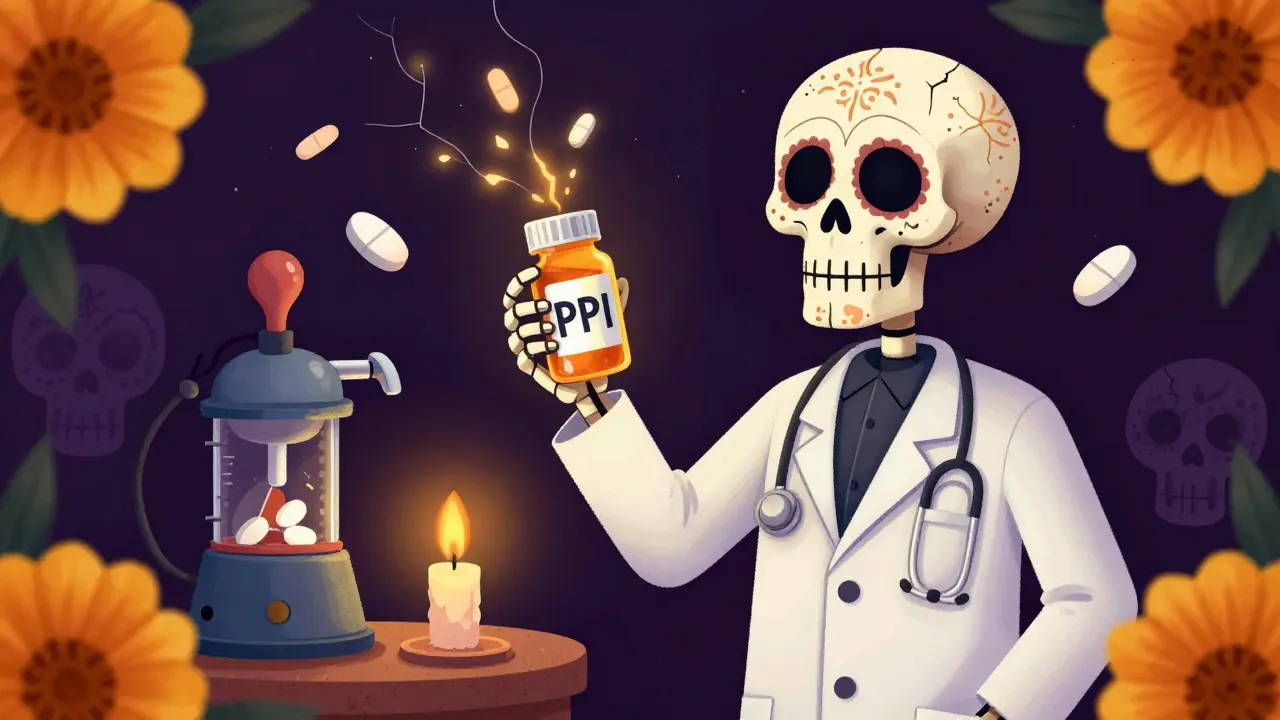
Millions of Americans take proton pump inhibitors (PPIs) every day to manage heartburn, GERD, or ulcers. These drugs-like omeprazole, esomeprazole, and pantoprazole-are powerful, effective, and often life-changing for people with chronic acid reflux. But there’s a quiet, growing concern: long-term use might be quietly weakening your bones.
What Are Proton Pump Inhibitors?
PPIs work by shutting down the acid pumps in your stomach lining. They’re not antacids that just neutralize acid-they stop acid production at the source. That’s why they work better and longer than older drugs like H2 blockers (ranitidine, famotidine). When they came out in the late 1980s, doctors thought they were safe for short-term use. But today, many people take them for months or even years. The FDA originally approved them for 4 to 8 weeks. Yet, studies show that 60-70% of PPI prescriptions are for longer than that, often without clear medical need.
The Fracture Risk Connection
Starting around 2006, large population studies began to show a pattern: people who took PPIs for a long time had more bone fractures-especially in the hip, spine, and wrist. One study found that long-term users had nearly double the risk of hip fractures compared to non-users. Another looked at over 50,000 people over 50 and found that PPI users had a 27% higher chance of breaking a hip than those using H2 blockers. The risk didn’t jump right away. It built up slowly. After five years of daily use, the risk started to climb. After seven years, it more than quadrupled in some groups.
It’s not just about age. Postmenopausal women on long-term PPIs had a 35% higher risk of hip fractures. That’s significant. Why? Because their bones are already more fragile. And if you’re on steroids, have low body weight, or have had a fracture before, your risk goes up even more.
Why Would Stomach Acid Affect Your Bones?
This is where it gets interesting. Your stomach needs acid to absorb calcium. Most calcium supplements-like calcium carbonate-require an acidic environment to dissolve and be absorbed. If PPIs are lowering your stomach acid too much, your body might not be getting enough calcium from food or pills. That’s a problem because your bones are constantly being rebuilt. If you don’t have enough calcium, your body pulls it from your bones to keep your heart and muscles working. Over time, that weakens your skeleton.
But it’s not that simple. Some studies found no real drop in calcium absorption in PPI users. Others suggest another mechanism: PPIs may cause your body to make more gastrin, a hormone that can trigger bone breakdown. There’s also evidence that histamine changes in the gut might affect bone cells directly. The truth? We still don’t fully understand how this works. But the link between long-term PPI use and fractures is real-and it’s backed by multiple large studies.

Not All Acid Reducers Are the Same
H2 blockers like famotidine (Pepcid) also reduce stomach acid-but they don’t shut down pumps the way PPIs do. They’re weaker and shorter-acting. And here’s the kicker: studies show H2 blockers don’t carry the same fracture risk. One big study comparing over 100,000 kids found no overall increase in fractures with H2 blockers, but a small rise in lower-limb fractures with PPIs. In adults, switching from PPIs to H2 blockers might lower your fracture risk-especially if you don’t need strong acid suppression.
That’s why doctors now ask: Do you really need a PPI? Or could a lower-dose H2 blocker, lifestyle changes, or even just avoiding late-night meals work just as well?
Who’s Most at Risk?
Not everyone on PPIs will break a bone. But some people are far more vulnerable:
- Women over 65, especially postmenopausal
- People with low body weight (under 125 pounds)
- Those with a history of fractures
- People taking corticosteroids (like prednisone)
- Anyone on high-dose PPIs for more than a year
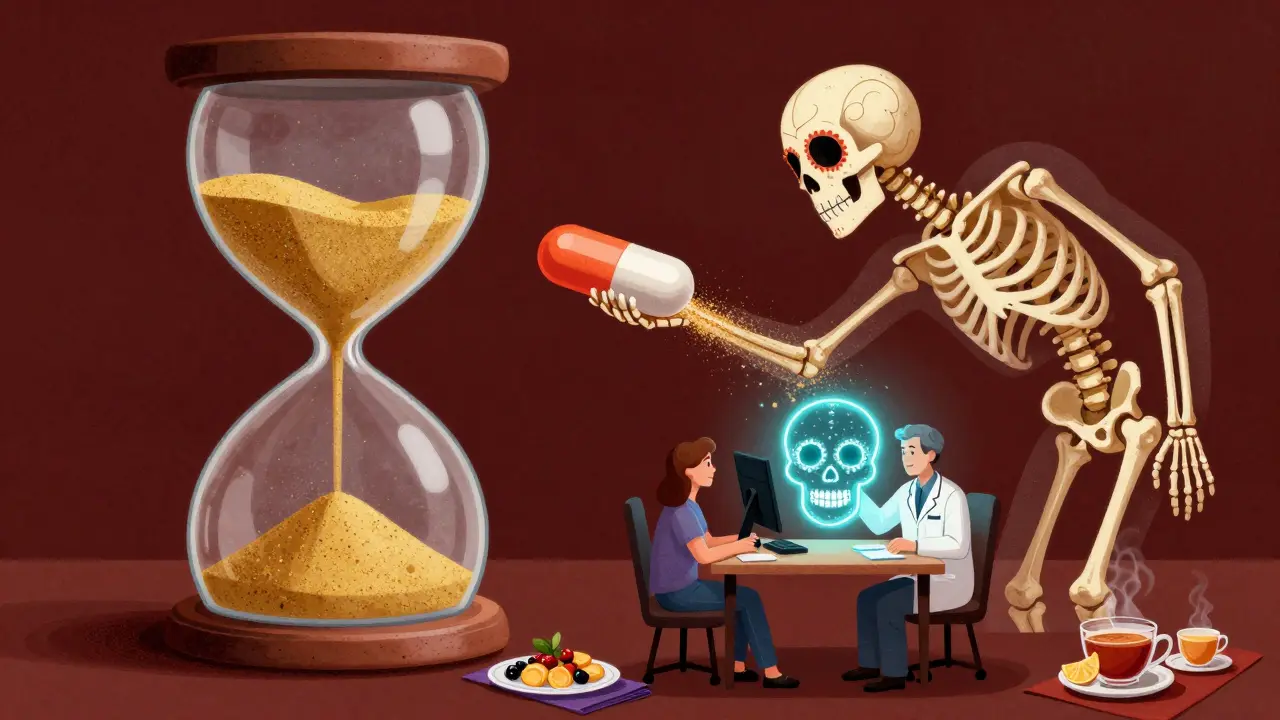
If you fit even one of these categories and have been on PPIs for over 8 weeks, you should talk to your doctor about your bone health. It’s not about stopping the medication-it’s about making sure you’re not adding unnecessary risk.
What Should You Do?
If you’re on a PPI and worried about your bones, here’s what to do:
- Ask if you still need it. Many people take PPIs long after their symptoms are gone. Your doctor can help you try tapering off or switching to on-demand use.
- Use the lowest dose possible. You don’t need 40mg of omeprazole if 20mg works. Lower dose = lower risk.
- Take calcium citrate, not calcium carbonate. Calcium citrate doesn’t need stomach acid to absorb. It’s the better choice if you’re on a PPI.
- Get enough vitamin D. Aim for 800-1000 IU daily. Your body needs it to use calcium.
- Consider a bone density test. If you’re over 65, female, or have other risk factors, ask your doctor about a DEXA scan. It’s quick, painless, and tells you if your bones are thinning.
Don’t stop your PPI cold turkey. Suddenly stopping can cause rebound acid reflux. Work with your doctor to taper off safely.
The Bigger Picture
It’s easy to panic when you hear ‘PPIs cause fractures.’ But here’s the truth: the absolute risk is still low. For every 1,000 people on long-term PPIs, maybe 2-3 extra fractures happen per year. That’s not nothing-but it’s not a disaster either. The real issue is unnecessary use. If you don’t have GERD, ulcers, or Barrett’s esophagus, you probably don’t need a PPI. And if you do, you can still use it safely-with the right precautions.
Doctors are catching on. Between 2015 and 2021, long-term PPI prescriptions dropped by nearly 20% among Medicare patients. That’s progress. But nearly half of prescriptions are still inappropriate. That means millions of people are taking these drugs without clear benefit-and possibly increasing their fracture risk.
What’s Next?
A major NIH study called PPI-BONE is tracking 15,000 people over five years. Results are expected in mid-2025. That study will control for more variables than ever before-diet, activity, other meds, genetics-and could finally tell us how big the real risk is.
In the meantime, the American Gastroenterological Association, the Endocrine Society, and the FDA all agree: use PPIs only when needed, at the lowest dose, for the shortest time possible. And if you’re at risk for fractures, take steps to protect your bones.
There’s no reason to fear PPIs if you’re using them correctly. But if you’re taking them out of habit, or because you’ve been on them for years without a check-up-it’s time to ask: Is this still helping me? Or is it quietly hurting me?
Do proton pump inhibitors cause osteoporosis?
PPIs don’t directly cause osteoporosis, but long-term use is linked to a higher risk of fractures-especially in people who already have weak bones. The drugs may interfere with calcium absorption and bone remodeling, leading to thinner bones over time. This doesn’t mean everyone on PPIs will develop osteoporosis, but the risk increases with duration and dose.
Which PPIs are safest for bone health?
No PPI is proven to be safer for bones than others. All PPIs work the same way-by blocking acid production. The key isn’t which drug you take, but how long and how much you take. Using the lowest effective dose for the shortest time reduces risk. If you’re concerned, talk to your doctor about switching to an H2 blocker like famotidine, which doesn’t carry the same fracture risk.
Can I take calcium supplements while on PPIs?
Yes-but choose calcium citrate, not calcium carbonate. Calcium carbonate needs stomach acid to dissolve, and PPIs reduce that acid. Calcium citrate absorbs well regardless of stomach pH. Take 500-600 mg at a time with meals for best absorption. Also make sure you’re getting at least 800-1000 IU of vitamin D daily to help your body use the calcium.
How long is too long to be on a PPI?
The FDA originally approved PPIs for 4-8 weeks. If you’re still taking them after 8 weeks without a clear diagnosis like ulcers, Barrett’s esophagus, or severe GERD, you should talk to your doctor. Long-term use-especially over 1 year-increases fracture risk. Many people can stop or reduce PPIs with lifestyle changes, dietary adjustments, or switching to on-demand use.
Should I get a bone density scan if I’m on PPIs?
If you’re over 65, female, have a history of fractures, low body weight, or take steroids, yes. The Endocrine Society recommends a bone density test (DEXA scan) for people on long-term PPIs with additional fracture risk factors. Even if you’re younger, if you’ve been on PPIs for more than 3 years and have other risks, ask your doctor. Early detection of bone loss can prevent fractures.
Emma Addison Thomas
January 8, 2026 AT 04:57I’ve been on omeprazole for 6 years for silent reflux. Never thought about bones until now. I’m 68, postmenopausal, and just had a DEXA scan last month-T-score of -2.1. My doctor didn’t mention PPIs as a factor. I’m switching to calcium citrate and reducing my dose next week. Thanks for the wake-up call.
Christine Joy Chicano
January 9, 2026 AT 08:10Let’s be clear: the data isn’t causal, it’s correlational. But correlation with biological plausibility? That’s a red flag worth heeding. The calcium absorption mechanism is well-documented in vitro, and the epidemiological signal is robust across continents. This isn’t fearmongering-it’s pharmacovigilance in action. If you’re on PPIs long-term, you owe it to your skeleton to audit your regimen.
Adam Gainski
January 10, 2026 AT 04:25As a GI nurse practitioner, I see this every day. People come in on 40mg omeprazole because they had heartburn once in 2019. We gently taper them. Often, they realize they just needed to stop eating pizza at midnight. The fracture risk is real, but so is the relief PPIs give. It’s about balance-not blanket avoidance. Always check with your doc before stopping.
Anastasia Novak
January 11, 2026 AT 13:30Oh wow, another ‘pharma is poisoning you’ article. Let me guess-next you’ll tell us aspirin causes bleeding and sunlight causes skin cancer? People are dying from acid reflux complications while others are terrified of a 0.3% increased fracture risk. Wake up. Your anxiety is worse than the PPI.
Jonathan Larson
January 13, 2026 AT 07:50The philosophical tension here lies in the tension between medical intervention and bodily autonomy. We are granted powerful tools to alleviate suffering-yet those same tools, wielded without discernment, become instruments of unintended consequence. The PPI is not evil; it is neutral. It is we who must ask: For what purpose do we use it? And at what cost? The answer is not in the pill, but in the practice of mindful stewardship over our own physiology.
Katrina Morris
January 13, 2026 AT 10:42Andrew N
January 15, 2026 AT 00:25LALITA KUDIYA
January 16, 2026 AT 10:31Poppy Newman
January 17, 2026 AT 14:26Vince Nairn
January 18, 2026 AT 11:33Ayodeji Williams
January 18, 2026 AT 12:18Alex Danner
January 19, 2026 AT 05:39The real issue isn’t PPIs-it’s the medical system that prescribes them like candy. Primary care docs don’t have time to do a full reflux workup. Patients don’t know to ask about alternatives. And then we blame the drug. It’s not the PPI’s fault-it’s the lack of follow-up. The solution isn’t to avoid PPIs-it’s to audit them annually. Taper, reassess, reevaluate. That’s the standard of care we’re missing.
Anthony Capunong
January 19, 2026 AT 15:29