

When you're pregnant, your body changes in ways you never expected. But what if your liver starts acting up? One of the most serious, yet often overlooked, liver conditions during pregnancy is intrahepatic cholestasis of pregnancy (ICP). It doesn't cause nausea or fatigue like other pregnancy issues. Instead, it brings an unbearable itch - no rash, no visible sign - just relentless, worsening itching, especially on your palms and soles. And while it might feel like just another annoying symptom, ICP is a medical red flag that demands attention.
ICP isn't something you caused. It's not your diet, your stress, or your sleep habits. It's a hormonal ripple effect. During pregnancy, estrogen and progesterone levels soar. In some women, especially those with a genetic predisposition, these hormones interfere with the liver's ability to move bile out of the body. Bile acids build up in the bloodstream. And that’s when trouble starts - not for the mother, but for the baby.
What ICP Really Does to Your Body
The hallmark of ICP is intense itching. It usually begins in the late second or early third trimester. You might wake up at 3 a.m. scratching your hands. You might rub lotion all day and still feel like your skin is on fire. But here’s the catch: you won’t see a single rash. No redness, no bumps - just the itch. That’s why so many women are told it’s dry skin or allergies. By the time they’re diagnosed, weeks have passed.
The real danger isn’t the itch. It’s the bile acid levels. Doctors use a simple blood test to measure them. Normal levels are below 10 µmol/L. Once you hit over 10, it’s ICP. If you’re above 40, you’re in the moderate-to-severe range. And if you cross 100? That’s a red zone. A 2021 study in the Journal of Hepatology found that when bile acids exceed 100 µmol/L, the risk of stillbirth jumps to 3.4%. That’s 12 times higher than in women with normal levels. And it can happen without warning.
Most women don’t realize how fast this can change. One week, your levels are 25. The next, they’re 60. That’s why doctors recommend checking bile acids every one to two weeks once diagnosed. A 2023 study from Mayo Clinic found that 30% of women with mild ICP see their levels climb into the severe range within just 14 days.
Who’s at Risk?
ICP doesn’t pick randomly. Certain women are far more likely to get it. If you’re carrying twins or triplets, your risk triples or even quadruples. IVF pregnancies double your chances. And if your mom or sister had it? You’re 12 to 15 times more likely to develop it. That’s not a coincidence - it’s genetics.
Geography matters too. In the U.S., about 1 in 500 pregnancies involve ICP. But in Chile? It’s 1 in 6. In some parts of Latin America and Scandinavia, rates are 5 to 10 times higher. Why? It’s not just climate or diet. It’s genes. Certain mutations in liver transport proteins are more common in these populations. That’s why screening isn’t universal - yet.
And here’s something rarely talked about: ICP doesn’t just disappear after birth. Women who’ve had it are 3.2 times more likely to develop gallstones, chronic hepatitis, or even liver cancer later in life. That’s not a scare tactic - it’s data from a 2021 study of over 12,000 women. Your liver remembers.
How Is It Diagnosed?
Many OB-GYNs don’t test for ICP unless you complain. That’s a problem. In the U.S., only 42% of practices routinely screen for it. The rest wait until the itch becomes unbearable - and by then, it might be too late.
The gold standard is a serum bile acid test. No fancy scans. No biopsies. Just a blood draw. ALT and AST liver enzymes might be elevated, but they’re not reliable. Some women with ICP have normal liver enzymes. The only thing that confirms it? Bile acid levels above 10 µmol/L.
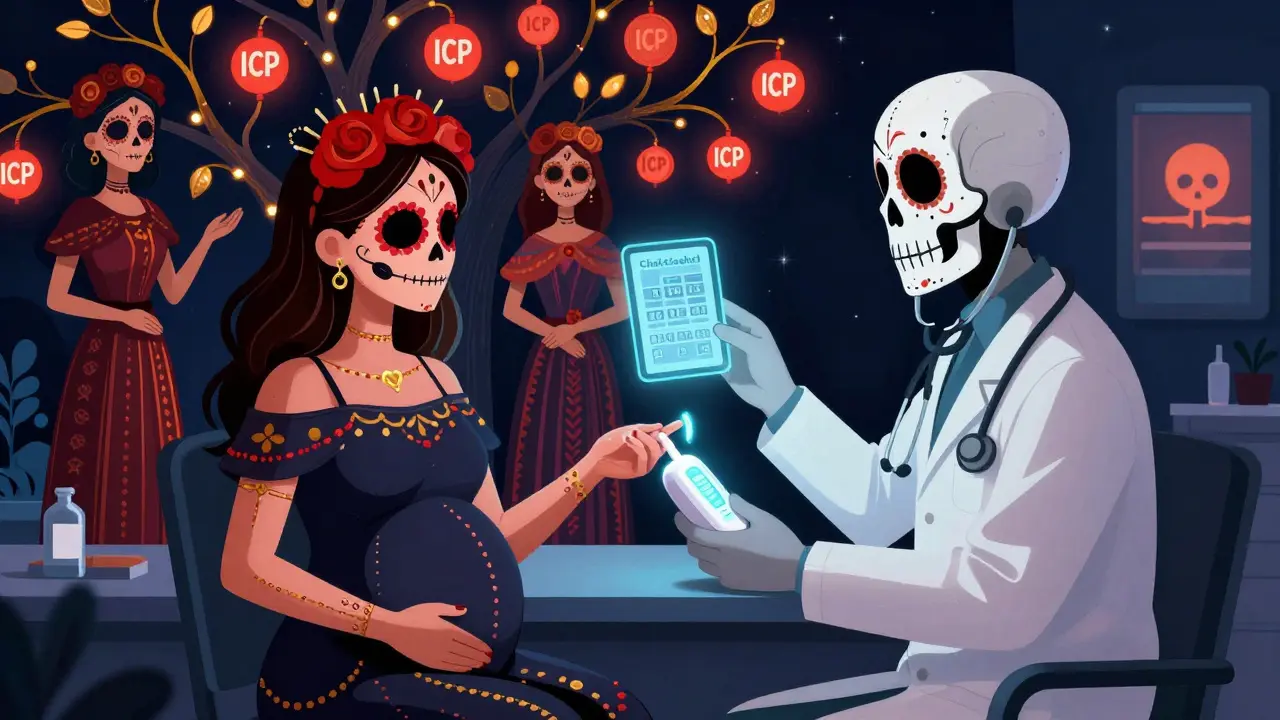
There’s a new test on the horizon: CholCheck®, a point-of-care device that gives results in 15 minutes. It’s already in use in 65% of high-risk maternity hospitals. No more waiting three days for lab results. This could be a game-changer - especially for women in rural areas.
Another emerging marker is autotaxin, an enzyme that spikes in ICP. A 2020 study of 145 women showed it’s 98.6% accurate at spotting ICP. It’s not widely available yet, but it’s coming fast.
What Are the Safe Treatments?
The first-line treatment? Ursodeoxycholic acid (UDCA). It’s been used for decades. It works by replacing toxic bile acids with a safer version. Studies show it cuts itching by 70%. Some research suggests it may also reduce preterm births by 25%.
But here’s the catch: a 2022 Cochrane Review of nearly 2,400 women found no clear proof that UDCA lowers stillbirth risk. That’s why some doctors are cautious. Others say: if it reduces itching and improves quality of life - and might help the baby - why not use it?
Typical dose: 15 mg per kilogram of body weight, taken in two or three doses daily. Most women start feeling better within a week. Side effects? Rare. Maybe loose stools. That’s it.
If UDCA doesn’t work or causes discomfort? S-adenosyl methionine (SAMe) is the next option. It’s an amino acid derivative. Small studies show it cuts itching by 40-50%. But it’s expensive, and the evidence is thin. Still, for some women, it’s the only thing that helps.
What about cholestyramine? It’s an old-school bile acid binder. It’s cheap. But it causes vitamin K malabsorption in 15% of users. That’s dangerous near delivery - it raises the risk of postpartum bleeding. Most experts avoid it now.
Delivery Timing: When to Act
Delivery isn’t just about due date anymore. In ICP, it’s about safety.
For mild cases (bile acids under 40 µmol/L), most doctors recommend delivery at 37 to 38 weeks. For severe cases (over 100 µmol/L), delivery between 34 and 36 weeks is common. Why? Because the stillbirth risk climbs sharply after 37 weeks if levels are high.
But here’s the new thinking. A 2023 preliminary report from the Royal College of Obstetricians and Gynaecologists suggests that with close monitoring and UDCA treatment, stillbirth risk stays under 0.5% even at 38 weeks - even if bile acids are in the 30-40 range. That means fewer unnecessary early deliveries.
That’s why fetal monitoring is non-negotiable. Twice-weekly non-stress tests start at 32 to 34 weeks. No exceptions. If the baby’s heart rate doesn’t respond to movement, it’s a signal. And if you’re past 36 weeks with high bile acids? Induction isn’t optional. It’s lifesaving.

What You Can Do Right Now
If you’re pregnant and have unexplained itching:
- Don’t wait. Ask your doctor for a bile acid test.
- Track your symptoms: When does it start? Does it get worse at night? Where do you itch?
- Know your family history. Did your mom or sister have ICP?
- If you’re carrying multiples or had IVF, mention it upfront.
- Ask if your hospital uses CholCheck® or offers rapid bile acid testing.
Education matters. Women who get clear, detailed information about ICP report 22% less anxiety and 18% better adherence to treatment. That’s huge. You’re not just managing a symptom - you’re protecting your baby.
The Future of ICP Care
Change is coming. The 2024 International Cholestasis of Pregnancy Consensus Statement will likely shift guidelines. Instead of relying on a single bile acid number, doctors may track how fast levels rise. That’s called a “trajectory.” If your bile acids climb slowly, you might not need to deliver at 34 weeks. If they spike? That’s a different story.
Researchers are testing new drugs - autotaxin inhibitors. Early trials show a 68% drop in itching. These could be the next breakthrough. But they’re still in Phase II. Not available yet.
Meanwhile, countries like Sweden and Norway have been screening all pregnant women for bile acids since 2018. Result? A 35% drop in ICP-related stillbirths. The U.S. is still catching up.
One thing is clear: ICP isn’t rare. It’s underdiagnosed. And every woman deserves to know the risks - and the tools to protect her baby.
Is ICP the same as preeclampsia?
No. ICP and preeclampsia are completely different. ICP causes itching and elevated bile acids, with no high blood pressure or protein in urine. Preeclampsia causes high blood pressure, swelling, and sometimes liver damage - but not the same kind of itching. They can happen together, but they’re not the same condition.
Can ICP come back in future pregnancies?
Yes. If you had ICP in one pregnancy, you have a 60-90% chance of getting it again in the next. That’s why doctors recommend early testing if you’ve had it before. Don’t wait for itching to return - get tested as soon as you’re pregnant again.
Does ICP affect breastfeeding?
No. ICP does not affect your ability to breastfeed. UDCA and SAMe are considered safe during nursing. Bile acid levels drop rapidly after delivery - usually within 48 hours. Breastfeeding is encouraged and safe.
Are there natural remedies for ICP itching?
Cool baths, oatmeal lotions, and avoiding hot showers can help ease itching temporarily. But they don’t lower bile acids or reduce fetal risk. No herbal supplement or essential oil has been proven safe or effective in clinical studies. Always talk to your doctor before trying anything.
Why don’t all doctors test for ICP?
Because it’s not yet standard in the U.S. Many providers think it’s rare, or they don’t know how to interpret results. But in countries like Sweden, screening is routine. As rapid testing becomes more available, and as more data shows how dangerous ICP can be, testing will become standard. Until then, be your own advocate.
Joe Prism
March 7, 2026 AT 00:11William Minks
March 7, 2026 AT 04:10Susan Purney Mark
March 8, 2026 AT 03:34Andrew Poulin
March 9, 2026 AT 18:58Ferdinand Aton
March 11, 2026 AT 06:33Joey Pearson
March 11, 2026 AT 22:18Adebayo Muhammad
March 13, 2026 AT 00:14Ian Kiplagat
March 14, 2026 AT 19:15Amina Aminkhuslen
March 15, 2026 AT 16:31Roland Silber
March 15, 2026 AT 23:57Patrick Jackson
March 16, 2026 AT 08:21Jeff Mirisola
March 18, 2026 AT 04:36Pranay Roy
March 18, 2026 AT 10:49Bridget Verwey
March 19, 2026 AT 14:00amber carrillo
March 20, 2026 AT 12:14