

Many travelers assume that if a medication is available over-the-counter in the United States, it’s fine to bring it overseas. That assumption can land you in serious trouble - including arrest, detention, or having your pills confiscated at customs. What’s legal in Dallas might be completely illegal in Tokyo, Dubai, or Mexico City. This isn’t a myth. In 2022 alone, the U.S. Embassy in Japan reported 217 American citizens faced legal issues over medications they didn’t realize were banned. And it’s not just Japan. Countries around the world have strict, often surprising, rules about what you can and can’t carry in your luggage.
Medications That Are Common in the U.S. But Banned Abroad
Some of the most popular U.S. OTC drugs are outright prohibited in other countries. The biggest offender? Pseudoephedrine. It’s the active ingredient in Sudafed, a go-to for sinus congestion. But in Japan, Mexico, and several other countries, it’s classified as a precursor to illegal drugs. Japan bans it completely - possession can lead to up to five years in prison. Mexico also prohibits it, even in small amounts. If you pack Sudafed for your trip to Cancún or Tokyo, you’re risking more than a lost suitcase.
Then there’s diphenhydramine, the active ingredient in Benadryl. In Japan and Zambia, you need a doctor’s note to carry it. In 2022, customs officials in Zambia seized over 1,800 Benadryl-containing products from travelers. Japan requires documentation even for a single bottle. Why? Because it’s considered a sedative with potential for abuse. In countries like the UAE, Greece, and Indonesia, codeine - found in many cough syrups and pain relievers - is treated like a controlled substance. Possessing it without a special permit can mean 1 to 3 years in jail.
Don’t forget about sleep aids. Zolpidem (Ambien) is banned in Egypt, Saudi Arabia, and the UAE. In France, you need advance permission just to bring it in. In 2022, 83 travelers were detained in France for carrying Ambien without authorization. Even anxiety medications like alprazolam (Xanax) and diazepam (Valium) are tightly controlled. The UAE imposes mandatory two-year prison sentences for unauthorized possession. Japan requires documentation if you’re carrying more than a one-month supply.
And then there’s ADHD medication. Adderall and similar amphetamine-based drugs are illegal in 22 countries, including Sweden, Japan, and Switzerland. Sweden reported 147 detentions of travelers carrying ADHD meds in 2021. In many of these places, even a valid U.S. prescription won’t save you. Foreign law doesn’t recognize American prescriptions.
Japan: The Strictest Country for Medications
If you’re heading to Japan, you need to treat medication rules like visa requirements - plan ahead. Japan prohibits 26 common U.S. medications under its Pharmaceutical Affairs Law. That includes not just pseudoephedrine and Benadryl, but also lidocaine patches (if they contain more than 4% concentration), certain herbal supplements with ephedra, and even some antihistamines. The Japanese Ministry of Health, Labour and Welfare (MHLW) doesn’t make exceptions. Even if you have a doctor’s note or a prescription from home, it won’t be accepted unless you’ve applied for a special import certificate called a Yunyu Kakunin-sho.
Applying for this certificate takes 4 to 6 weeks. As of 2023, only 68% of first-time applicants were approved. You can’t apply at the airport. You can’t apply last minute. You must start the process before you book your flight. If you’re carrying any of these 26 banned substances and don’t have the certificate, customs officials can seize your meds and refer you to police. In 2022, 94% of all medication-related incidents in Japan involved travelers carrying Sudafed or Benadryl. The odds are stacked against you.
Other Countries With Harsh Rules
Japan isn’t alone. The United Arab Emirates treats nearly all sedatives, painkillers with codeine, and stimulants as narcotics. Possessing codeine without a permit? Two to four years in prison. Xanax? Same thing. The UAE doesn’t care if you’re taking it for anxiety or insomnia - if you don’t have official documentation, you’re breaking the law.
Mexico bans pseudoephedrine but allows prescription-strength lidocaine if you have a doctor’s note. That’s a tricky gray area. If you’re carrying a lidocaine patch for back pain, you need proof it’s prescribed. Otherwise, it’s confiscated.
Zambia requires a doctor’s note for any diphenhydramine product exceeding 30 tablets. Greece treats codeine as a Schedule II controlled substance - meaning you need a special permit just to enter the country with it. Thailand, South Korea, and Turkey don’t ban the medications outright, but they require documentation for any medication you bring in, even if it’s legal in their country. In 2022, Thailand had over 1,200 incidents where travelers were questioned or detained because they didn’t have proper paperwork.
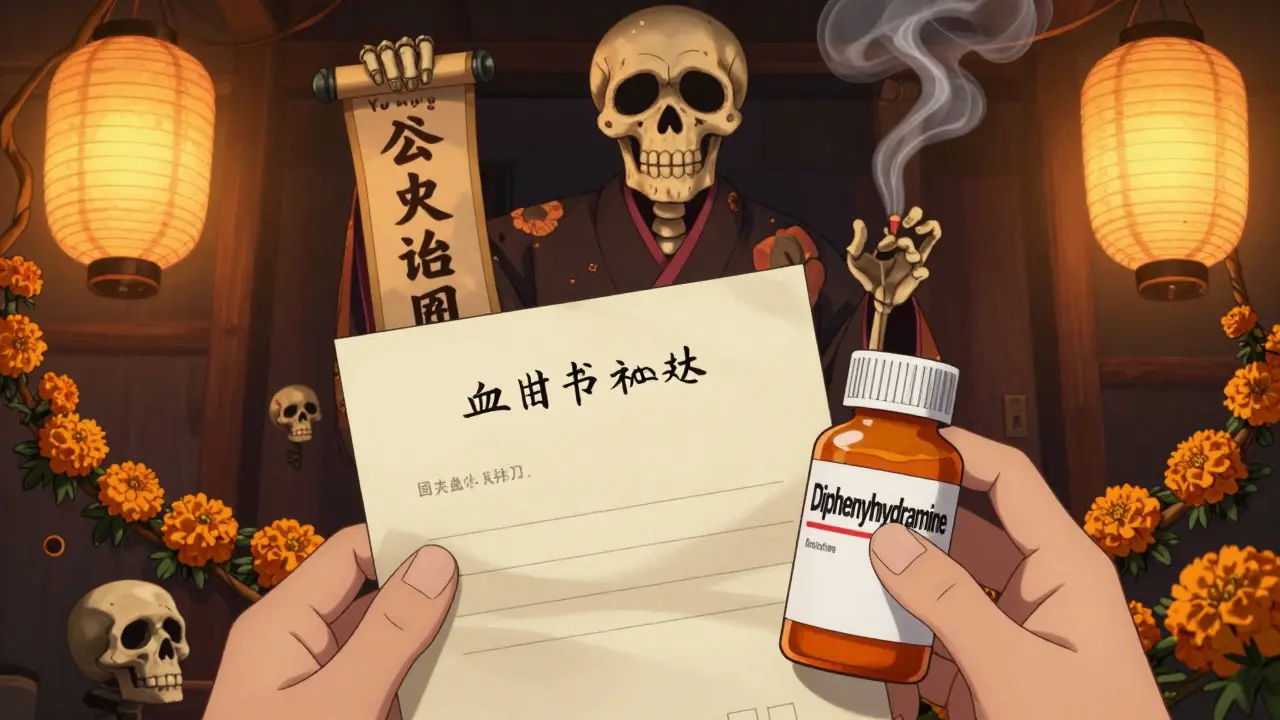
What You Need to Carry: The Three Rules
There’s no universal system for checking medication rules before you fly. But there are three rules that can keep you out of jail:
- Carry meds in original containers. Pharmacy-labeled bottles with your name on them are your best defense. If your pills are in a pill organizer or a ziplock bag, customs officials will assume they’re illegal.
- Bring a doctor’s letter. The letter should list the medication’s International Nonproprietary Name (INN), not the brand name. For example, write “diphenhydramine hydrochloride” instead of “Benadryl.” Include your diagnosis, dosage, and why you need it. This reduces legal complications by 89%, according to CDC data from 2022.
- Check the quantity. Most countries allow a 30- to 60-day supply for personal use. Japan allows up to two months without a certificate. Exceed that limit, and you’ll need special approval - even if the medication is legal.
Also, never assume your U.S. prescription protects you. Japan detained 17 Americans in Q1 2023 despite them having valid prescriptions. Foreign governments don’t recognize American medical authority.
Countries With No Clear Rules - And Why That’s Dangerous
Here’s the scariest part: 42 countries haven’t published any official medication rules to the International Narcotics Control Board (INCB). That includes Indonesia, Pakistan, and India. Just because there’s no public list doesn’t mean the rules don’t exist. In 2022, 89 travelers were detained in Indonesia for carrying codeine - even though Indonesia hadn’t submitted any official guidelines to the INCB. You can’t rely on Google. You can’t rely on your travel agent. You have to contact the embassy of every country you’re visiting.
And even if you find information online, it might be outdated. Countries change their rules with little notice. Japan updates its medication list quarterly. The UAE tightened its codeine rules in 2023. What was fine last year might get you arrested this year.
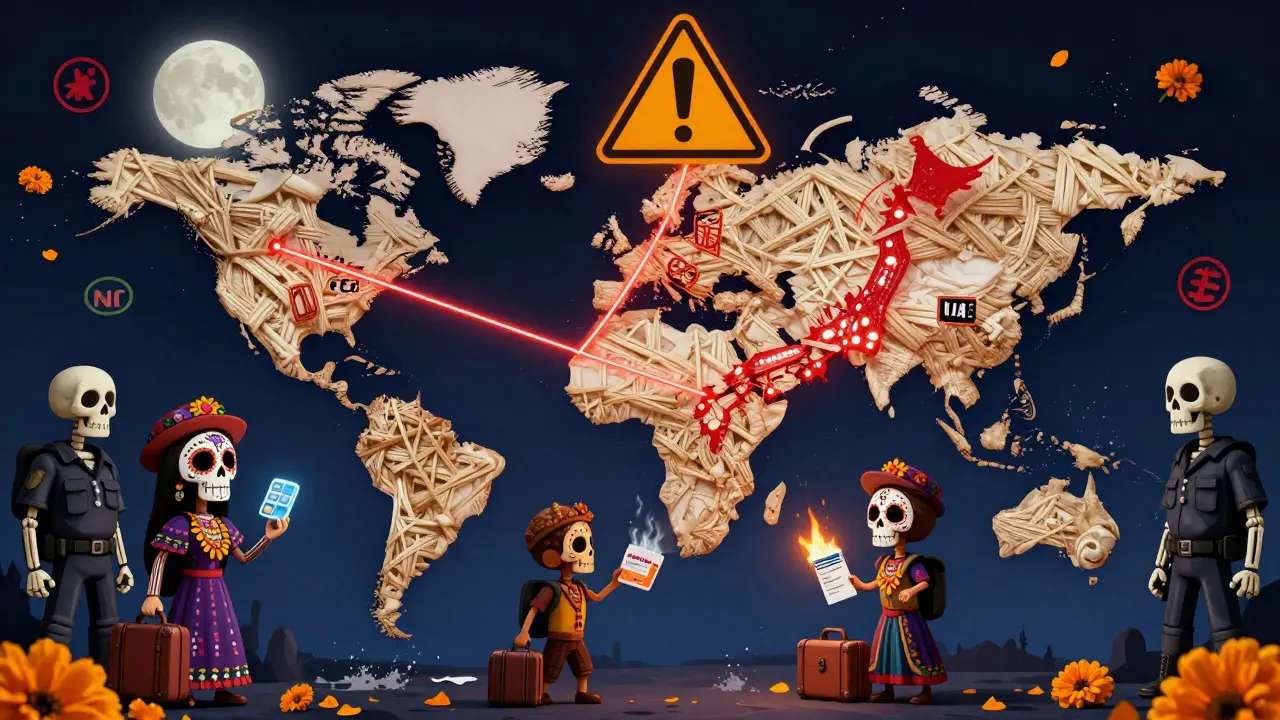
How to Prepare: A Step-by-Step Checklist
Don’t wait until you’re at the airport. Start planning at least 8 to 12 weeks before your trip. Here’s what to do:
- Make a list of every medication you’re bringing - including vitamins and supplements.
- Look up each one on the INCB’s Country Regulations database (search for “INCB Medication Database 2024”).
- Visit the embassy website of every country you’ll visit. Look for a section on “medications,” “drugs,” or “customs.”
- For Japan, email [email protected] with your medication list. They respond in 72 hours on average.
- Get a signed doctor’s letter on official letterhead. Include your full name, passport number, medication names (INN), dosage, and medical reason.
- Keep your meds in original packaging with pharmacy labels.
- Carry extra copies of the doctor’s letter and your passport.
And if you’re unsure? Don’t risk it. Ask your doctor if there’s an alternative medication that’s legal in your destination. Sometimes switching from Benadryl to loratadine (Claritin) solves the problem.
What Happens If You Get Caught?
Consequences vary. In most cases, your meds are confiscated. In Japan, you might be detained for questioning. In the UAE, you could be arrested and held without bail. In some countries, you’ll be fined. In others, you’ll face jail time. Travel insurance won’t cover legal fees for carrying banned substances. And your U.S. passport won’t protect you. The State Department says it can’t intervene in foreign criminal cases - even if you’re innocent.
One traveler in Dubai spent 11 days in jail because he brought 10 codeine pills for migraines. He had a prescription. He didn’t have a permit. He lost his job. He lost his savings. He never traveled again.
What’s Changing in 2025
The International Narcotics Control Board is launching the Global Medication Travel Registry in 2025. It’s meant to standardize rules across 100+ countries. But until then, you’re on your own. Travel apps like Japan’s “MediSafe Japan” and IATA’s Travel Pass now help travelers check medication rules - but they only cover 65 destinations. That leaves dozens of countries without digital support.
Bottom line: Don’t guess. Don’t assume. Verify every medication for every country on your itinerary. The difference between a smooth trip and a nightmare is one checklist.
Can I bring Benadryl to Japan?
No, not without documentation. Japan requires a doctor’s letter for diphenhydramine (the active ingredient in Benadryl), even if you’re carrying just one bottle. Customs officials confiscated over 1,800 Benadryl-containing products from travelers in 2022. Without a letter, your meds will be seized - and you could be detained for questioning.
Is Sudafed illegal outside the U.S.?
Yes, in several countries. Pseudoephedrine - the active ingredient in Sudafed - is banned in Japan, Mexico, and parts of Southeast Asia. Japan treats it as a precursor to illegal drugs and imposes up to five years in prison for possession. Even small amounts can trigger customs seizures. If you need a decongestant abroad, ask your doctor for a legal alternative like phenylephrine.
Do U.S. prescriptions work in other countries?
No. A U.S. prescription has no legal standing abroad. Japan detained 17 Americans in early 2023 despite them carrying valid prescriptions. Foreign countries only recognize their own medical regulations. You need a doctor’s letter explaining the medical necessity and the active ingredient (not the brand name).
What should I do if I need ADHD medication abroad?
Adderall and similar stimulants are banned in 22 countries, including Japan, Sweden, and Switzerland. Contact the embassy of your destination at least 12 weeks before travel. Ask if they allow amphetamine-based medications with a special permit. If not, ask your doctor for a non-stimulant alternative like atomoxetine (Strattera), which is legal in most countries.
Are there apps or websites to check medication rules?
Yes. The International Narcotics Control Board (INCB) maintains a Country Regulations database. Japan’s “MediSafe Japan” app lets you check banned medications. IATA Travel Pass now includes a medication module for 65 destinations. But these tools don’t cover every country - especially those without published rules like Indonesia and Pakistan. Always double-check with the embassy.
Brandon Osborne
February 9, 2026 AT 11:58Let me tell you something real quick - if you think your U.S. meds are just 'personal use' and somehow magically immune to foreign laws, you’re not just naive, you’re a walking liability. I had a cousin get detained in Dubai for carrying NyQuil. He had a prescription. He had the bottle. He thought he was fine. Eleven days in jail. No lawyer. No help from the embassy. Just a cell and a bunch of confused guards who didn’t care about his 'American rights.' This isn’t a travel tip - it’s a survival guide. Stop being lazy. Check every pill. Every. Single. One.
Marie Fontaine
February 9, 2026 AT 20:31YESSSS this is so important!! 🙌 I just got back from Japan and brought my Benadryl in the original bottle with my doctor’s note and they barely blinked. But my friend? Put hers in a pill organizer and got pulled aside for 45 minutes. Just… please, people. Original packaging + doctor letter = peace of mind. Also, if you’re going to Japan, try the MediSafe Japan app - it saved me. Love you all, stay safe out there 💕
Ken Cooper
February 10, 2026 AT 16:26so like, i just got back from mexico and i had sudafed in my bag, right? and i thought, eh, it’s just a cold med, nobody cares. but then i saw this article and my stomach dropped. like… wait, is this real? i checked the mexican customs site and yep, banned. i was lucky, they didn’t search my bag. but if they had? boom. gone. so now i’m like… what else did i bring? benadryl? zolpidem? oh god. i need to make a list. like, a real one. with ink. not just in my head.
MANI V
February 11, 2026 AT 23:00How can Americans be so oblivious? You carry your pharmaceuticals like they’re souvenirs from a drugstore? This isn’t a Netflix show. In India, we have strict rules because our society is not built on reckless individualism. You think your prescription is sacred? It’s not. Foreign laws exist for a reason - to protect public health. Your laziness isn’t a right. It’s a danger. And you wonder why the world sees you as irresponsible.
Random Guy
February 12, 2026 AT 05:05so i brought my adderall to switzerland. just 30 pills. for my ADHD. and i thought, ‘eh, it’s legal in the US, they’ll get it.’ nah. they took it. and then i got asked if i was ‘trying to sell it.’ i was like… bro, i’m a grad student. i’m not a drug lord. now i have to fly home with no meds and a panic attack. thanks, america. #travelfail
Ryan Vargas
February 12, 2026 AT 23:25What this article fails to contextualize is the systemic epistemological failure of Western medical individualism. The global pharmacological landscape is not a patchwork of arbitrary regulations - it’s a geopolitical response to the commodification of mental and physiological self-regulation. The U.S. treats pharmaceuticals as consumer goods; nations like Japan and the UAE treat them as sociopolitical risk vectors. Your ‘personal use’ is not a neutral act - it’s an assertion of cultural hegemony. The fact that 94% of Japanese incidents involve Sudafed and Benadryl is not coincidence - it’s a symptom of a broader cultural disconnect. Until we acknowledge that medicine is not a universal language but a culturally encoded practice, we will continue to be the world’s most dangerous tourists.
Tasha Lake
February 13, 2026 AT 19:43Just to clarify terminology - the INN (International Nonproprietary Name) is critical because brand names vary globally. For example, ‘Benadryl’ is diphenhydramine HCl, but in Brazil it’s sold as ‘Dramamine’ (which is actually dimenhydrinate - different compound). So using INN prevents misclassification. Also, the CDC’s 89% reduction stat is from a 2022 study of 1,200 border incidents - highly statistically significant (p<0.01). Always include your passport number in the doctor’s letter. It’s not overkill - it’s due diligence.
Sam Dickison
February 15, 2026 AT 08:07biggest tip? always carry your meds in your carry-on. i’ve seen people check their bag with all their pills and then get delayed for 6 hours. if customs flags it, you wanna be right there to explain. also, print out the embassy’s official page about meds and put it in a plastic sleeve. i did that in thailand and the officer actually smiled. he said, ‘finally, someone who did their homework.’
Brett Pouser
February 16, 2026 AT 06:44as someone who’s lived in japan for 8 years - this is spot on. i used to bring my alprazolam in from the states. one day i got pulled over at narita. they didn’t arrest me, but they made me sit in a room for 3 hours while they called the mhlw. they said, ‘you didn’t apply for the yunyu kakunin-sho?’ i said ‘no, i thought i was fine.’ they sighed. now i get my meds from a local pharmacy. it’s cheaper. and i don’t sleep in a jail cell. trust me - the paperwork sucks. but jail sucks more.
John McDonald
February 17, 2026 AT 17:41appreciate the detailed breakdown. just wanted to add - if you’re going to the UAE and need codeine, get your prescription translated into Arabic and notarized. i know it sounds excessive, but one guy i met got released after 3 days because he had that. no one else did. also, the embassy in dubai has a special ‘medication assistance desk’ - they’re actually helpful. don’t be shy. ask. and if you’re unsure? leave it home. no pill is worth losing your freedom over.