
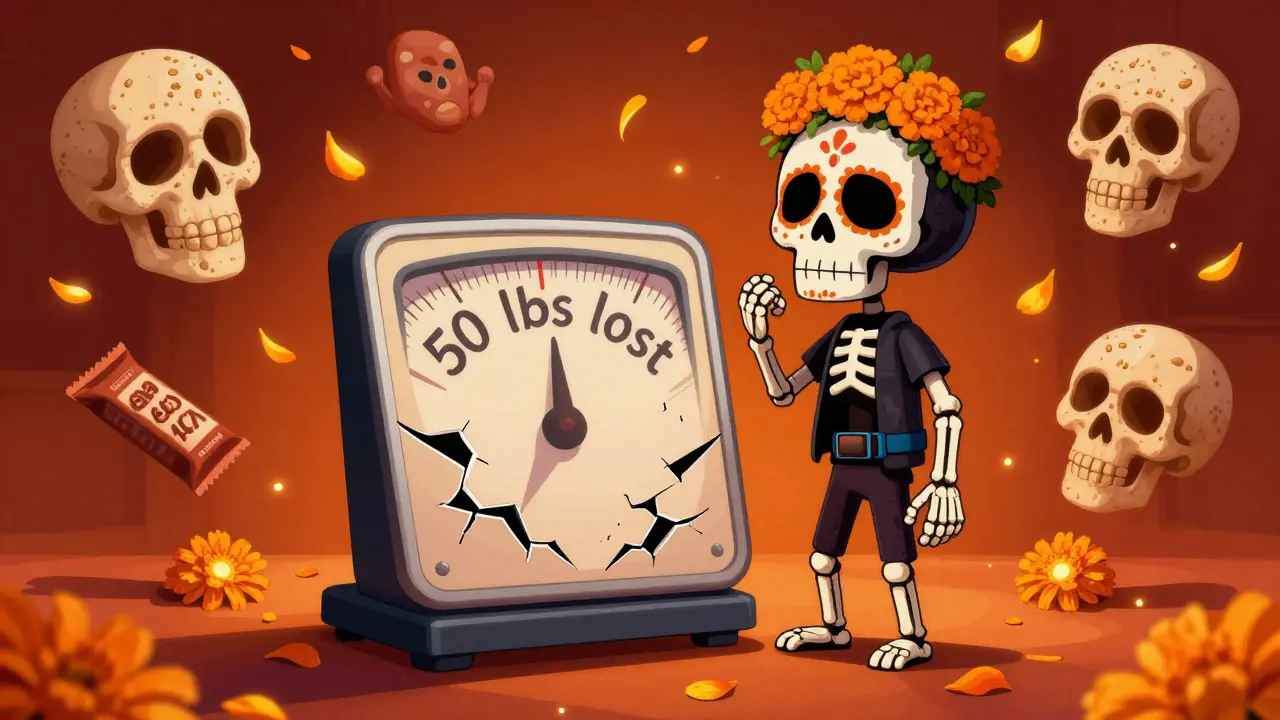
After losing 50 pounds, Sarah thought she’d finally cracked the code. She ate clean, tracked every calorie, and hit her fitness goals. But then, something strange happened: the scale stopped moving. Even when she dropped to 1,400 calories a day, she didn’t lose another ounce. She felt exhausted, hungry all the time, and worse-like her body had turned against her. She wasn’t lazy. She wasn’t failing. Her metabolic rate had changed.
Why Your Metabolism Slows Down After Weight Loss
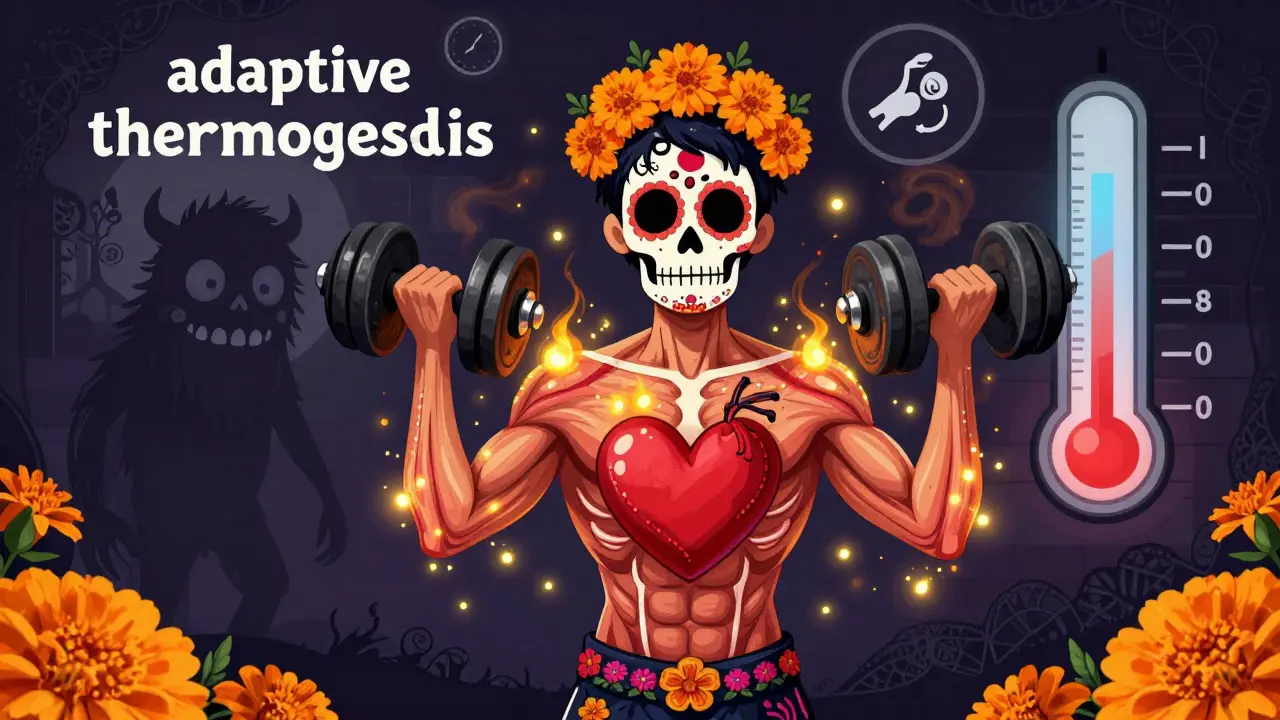
Your body doesn’t want you to lose weight. Not because it’s being stubborn, but because it’s wired for survival. When you cut calories, your body thinks it’s starving. In response, it lowers your metabolic rate to conserve energy. This isn’t just a side effect-it’s a full-blown physiological defense system called adaptive thermogenesis.
Adaptive thermogenesis means your body burns fewer calories than it should based on your new weight and muscle mass. A 2020 study found that after just one week of dieting, people burned an average of 178 fewer calories per day-just from metabolic adaptation alone. That’s like eating a whole bowl of oatmeal for free every day, without even trying. And it doesn’t go away after you stop losing weight. Research shows this slowdown can last for at least a year, even if you’ve kept the weight off.
This isn’t just about fat loss. Your body also protects muscle. When you diet, your body breaks down muscle tissue for energy, which lowers your resting metabolic rate even more. Less muscle = fewer calories burned at rest. And here’s the kicker: the more weight you lose, the stronger this effect becomes. People who lose 100 pounds or more often report their metabolism dropping by 20-30%. That’s not normal. That’s your body fighting back.
The Biggest Loser Effect: Why Diets Often Backfire
One of the most famous studies on this topic followed contestants from the TV show The Biggest Loser. These people lost massive amounts of weight-some over 100 pounds-in just six months. But six years later, almost all of them had regained the weight. Why? Their metabolisms had crashed.
At the end of the show, their resting metabolic rates were 500-800 calories lower than expected for their new body size. Even after regaining weight, their metabolisms didn’t bounce back. They were burning hundreds fewer calories per day than someone who had never lost weight. That’s why keeping weight off feels impossible for so many people. It’s not willpower. It’s biology.
And it’s not just extreme dieters. Anyone who’s lost weight and hit a plateau has experienced this. The scientific term is simple: your body adapts. It’s not broken. It’s doing exactly what evolution designed it to do-survive.
What Is Reverse Dieting? A Realistic Approach
Reverse dieting isn’t a magic trick. It’s not about eating more to “trick” your metabolism. It’s about slowly giving your body back the energy it thinks it’s missing, so it can start burning calories normally again.
The idea is simple: after a long period of dieting, you gradually increase your daily calories-usually by 50 to 100 per week-while watching your weight. If you stay within a 1-2 pound range, you keep going up. If you gain more than that, you pause and hold for another week before trying again.
Why does this work? Because your body needs time to adjust. If you jump from 1,200 calories to 2,000 overnight, your body doesn’t have time to rebuild its metabolic machinery. It just stores the extra energy as fat. But if you increase slowly, your body starts to trust that food isn’t scarce. Leptin levels rise. Thyroid function improves. Your nervous system stops signaling “emergency.”
Most people need 3 to 6 months to reverse diet properly. It’s not fast. But it’s sustainable. And unlike crash diets, it doesn’t leave you drained or ravenous.

What Actually Works: The Science-Backed Rules
Not all reverse dieting advice is equal. Here’s what the research says actually makes a difference:
- Protein is non-negotiable. Aim for 1.6 to 2.2 grams per kilogram of body weight. Protein helps preserve muscle, which keeps your metabolism higher. One study showed that high-protein diets during reverse dieting preserved 18% more resting metabolic rate than standard diets.
- Strength training is essential. Lifting weights 2-3 times a week helps rebuild muscle lost during dieting. Muscle burns more calories than fat-even at rest. Research shows people who strength train during weight loss reduce metabolic adaptation by about 15%.
- Don’t rush. Increasing calories by more than 150 per week increases the risk of regain. Slow and steady wins the race.
- Track more than the scale. Your energy levels, sleep quality, hunger, and even your morning body temperature matter. A drop of 5-10% in your morning temperature can signal your metabolism is still suppressed.
Some people swear by tracking resting heart rate. If your heart rate is lower than usual in the morning, your metabolism might be running slow. It’s not a lab test, but it’s a useful real-world indicator.
What Doesn’t Work (And Why)
There are a lot of myths floating around. Here’s what you can ignore:
- “Detox” teas or supplements that “boost metabolism.” No supplement has been proven to reverse adaptive thermogenesis. If it sounds too good to be true, it is.
- “Eat more carbs to reset your metabolism.” Carbs help with energy and mood, but they don’t magically fix your metabolism. Protein and strength training do.
- “Just eat less and try harder.” That’s what got you here. Your body already responded to that. Pushing harder just makes it dig in deeper.
Even some fitness influencers promote reverse dieting as a quick fix. But real progress takes months. If someone promises results in 2 weeks, they’re selling hope, not science.
Who Benefits Most from Reverse Dieting?
Reverse dieting isn’t for everyone. But it’s especially helpful for:
- People who lost weight but hit a plateau and can’t lose more-even at very low calories
- Those who feel constantly tired, cold, or irritable after dieting
- Anyone who’s experienced weight cycling (yo-yo dieting), which makes metabolic adaptation worse
- People who want to eat normally again without gaining back everything
It’s not a weight-loss tool. It’s a recovery tool. Think of it like rehab for your metabolism.
What About Bariatric Surgery?
Here’s something surprising: people who get gastric bypass surgery don’t experience the same level of metabolic adaptation as those who lose weight through dieting alone. Why? The surgery changes gut hormones and how the body processes food. It doesn’t just shrink your stomach-it resets your metabolism.
That’s why, even though gastric bypass patients lose more weight, they’re less likely to regain it. Their bodies don’t fight back the same way. But surgery isn’t an option for everyone. And reverse dieting offers a non-surgical way to mimic some of those benefits-by giving your body the time and fuel it needs to heal.
The Future: Personalized Metabolism Testing
Companies like Zoe and Levels are now using continuous glucose monitors and indirect calorimetry to measure individual metabolic adaptation. Early tests can predict with 85% accuracy who’s likely to regain weight after dieting-based on how their metabolism responds.
Future treatments might include targeted drugs that activate brown fat (a type of fat that burns calories for heat) or probiotics that tweak gut bacteria linked to metabolism. But none of that is available yet. Right now, the best tool you have is time, protein, strength training, and patience.
Final Thoughts: Your Metabolism Can Heal
Metabolic adaptation isn’t your fault. It’s not weakness. It’s biology. And the good news? It’s reversible.
You don’t need to starve yourself forever. You don’t need to quit eating carbs or fats. You don’t need to buy another “metabolism-boosting” product.
You just need to give your body what it’s been asking for: consistent, gradual fuel. Slowly. With protein. With movement. With patience.
Reverse dieting isn’t about getting back to your old weight. It’s about building a metabolism that can handle real life-without crashing, without hunger, without fear.
It’s not a quick fix. But it’s the only one that lasts.
Hilary Miller
January 22, 2026 AT 02:44This is the most accurate breakdown of metabolic adaptation I’ve ever read. Finally, someone gets it.
Rob Sims
January 23, 2026 AT 02:55Of course it’s biology. But let’s be real-most people who hit plateaus just never stopped eating like they were still gaining weight. This isn’t magic, it’s basic math. You think your body’s ‘fighting back’? Nah, you’re just bad at counting.
Neil Ellis
January 24, 2026 AT 19:32Man, I wish I’d read this five years ago. I lost 60 lbs on a 1,200-calorie diet and spent the next three years feeling like a zombie. Reverse dieting didn’t just fix my metabolism-it brought back my joy. I can eat a damn bagel now without crying. Thank you for writing this.
shivani acharya
January 24, 2026 AT 20:26So let me get this straight-you’re telling me Big Pharma doesn’t want us to know that our bodies can heal themselves? That’s why they sell ‘metabolism-boosting’ supplements, right? They profit off our suffering. I’m not buying it. I’m going full paleo and fasting for 20 hours a day. That’s what my cousin’s yoga teacher told me works.
Sarvesh CK
January 26, 2026 AT 13:57Adaptive thermogenesis is not merely a physiological phenomenon-it is an evolutionary narrative encoded in our very DNA. The human organism, shaped over millennia by cycles of scarcity and abundance, responds to caloric restriction not as a failure of will, but as a sacred act of preservation. To pathologize this process is to misunderstand the profundity of biological intelligence. We are not broken machines needing repair; we are living systems seeking equilibrium. Reverse dieting, then, is not a tactic-it is a ritual of reintegration, a gentle return to harmony with our ancestral biology. The body does not betray. It remembers.
Philip House
January 27, 2026 AT 07:21Let’s be honest-this whole reverse dieting thing is just a fancy way of saying ‘eat more and hope your body forgives you.’ The science is thin. The studies cited are all short-term. And the ‘1.6 to 2.2g/kg protein’ recommendation? That’s just standard sports nutrition. Nothing revolutionary here. This reads like a blog post dressed up as peer-reviewed research.
Tatiana Bandurina
January 27, 2026 AT 16:03Why do people always assume that if they lose weight and then gain it back, it’s because their metabolism ‘crashed’? What if they just went back to eating like they did before they lost weight? What if they never changed their relationship with food? This obsession with blaming biology is just another way to avoid accountability. You didn’t fail your metabolism-you failed yourself.
arun mehta
January 28, 2026 AT 15:26Respectfully, this article is a masterpiece. 🙏
Protein + strength training + patience = the only triad that matters.
Metabolism is not a faucet you turn off-it’s a flame that needs steady fuel.
Thank you for honoring the science, not the hype.
And yes, morning temperature is a quiet but powerful indicator. I track mine daily. 97.8°F = time to increase calories. 98.2°F = body is healing. 🌞
Reverse dieting isn’t sexy. But it’s sacred.
Malik Ronquillo
January 29, 2026 AT 15:08So you're telling me I don't need to buy that $80 ‘metabolism reset’ powder? I'm kinda mad now.
Keith Helm
January 29, 2026 AT 20:13Adaptive thermogenesis is well-documented. However, the reverse dieting protocol lacks randomized controlled trials with long-term follow-up. The evidence is anecdotal. Please cite the 2020 study by name and journal.
Brenda King
January 30, 2026 AT 06:10I’ve been reverse dieting for 4 months now. Started at 1,300, now at 1,900. No weight gain. Energy is through the roof. I sleep better. My period came back. I didn’t think I’d ever feel normal again. This isn’t just about weight. It’s about living.
Also, protein is king. Don’t skip it.
Oren Prettyman
January 30, 2026 AT 23:35Interesting how this article conveniently ignores the fact that most people who ‘reverse diet’ end up gaining more than they lost. The studies on The Biggest Loser? They didn’t follow the participants for 10 years. And what about the fact that muscle mass is nearly impossible to rebuild after extreme weight loss? This is optimism dressed as science. You’re not healing your metabolism-you’re just feeding it until it gives up and stores everything.
Daphne Mallari - Tolentino
January 31, 2026 AT 02:36While the article is commendable for its accessibility, it lacks sufficient engagement with the epistemological underpinnings of metabolic adaptation theory. The reliance on popularized studies from non-peer-reviewed sources undermines its credibility. Moreover, the invocation of ‘morning body temperature’ as a biomarker is methodologically unsound and borders on pseudoscientific.
Alec Amiri
January 31, 2026 AT 04:40Wow. So after all this, the answer is… eat more protein and lift weights? No wonder you didn’t lose weight-you were doing it wrong from the start. 🤦♂️