

When a medication causes your body to stop making white blood cells, the consequences can be deadly. This isn’t hypothetical-it happens. Agranulocytosis is a rare but life-threatening condition where your absolute neutrophil count (ANC) drops below 100 per microliter. That’s not just low-it’s nearly zero. Neutrophils are the body’s first responders to bacterial and fungal infections. Without them, even a mild sore throat can turn into sepsis within hours.
What Exactly Is Agranulocytosis?
Agranulocytosis isn’t a disease you catch. It’s a side effect-usually from a drug you’re taking. It’s the extreme end of neutropenia, where white blood cell production in the bone marrow crashes. The result? You’re defenseless. The condition was first documented in the 1800s, but it became a major clinical concern after the 1950s, when new drugs like clozapine and antithyroid medications entered widespread use.
Up to 70% of all agranulocytosis cases are tied to medications. That’s the finding from VisualDx in 2023. The rest come from infections, autoimmune disorders, or radiation-but drugs are the main culprit. The body reacts in two ways: either the immune system attacks neutrophils like they’re invaders, or the drug poisons the bone marrow directly. Either way, your body can’t make enough white blood cells to survive.
Which Medications Are Most Dangerous?
Over 200 drugs have been linked to agranulocytosis. But only a handful carry real, documented risk. Here’s what you need to know:
- Clozapine (used for treatment-resistant schizophrenia) has the highest risk: 0.77% of patients develop agranulocytosis, according to FDA data from 2022. That’s nearly 8 in every 1,000 people. Because of this, the FDA requires weekly blood tests for the first six months of treatment.
- Propylthiouracil (for overactive thyroid) carries a risk of 0.3-0.5 cases per 10,000 patient-years. Methimazole is safer-about half the risk.
- Trimethoprim-sulfamethoxazole (an antibiotic) increases risk 15.8 times compared to other antibiotics, per a 2019 JAMA study.
- Dipyrone (a painkiller banned in the U.S. but used elsewhere) causes agranulocytosis in about 1.2 cases per 10,000 patient-years.
- Ibuprofen and other common NSAIDs? Nearly no risk. Don’t panic over your Advil.
Some drugs are so risky they come with federal monitoring rules. Clozapine is one. The Clozapine REMS program, launched in 2015, forces doctors to check ANC weekly at first. If the count drops below 1,000/μL, treatment stops. If it falls below 500/μL, it’s a medical emergency.
How Fast Does It Happen?
There’s no single timeline. Agranulocytosis can strike within days-or not until after a year of use. Most cases appear between 1 and 3 months after starting the drug. But that’s not a guarantee. A patient on clozapine for 18 months can still drop into agranulocytosis. That’s why ongoing monitoring matters, even after the first few months.
Some people develop it after years. That’s why stopping monitoring too early is dangerous. A 2020 study in Psychiatric Services found that only 68% of U.S. prescribers followed the weekly monitoring rule in the first 18 weeks. That’s a huge gap in safety.
What Are the Warning Signs?
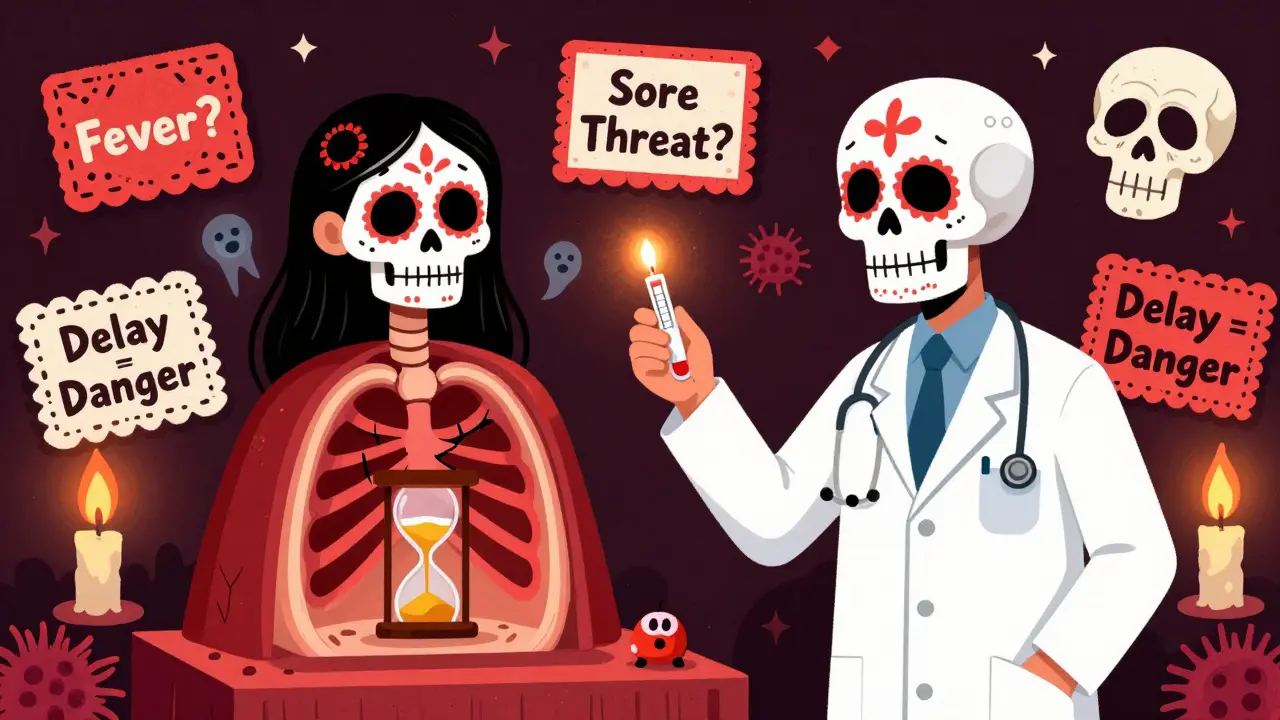
Here’s the brutal truth: early symptoms look like the flu. You get a fever. Your throat hurts. You feel tired. You might have chills or mouth ulcers. These are classic signs-but most patients are told they have a virus. That’s why 63% of patients in a 2021 Rare Diseases Network survey had their symptoms dismissed for more than 48 hours.
According to the Infectious Diseases Society of America (IDSA), any fever above 38.3°C (101°F) in someone with an ANC below 500/μL is a medical emergency. No waiting. No tests. Antibiotics must start immediately.
And here’s the kicker: patients often don’t feel sick until it’s too late. One Reddit user in r/medicine described feeling fine until he woke up with a 102°F fever and couldn’t swallow. By the time he got to the ER, his ANC was 22/μL. He spent 17 days in the ICU.
How Is It Diagnosed?
Diagnosis isn’t based on symptoms alone. Two things are required:
- Two consecutive blood tests showing ANC below 100/μL.
- A bone marrow biopsy confirming the absence of granulocyte precursors.
It’s not enough to just see low white blood cells. Other conditions-like viral infections or vitamin deficiencies-can mimic low counts. The bone marrow test confirms the problem is in production, not destruction.
But in practice, doctors often skip the biopsy. If the ANC is below 100/μL and a high-risk drug is involved, they assume agranulocytosis and act. Time is everything.
What Happens After Diagnosis?
Step one: Stop the drug. Immediately. That’s the single most important action. Dr. David C. Dale, a leading neutropenia researcher, says recovery usually takes 1-3 weeks after stopping the offending medication. The bone marrow can bounce back-if it’s not permanently damaged.
Step two: Treat the infection. Broad-spectrum antibiotics are started right away. Pseudomonas aeruginosa is the most common killer in these cases, so coverage must include it. According to a 2022 IDSA trial, timely antibiotics cut mortality from 21% to under 6%.
Step three: Supportive care. This includes isolation, no raw foods, no dental work, and avoiding crowds. Even a cold can be deadly.
Step four: Consider growth factors. G-CSF (granulocyte colony-stimulating factor) can help the bone marrow recover faster. It’s not always used, but in severe cases, it’s a lifeline.
Monitoring Protocols: What Works and What Doesn’t
Monitoring isn’t optional. It’s mandatory for high-risk drugs. But implementation is messy.
Clozapine monitoring is the gold standard: weekly CBC for six months, then biweekly for six more, then monthly. But rural patients often can’t get to a lab every week. A 2021 study in the American Journal of Managed Care found 38% of cases involved patients without reliable access to labs.
Enter point-of-care devices. The Hemocue WBC DIFF system, cleared by the FDA in March 2022, gives results in five minutes using just a finger prick. In a 2022 Blood Advances trial, it improved adherence by over 30%. That’s huge.
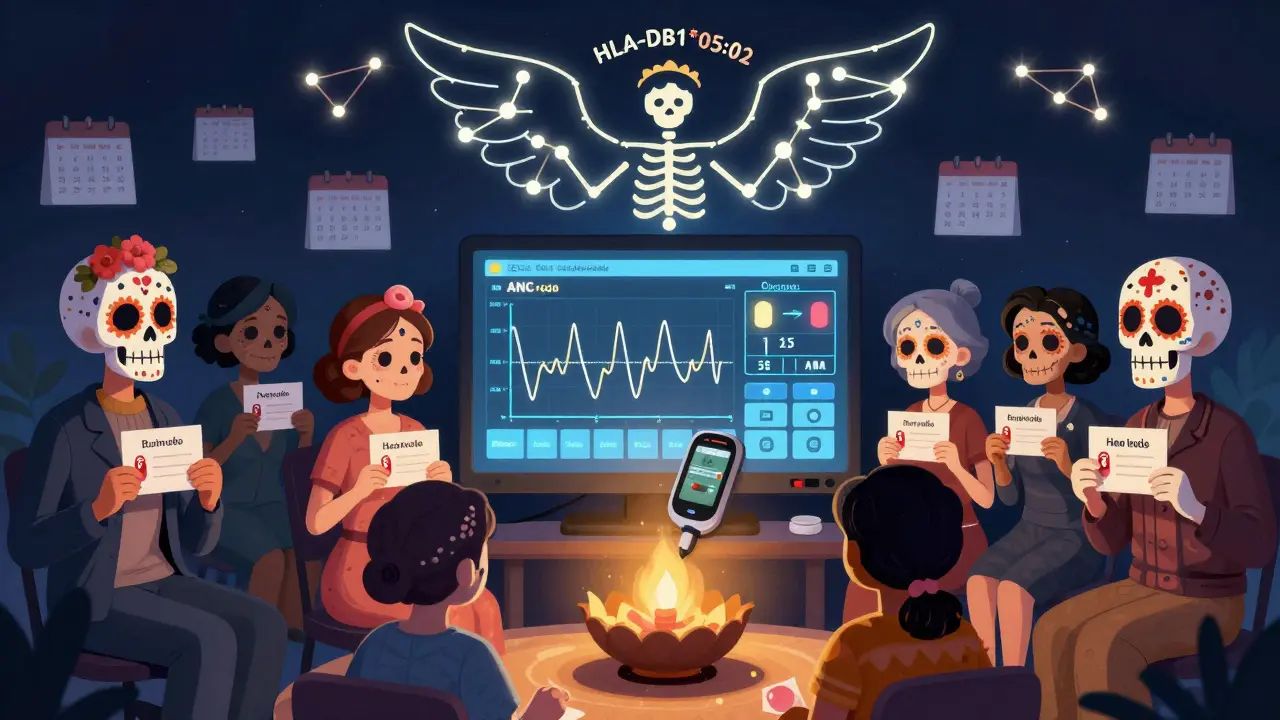
Even better? Genetic testing. In January 2023, the FDA approved the first predictive test: HLA-DQB1*05:02. People with this gene variant have a 14.3 times higher risk of clozapine-induced agranulocytosis. Testing before starting the drug could prevent many cases.
But here’s the problem: only 12% of U.S. psychiatrists currently order this test. Cost, access, and lack of awareness are barriers. The European Union has stricter rules-98.7% compliance in Germany. The U.S. is lagging.
Who’s at Highest Risk?
It’s not just about the drug. Patient factors matter too:
- Age over 60
- Female gender (some drugs like propylthiouracil affect women more)
- Pre-existing autoimmune disease
- History of low white blood cell counts
- Living in a rural area with poor lab access
Dr. Lisa M. Brown of the CDC reported in 2023 that rural and underserved populations die from this condition 2.3 times more often. Why? Delayed testing. No specialists nearby. No point-of-care devices. These aren’t just medical issues-they’re equity issues.
What’s Changing in 2026?
The field is evolving fast:
- The European Hematology Association updated its guidelines in May 2023 to recommend intervention at ANC <1,000/μL-not 500/μL. That’s a big shift. Earlier action saves lives.
- AI-powered alerts in electronic health records are reducing missed cases by 47%, according to a 2022 JAMIA study.
- By 2028, the Personalized Medicine Coalition predicts 40% of high-risk drugs will require genetic screening before use.
- Pharmaceutical companies are being held accountable. AstraZeneca paid $187 million in 2021 to settle lawsuits over Seroquel-induced agranulocytosis.
The future is proactive-not reactive. We’re moving from watching for symptoms to predicting who’s at risk before they even start the drug.
What Should You Do If You’re on a High-Risk Drug?
If you’re taking clozapine, propylthiouracil, or trimethoprim-sulfamethoxazole, here’s your action plan:
- Know your drug’s risk level. Ask your doctor: Is this Tier 1 (high risk)?
- Get a baseline ANC before starting.
- Follow the monitoring schedule exactly. No skipping. No delays.
- Carry a medical alert card listing your medication and risk.
- If you develop fever, sore throat, or mouth sores-go to the ER immediately. Don’t wait. Don’t call your doctor first.
- Ask about HLA-DQB1*05:02 testing if you’re on clozapine. It’s available and covered by most insurers.
Most people on these drugs never develop agranulocytosis. But if you’re one of the few who do, early detection is everything. The difference between life and death can be a single blood test done on time.
Final Thought: It’s Not About Fear-It’s About Awareness
Agranulocytosis isn’t common. But it’s not rare enough to ignore. For every 10,000 people on clozapine, 77 will develop it. That’s more than the number of people who die from lightning strikes in a year. We have the tools to prevent most of these deaths. We just need to use them.
Doctors need better education. Patients need better information. Systems need better alerts. The technology exists. The data is clear. The only thing missing is consistent action.
Can agranulocytosis be reversed?
Yes, in most cases. Once the triggering medication is stopped, the bone marrow typically recovers within 1 to 3 weeks. Recovery depends on how quickly the drug was discontinued and whether an infection was already present. Early intervention dramatically improves outcomes.
How often should blood tests be done for clozapine?
Under FDA-mandated REMS rules, patients on clozapine need weekly complete blood count (CBC) tests for the first 6 months. After that, testing is done every 2 weeks for the next 6 months, then monthly. If the absolute neutrophil count (ANC) falls below 1,000/μL, treatment must stop immediately.
Can I take over-the-counter painkillers if I’m on a high-risk drug?
Most common OTC painkillers like ibuprofen or acetaminophen are safe. Avoid dipyrone or phenylbutazone, which are banned in the U.S. but sometimes used abroad. Always check with your doctor before starting any new medication, even if it seems harmless.
Is agranulocytosis the same as leukemia?
No. Agranulocytosis is a drop in white blood cell production, usually caused by drugs. Leukemia is a cancer of the blood-forming cells that produces abnormal, non-functional white blood cells. They can look similar on a blood test, but a bone marrow biopsy clearly distinguishes them.
What should I do if I miss a blood test?
Contact your prescriber immediately. Missing even one test increases your risk. If you can’t get to a lab, ask about point-of-care testing options like the Hemocue WBC DIFF device. Do not continue the medication without a current ANC result.
Can children get medication-induced agranulocytosis?
Yes, though it’s rare. Antithyroid drugs like propylthiouracil are the most common cause in children. Monitoring protocols for kids are similar to adults, but dosing and testing frequency may be adjusted. Parents should watch for fever, mouth sores, or unusual fatigue and report them immediately.
Are there alternatives to clozapine if I’m worried about agranulocytosis?
Yes, but clozapine is uniquely effective for treatment-resistant schizophrenia. Other antipsychotics like risperidone or olanzapine may be tried first. If those fail, clozapine remains the best option for many patients. Genetic testing (HLA-DQB1*05:02) can help determine if you’re at high risk before starting.
Haley Parizo
January 2, 2026 AT 23:25This isn't just medical-it's a systemic failure. We're asking patients to trust drugs that can kill them in days, then blaming them for not getting weekly blood draws in rural towns with no labs. It's colonial medicine dressed in white coats. The FDA requires monitoring, but doesn't fund access. That's not safety-it's negligence wrapped in policy.
Ian Detrick
January 4, 2026 AT 08:22I’ve seen this up close. My cousin was on clozapine for five years-no issues. Then one Tuesday, he woke up with a fever and couldn’t swallow. By Thursday, he was in the ICU. They didn’t catch it because his local clinic didn’t have the equipment. He’s fine now, but it took 17 days and a miracle. If we had point-of-care testing, he’d have been home in three.
Sarah Little
January 5, 2026 AT 03:15Per the 2023 VisualDx meta-analysis, medication-induced agranulocytosis exhibits a biphasic temporal distribution with a primary peak at 4–12 weeks post-initiation and a secondary, lower-amplitude wave beyond 18 months, consistent with immune-mediated versus direct myelotoxic mechanisms. The HLA-DQB1*05:02 allele confers an OR of 14.3 (95% CI: 8.9–22.1) in Caucasian populations, but penetrance varies significantly across ethnic subgroups, necessitating stratified risk modeling.
innocent massawe
January 6, 2026 AT 20:09Man... this is heavy. 😔 I’m from Nigeria, and we don’t even have regular blood tests for most people. If someone here gets this, they’re basically done. No monitoring. No antibiotics. Just prayers. We need these point-of-care tools here more than anywhere.
Philip Leth
January 8, 2026 AT 08:41Bro, I took ibuprofen yesterday and just panicked. Then I read the part where it said ‘nearly no risk’ and almost cried. I’m not mad, I’m just… wow. This is the kind of stuff you don’t hear unless you’re in the weeds. Thanks for laying it out.
Angela Goree
January 8, 2026 AT 14:29STOP. JUST STOP. Who gave these drug companies permission to poison people and then slap on a ‘weekly blood test’ sticker like that fixes everything? The FDA is a corporate puppet. Clozapine? Banned in 30 countries. And we’re proud of our ‘monitoring protocol’? We’re not protecting patients-we’re just delaying the funeral.
Joy F
January 10, 2026 AT 07:04Let’s be real-this isn’t about medicine. It’s about capitalism. Pharma makes billions off clozapine. The monitoring program? A liability shield. They don’t care if you live-they care if you sign the waiver. And the HLA test? Too expensive. Too inconvenient. Too inconvenient for profit. We’ve turned survival into a compliance checklist.
And don’t get me started on how rural patients are treated like afterthoughts. ‘Oh, you live 80 miles from a lab? Sorry, your ANC dropped to 80, you’re dead now.’ That’s not healthcare. That’s eugenics with a stethoscope.
Meanwhile, the same companies pushing this drug are lobbying to cut Medicaid. You think that’s a coincidence? No. It’s the design.
Palesa Makuru
January 11, 2026 AT 10:31It’s fascinating how we’ve pathologized the body’s response to synthetic molecules while ignoring the deeper epistemological rupture in modern pharmacology. The bone marrow isn’t ‘failing’-it’s rejecting the ontological violence of pharmaceutical hegemony. We’re not treating agranulocytosis; we’re just managing the symptoms of a system that commodifies biological vulnerability.
And let’s not pretend point-of-care devices are ‘progress.’ They’re just faster tools for a broken paradigm. The real solution? Abolish the profit motive in drug development. Until then, we’re just rearranging deck chairs on the Titanic.
Hank Pannell
January 13, 2026 AT 04:50I’ve been reading up on this for my brother-he’s on clozapine. The HLA test thing blew my mind. I didn’t even know it existed. Why isn’t this standard? Why isn’t every psych ward requiring it before the first script? If we can test for BRCA, why not this? It’s not even expensive. It’s just… ignored. And the rural access gap? That’s not an oversight. That’s a choice.
Also, that Reddit story about the guy waking up with a 102 fever and couldn’t swallow? That’s my brother’s exact symptoms. We got lucky. He’s alive. But not everyone will be.
Lori Jackson
January 13, 2026 AT 17:40People who take clozapine should be required to sign a notarized waiver that says they understand they might die. And if they do? Too bad. You chose the drug. You knew the risks. Stop whining about ‘access’-if you can’t afford weekly labs, maybe you shouldn’t be on a drug that kills 1 in 130 people. Self-responsibility isn’t a buzzword-it’s survival.
Wren Hamley
January 14, 2026 AT 16:30Imagine your body’s immune system is a SWAT team. Then someone slips a poison into their coffee. They start dropping like flies. That’s agranulocytosis. And the worst part? You don’t feel it until the whole damn team’s dead. Then the ER’s like, ‘Uh, you got a fever?’ Yeah. And my neutrophils? 22. Good luck.
erica yabut
January 16, 2026 AT 08:51Wow. So we’re just supposed to trust that the FDA knows what they’re doing? And that doctors are actually reading the guidelines? Newsflash: most of them are burnt out and scrolling TikTok between patients. This isn’t a medical crisis-it’s a trust crisis.
Tru Vista
January 18, 2026 AT 02:46ANC <100 = emergency. Got it. But why does everyone keep saying ‘bone marrow biopsy’? That’s outdated. CBC + drug history = diagnosis. Biopsy is for academic papers, not ERs. Stop overcomplicating it.