
Medication Safety Calculator for Kidney Disease
Calculate Your Medication Safety
Medication Safety Assessment
Your medication is safe for your current kidney function.
Critical Warning!
This medication can cause dangerous toxicity at your current kidney function.
Key Risks
- Risk 1
- Risk 2
- Risk 3
Recommended Action
Consult your doctor immediately to adjust your medication dose or switch to safer alternatives.
When your kidneys aren't working right, your meds can turn against you. It sounds simple, but it’s one of the most dangerous blind spots in modern medicine. People with chronic kidney disease (CKD) often take 10 or more medications a day-for diabetes, high blood pressure, heart disease. But if those drugs aren’t adjusted for failing kidneys, they don’t just stop working. They build up. And that buildup can poison your body.
How Kidneys Keep Meds Out of Trouble
Your kidneys do more than make urine. They filter about 30% of all prescription drugs out of your bloodstream. When kidney function drops, those drugs don’t get cleared. They stick around. Longer. Stronger. Toxic.Normal kidney function means a glomerular filtration rate (eGFR) of 90 or higher. Once eGFR falls below 60, you’re in stage 3 CKD. That’s the tipping point. At this stage, 40% of commonly used medications need a dose change. But most doctors don’t check eGFR unless you’re in dialysis. They look at your creatinine level alone. That’s like judging a car’s speed by looking at the gas gauge-you’re missing the whole picture.
Here’s how drugs get stuck:
- Reduced filtration: Fewer filters = less drug removal.
- Impaired secretion: Kidney tubules can’t push drugs into urine like they should.
- Protein binding changes: With CKD, proteins that carry drugs in blood get messed up, leaving more free drug floating around to cause harm.
Medications That Turn Deadly in CKD
Not all drugs are created equal when kidneys fail. Some are harmless. Others? They’re landmines.NSAIDs (Ibuprofen, Naproxen, Diclofenac) - These over-the-counter painkillers are the #1 cause of preventable kidney injury in CKD patients. They block prostaglandins, chemicals your kidneys need to keep blood flowing. When that happens, your kidneys shut down. Studies show NSAIDs triple the risk of acute kidney injury when eGFR is below 60. One Reddit user posted: ‘My doctor gave me ibuprofen for back pain. My creatinine jumped from 1.8 to 3.2 in 48 hours. I ended up in the hospital for five days.’
Sulfonylureas (Chlorpropamide, Glyburide) - Used for diabetes, these drugs cause dangerous drops in blood sugar. Chlorpropamide’s half-life jumps from 34 hours to over 200 hours in stage 5 CKD. Glyburide’s active metabolite lingers for 72+ hours. Patients wake up confused, sweating, shaking-classic hypoglycemia. One study found 35% of CKD patients on these drugs had severe low blood sugar within 72 hours.
Metformin - The most common diabetes drug in the U.S. (18 million users). It’s usually safe. But when eGFR drops below 30, it can cause lactic acidosis-a rare but deadly buildup of acid in the blood. The good news? A Cochrane review of 20,000 patients found zero cases of lactic acidosis when doctors followed the rules: reduce dose at eGFR <45, stop it at eGFR <30.
Trimethoprim (and Co-trimoxazole) - This antibiotic, often used for UTIs, can spike potassium levels. In CKD patients, it’s like pouring gasoline on a fire if they’re also taking ACE inhibitors or ARBs. Studies show potassium levels rise 1.2-1.8 mmol/L within 48 hours. That’s enough to trigger heart rhythm problems. One patient described feeling ‘like my chest was being squeezed’ after starting trimethoprim with lisinopril.
Aciclovir - Used for shingles and herpes, this drug can form crystals in the kidney tubules. In patients with eGFR under 50, crystal nephropathy happens in 5-15% of cases. Symptoms? Confusion, seizures, kidney failure. It’s preventable with proper hydration and dose reduction.
DOACs (Apixaban, Rivaroxaban) - These newer blood thinners are popular because they don’t need frequent lab checks. But 50% of apixaban and 33% of rivaroxaban leave the body through the kidneys. In stage 4 CKD (eGFR 15-29), bleeding risk jumps 40% compared to stage 2. Warfarin, which is cleared by the liver, is often safer here.
What Doctors Miss (And Why)
A JAMA Internal Medicine study found 35% of primary care visits for older adults didn’t include an eGFR calculation. Instead, doctors saw a creatinine of 1.4 and assumed ‘it’s just aging.’ That’s wrong. Creatinine doesn’t tell you kidney function-it tells you muscle mass. A frail 80-year-old woman with low muscle mass can have a normal creatinine but severely damaged kidneys.Another big problem? Dosing errors. The American Society of Health-System Pharmacists found a 42% error rate when prescribing drugs with more than 50% renal clearance to CKD patients. That means almost half the time, the dose is too high.
And then there are drug interactions. NSAIDs + ACE inhibitors? Risk of kidney injury goes up 5-fold. Trimethoprim + spironolactone? Potassium skyrockets. These aren’t rare mistakes. They’re routine.
How to Stay Safe
If you or someone you care for has CKD, here’s what actually works:- Know your eGFR. Ask for it at every visit. Don’t settle for creatinine alone. eGFR tells you the real story.
- Review every med every 3 months. Use a list. Bring it to every appointment. Ask: ‘Is this still needed? Does it need a dose change?’
- Avoid NSAIDs completely if eGFR is below 60. Use acetaminophen instead for pain. It’s safer.
- Choose kidney-safe alternatives. For diabetes, switch from glyburide to glipizide. For infection, avoid trimethoprim if on ACE inhibitors.
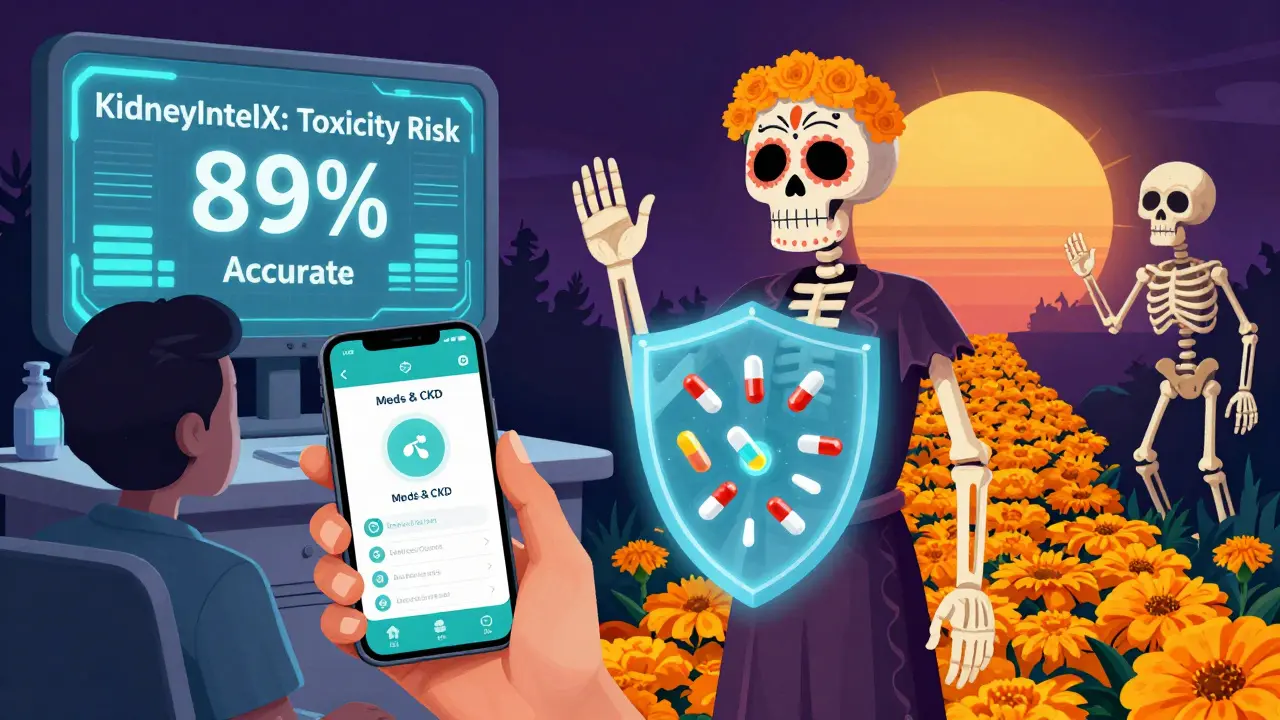
- Use tools. Apps like Meds & CKD (by Healthmap Solutions) scan your meds and flag risks. 82% of users say it improved their doctor conversations.
- Hydrate before imaging. If you need a CT scan with contrast, drink water before and after. Without it, 12-18% of CKD patients get contrast-induced kidney injury. With it? Risk drops to 1-2%.
The Future Is Here-And It’s Preventable
New tools are changing the game. The FDA approved KidneyIntelX in 2023-a machine learning tool that predicts individual drug toxicity risk with 89% accuracy. It’s not just theory. Hospitals are already using it.Electronic health records are starting to auto-flag dangerous prescriptions. Stanford’s Dr. Richard Lafayette predicts that within five years, your doctor’s computer will pop up a warning if you have CKD and are about to get a risky drug. That’s not science fiction. It’s coming.
The cost of getting this wrong? $10,000-$15,000 per hospitalization. $18.7 billion a year in preventable costs in the U.S. alone. And 65% of these cases? They’re avoidable.
Medication accumulation in kidney disease isn’t a mystery. It’s a system failure. We know the drugs. We know the doses. We know the risks. What’s missing is consistent action.
You don’t need to be a doctor to protect yourself. Just ask. Check. Question. Track. Your kidneys can’t speak-but you can.
Mandy Vodak-Marotta
February 3, 2026 AT 17:18Man, I had no idea how dangerous OTC painkillers could be for people with CKD. My grandma was on ibuprofen for years because ‘it’s just aspirin but stronger’ - until her creatinine spiked and she almost needed dialysis. Doctors just assume you know what’s safe. No one tells you until it’s too late. And honestly? Most of us don’t even know what eGFR means. We just take the pills they hand us and hope for the best. This post should be mandatory reading for every middle-aged person on 8+ meds. Seriously.
Also, why is metformin still on the list of ‘safe’ drugs when half the patients I know have been told to stop it cold turkey? It’s like the medical system is stuck in 2005.
And NSAIDs? Bro, they’re literally in every pharmacy aisle next to gum and mints. No warning labels. No ‘WARNING: MAY KILL YOUR KIDNEYS’ sticker. We need better public education, not just more prescriptions.
Nathan King
February 4, 2026 AT 04:29While the sentiment expressed herein is not without merit, the author’s conflation of clinical pharmacokinetics with layperson anecdotal evidence undermines the scientific rigor required for such a critical discourse. The assertion that ‘doctors don’t check eGFR unless you’re in dialysis’ is empirically inaccurate; current guidelines from the KDIGO and NKF mandate eGFR monitoring at least annually in stage 3 CKD. Furthermore, the attribution of causality to NSAIDs without accounting for confounding variables such as volume depletion or concurrent ACE inhibitor use represents a fundamental flaw in causal inference. One must distinguish between association and mechanism.
rahulkumar maurya
February 6, 2026 AT 02:34Let me be blunt: this is why Western medicine is a joke. You give people 10 pills for every problem and then act shocked when they crash. In India, we have grandmas on 2 pills max - and they live to 95. You don’t need 5 different blood pressure meds. You need diet, walking, and a damn doctor who actually listens. This ‘medication accumulation’? It’s not a kidney problem. It’s a pharmaceutical industry problem. They profit off the chaos. And now they’ve convinced you that your body can’t handle anything unless it’s wrapped in a patent.
Also, metformin? Please. That drug’s been around since the 1950s. If your kidneys are failing, you don’t need a new drug - you need to stop eating white bread and soda. But hey, let’s just keep prescribing.
Demetria Morris
February 7, 2026 AT 17:42It’s disgusting how little regard the medical system has for patient safety. People are being poisoned by their own prescriptions and no one takes responsibility. I’ve seen it firsthand - my sister’s cardiologist prescribed her glyburide even after her eGFR dropped to 42. When she had a hypoglycemic seizure, he blamed her for ‘not monitoring properly.’ No. He didn’t adjust the dose. He didn’t even check. And now she’s on insulin because of his negligence. This isn’t medicine. It’s gambling with people’s lives.
Susheel Sharma
February 7, 2026 AT 20:09LMFAO 😂😂😂
So let me get this straight - we’re shocked that giving people 10 pills a day while their kidneys are failing leads to poisoning? Who’s the genius here? The guy who wrote this? Or the 87-year-old who’s been taking ibuprofen since 1998 because ‘it’s just a pill’?
Also, metformin = lactic acidosis? Bro, that’s like saying ‘water can drown you’ - technically true, but only if you’re an idiot who drinks the whole ocean. The Cochrane review says zero cases when DOCTORS FOLLOW THE RULES. So the problem isn’t the drug. It’s the doctors who don’t read the damn guidelines.
TL;DR: Stop blaming the meds. Start blaming the prescribers. And maybe, just maybe, stop Googling ‘how to cure diabetes’ at 3 a.m.
Janice Williams
February 9, 2026 AT 11:36How can you possibly justify the casual dismissal of pharmaceutical science? The notion that ‘doctors don’t check eGFR’ is not only statistically false but dangerously misleading. The entire structure of modern nephrology is predicated on eGFR monitoring. To suggest otherwise is to insult every nephrologist, pharmacist, and clinical guideline committee that has spent decades refining these protocols. Furthermore, the anecdotal nature of this post - replete with Reddit horror stories - is an affront to evidence-based medicine. One must ask: who benefits from this fearmongering? The anti-pharma influencers? The supplement industry? The truth is, the system is imperfect - but it is not broken. And we do not fix it by blaming doctors for the sins of patients who refuse to comply.
Roshan Gudhe
February 9, 2026 AT 17:27There’s a quiet truth here that no one talks about: our bodies weren’t designed to handle 10 pills a day. We’ve turned medicine into a buffet - and now we’re surprised when the stomach gets sick.
It’s not just kidneys. It’s the whole system. We treat symptoms, not causes. We give drugs for high blood pressure because we don’t want to talk about salt, stress, or sleep. We give metformin because we don’t want to talk about diet. We give NSAIDs because we don’t want to talk about physical therapy.
Maybe the real solution isn’t adjusting doses - it’s reducing the number of pills in the first place. I’ve seen patients with CKD who got off 7 meds and started walking 30 minutes a day - their eGFR improved. Not because of magic pills. Because they stopped letting pills run their lives.
It’s not about the kidneys failing. It’s about us failing the kidneys.
Rachel Kipps
February 11, 2026 AT 10:13i read this and just cried. my mom has ckd and takes like 12 meds and no one ever told us about any of this. we just thought she was getting sicker because she was old. the part about glyburide made me sick to my stomach. she’s been on it for 7 years. i’m calling her doctor tomorrow. thank you for writing this. i didn’t know what to do but now i know to ask for eGFR and drug adjustments. please keep sharing stuff like this.
Alex LaVey
February 12, 2026 AT 04:34Hey, I’m not a doctor, but I’ve been living with stage 4 CKD for 8 years. This post? It’s the most accurate thing I’ve read in years.
My nephrologist changed my meds after I brought up the eGFR issue - and it was like night and day. No more brain fog. No more dizziness. I used to think I was just ‘getting old.’ Turns out, I was just poisoned.
Here’s what I tell everyone: ask your doctor: ‘Is this dose safe for my kidney function?’ and ‘Is there a safer alternative?’ Don’t wait for them to bring it up. They’re busy. You’re the one taking the pills.
Also - if you’re on NSAIDs? Just stop. Use heat, massage, or acupuncture. Your kidneys will thank you. I did. And I’m still alive. 😊
Jhoantan Moreira
February 12, 2026 AT 13:23Beautifully written. This is exactly the kind of patient-centered education we need. Too often, we treat CKD as a ‘kidney problem’ - but it’s a whole-system issue. Medication management, diet, mental health, access to care - it’s all connected.
I’ve worked in rural clinics where patients get prescriptions from a telehealth doc who’s never seen them. No labs. No history. Just a click and a script. This post should be shared in every waiting room. Thank you for speaking up.
Justin Fauth
February 13, 2026 AT 11:06THIS IS WHY AMERICA IS FALLING APART. We let corporations run our healthcare. Doctors are paid to prescribe, not to think. You think your doctor cares if you live or die? Nah. They care if they hit their quota for prescriptions. That’s why your grandma’s on 12 pills and her kidneys are toast. It’s not medicine - it’s a profit scheme. And you’re the product.
STOP TRUSTING THE SYSTEM. START ASKING QUESTIONS. OR YOU’LL BE NEXT.
Meenal Khurana
February 13, 2026 AT 17:56NSAIDs are dangerous. Avoid them. Simple.
Zachary French
February 13, 2026 AT 22:07Okay, let’s get one thing straight: this post is 90% correct - but the author is clearly an amateur. Metformin isn’t ‘safe’ at eGFR 30 - it’s ‘conditionally safe’ with strict monitoring. And the part about protein binding? That’s PhD-level pharmacokinetics. You didn’t explain it. You just threw it out there like a meme. Also - ‘one Reddit user’? That’s not evidence. That’s a TikTok story.
But here’s the real issue: the medical system doesn’t train doctors to think about drug accumulation. They train them to bill codes. So we get this mess. And now we’re surprised when patients die from ‘medication toxicity’?
Fix the system. Not the pills. The system.