
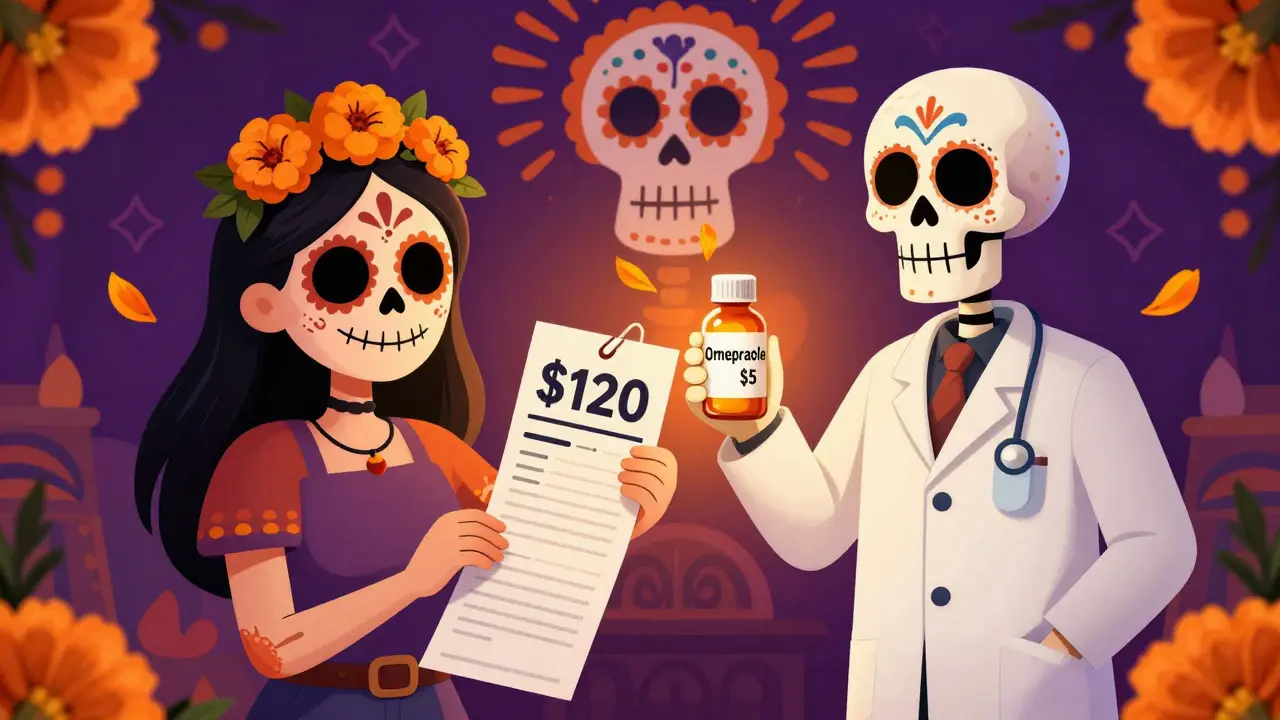
If you’ve ever stared at a prescription receipt and wondered how you’re supposed to afford it month after month, you’re not alone. Nearly 3 in 10 Americans skip doses, split pills, or skip refills because of cost. But there’s a way to keep taking the medicine you need without draining your wallet - and it doesn’t involve quitting or going without. It’s called therapeutic alternative medication.
Therapeutic alternatives aren’t generics. They’re different drugs that work just as well for your condition but cost a fraction of what you’re paying. For example, switching from brand-name Nexium (esomeprazole) to generic omeprazole can drop your monthly bill from $120 to $5. That’s not a typo. It’s a 96% savings. And it’s legal, safe, and supported by doctors, pharmacies, and even Medicare.
What Is a Therapeutic Alternative?
A therapeutic alternative is a different medication - not the same chemical compound - that treats your condition in a similar way. Think of it like choosing between two different brands of pain relievers. Both contain active ingredients that reduce inflammation, but one costs ten times more.
For instance:
- Instead of Eliquis (apixaban), you might use warfarin - a decades-old blood thinner that costs $10 a month instead of $500.
- Instead of Jardiance (empagliflozin), you could switch to metformin - a generic diabetes drug that’s been around since the 1950s.
- Instead of Lyrica (pregabalin), gabapentin can treat nerve pain at 1/30th the price.
The key is that these alternatives have been studied head-to-head and proven to deliver similar results. The American College of Physicians says they must match in efficacy, safety, and dosing. That’s not guesswork - it’s science.
Therapeutic interchange is different from generic substitution. Generics are exact copies of brand-name drugs. Therapeutic alternatives are different drugs in the same class - like swapping one SUV for another, not buying the same SUV at a discount.
Why Don’t Doctors Always Suggest These?
Many doctors want to help you save money. But they’re busy. They’re trained to prescribe what they know. And not every provider keeps up with the latest cost data.
According to a 2023 survey by the American Academy of Family Physicians, 43% of patients said their doctor initially resisted switching to a cheaper option. That doesn’t mean the doctor is against it - it means they weren’t sure if the alternative would work for your specific case.
Here’s the truth: most chronic conditions - high blood pressure, diabetes, acid reflux, depression, high cholesterol - have multiple effective treatments. The problem isn’t medical. It’s awareness.
One Vanderbilt study found that when doctors got a simple alert in their electronic chart saying, “A cheaper alternative is available,” they switched prescriptions 10% faster. That’s it. A nudge. No extra paperwork. No training needed.
How to Ask for a Therapeutic Alternative - Step by Step
Asking for a cheaper option isn’t rude. It’s smart. And you’re not alone in doing it. Here’s how to do it right.
- Start with cost awareness. Before your appointment, check your medication’s price. Use GoodRx or NeedyMeds. Type in your drug name and zip code. You’ll see prices at nearby pharmacies. If you’re paying $200 a month and the same drug costs $15 elsewhere, you have leverage.
- Ask the right question. Don’t say, “Can I get something cheaper?” Say: “I’ve seen that omeprazole works just as well as esomeprazole for acid reflux, and it’s $15 a month instead of $120. Could we try that?” Naming the alternative shows you’ve done your homework.
- Bring data. Print out a price comparison from GoodRx or a summary from NeedyMeds. Doctors respond to facts, not emotions. A 2024 survey found that patients who brought printed price sheets were 68% more likely to get their request approved.
- Ask about extended prescriptions. If your doctor won’t switch drugs, ask for a 90-day supply. Many insurance plans charge the same copay for 90 days as they do for 30. That’s a 25% savings right there.
- Request prior authorization if needed. If your insurance won’t cover the alternative, your doctor can file a prior authorization. For Medicare Part D, this must be processed within 72 hours if it’s urgent. Tell your doctor: “I need this processed as urgent because I can’t afford the current drug.”
Some patients worry their doctor will think they’re trying to cut corners. Don’t. Doctors know the cost crisis is real. A 2025 AMA guideline says: “Cost should be a factor in prescribing decisions.” You’re not asking for less care. You’re asking for smarter care.
What Medications Have the Best Alternatives?
Not every drug has a cheap alternative. But many of the most common ones do.
Here are the top 5 classes with proven, affordable swaps:
- High blood pressure: Lisinopril (generic) instead of Benicar or Cozaar. Savings: up to $90/month.
- Cholesterol: Atorvastatin (Lipitor generic) instead of Crestor or Zetia. Savings: $300+/month.
- Diabetes: Metformin instead of Jardiance, Farxiga, or Ozempic. Savings: $400+/month.
- Acid reflux: Omeprazole instead of Nexium or Protonix. Savings: $105/month.
- Anxiety/depression: Sertraline instead of Lexapro or Zoloft (yes, Zoloft and sertraline are the same drug - Zoloft is just the brand name). Savings: $200/month.
These aren’t obscure options. These are first-line treatments recommended by guidelines from the American Heart Association, the American Diabetes Association, and the FDA.
For newer drugs like GLP-1 agonists (Ozempic, Wegovy), alternatives are limited. But even here, some patients can switch to metformin or other oral meds with similar long-term results - if their condition allows it.
What to Do If Your Doctor Says No
If your doctor refuses, don’t give up. Ask why. Is it because they’re unsure of the effectiveness? Ask for the evidence. Is it because of insurance rules? Ask them to file a prior authorization. Is it because they’ve never tried the alternative? Say: “I understand. Can we try it for 30 days and see how I do?”
Many doctors are open to a trial. A 2024 JAMA study showed that 89% of patients who tried a therapeutic alternative stayed on it after 6 months - with no drop in health outcomes.
If you still hit a wall, ask for a referral to a pharmacist. Clinical pharmacists specialize in medication cost optimization. Many hospitals and clinics have them on staff. They can review your entire list, flag high-cost drugs, and suggest alternatives - often with a written note to your doctor.
Free Tools to Help You Find Savings
You don’t need a degree in pharmacology to find cheaper options. Here are the best free tools:
- GoodRx - Compares prices at over 70,000 pharmacies. You can print or text a coupon. Covers 6,000+ medications.
- NeedyMeds - Lists patient assistance programs from drug makers. Many offer free or $0 copay for low-income patients.
- RxAssist - Government-backed site with links to state and federal aid programs.
- HealthWell Foundation - Offers copay assistance for 1,200+ medications. No credit check. Just income verification.
One patient used GoodRx to find that warfarin cost $3 at Walmart - but $480 at her local pharmacy. She switched, saved $477/month, and kept her blood thinning stable.
What to Watch Out For
Therapeutic alternatives work for most people - but not all. Some conditions are too complex. Some drugs have narrow therapeutic windows.
Be cautious with:
- Anticonvulsants for epilepsy
- Immunosuppressants after organ transplants
- Thyroid medications like levothyroxine
- Biologics for autoimmune diseases (like Humira or Enbrel)
In these cases, switching can be risky. Always monitor symptoms. If you feel worse after switching, call your doctor immediately.
Also, watch out for “stealth brand-name” drugs. Some companies repackage generics with new names and charge brand prices. Check the active ingredient. If it’s the same as a $5 generic, you’re being overcharged.
Real Stories: What Happens When People Switch
One woman in Ohio switched from Eliquis to warfarin. Her monthly cost dropped from $450 to $12. She started taking it regularly. Her stroke risk stayed low. Her bank account improved.
A man in Texas switched from Jardiance to metformin. His blood sugar didn’t spike. He lost 15 pounds. His insurance premium went down because he was now on a preferred drug.
But not every switch works. One patient switched from Taltz to methotrexate for psoriasis. His skin got worse. He ended up in the ER. His doctor admitted: “I should’ve checked his disease severity first.”
The lesson? Don’t switch blindly. Do your research. Talk to your provider. Monitor your health.
What’s Changing in 2025
The rules are shifting. In January 2025, Medicare Part D required all plans to use standardized criteria for therapeutic interchange. That means if your doctor says a cheaper drug is safe, your insurer can’t deny it without a good reason.
Electronic health records from Epic and Cerner now auto-suggest alternatives at the point of prescribing. Doctors are seeing pop-ups like: “Patient has high copay. Consider switching to generic lisinopril.”
And new AI tools are helping. A 2024 study showed an AI system identified therapeutic alternatives with 89% accuracy - better than human doctors in some cases.
It’s no longer about luck. It’s about access. And you have the right to ask.
Final Thought: You Deserve to Be Healthy - Without Going Broke
Medication isn’t a luxury. It’s a necessity. And you shouldn’t have to choose between your health and your rent.
Therapeutic alternatives aren’t a loophole. They’re a solution. A proven, safe, and widely accepted way to get the care you need at a price you can afford.
Start today. Check your next prescription. Ask one question. Bring one price sheet. You might just save hundreds - or thousands - a year. And you’ll still be taking the medicine that keeps you alive.
Can I just ask my pharmacist for a cheaper alternative?
Pharmacists can tell you what’s cheaper and suggest generic options, but they can’t change your prescription. Only your doctor can prescribe a new medication. However, pharmacists can give you price comparisons and help you understand your insurance coverage. Many will even call your doctor on your behalf if you ask.
Are therapeutic alternatives as safe as brand-name drugs?
Yes - if they’re chosen correctly. Therapeutic alternatives must meet strict clinical standards: same effectiveness, similar side effects, and comparable dosing. Studies show that for conditions like high blood pressure, diabetes, and depression, switching to a proven alternative doesn’t increase risk. But it’s not a one-size-fits-all. Your doctor should consider your age, other medications, and medical history before switching.
What if my insurance won’t cover the cheaper drug?
Your doctor can file a prior authorization or tiering exception. For Medicare Part D, this must be approved within 72 hours for urgent cases. If your insurance denies it, ask your doctor to appeal. You can also use patient assistance programs from drug manufacturers - many offer free medication for low-income patients.
How do I know if a drug is a true therapeutic alternative?
Check if the drugs are in the same therapeutic class (e.g., both are ACE inhibitors or both are SSRIs). Look for clinical studies comparing them. Resources like the Institute for Clinical Systems Improvement or the American College of Physicians provide official guidelines. If two drugs are listed as interchangeable in a medical journal or formulary, they’re safe to consider.
Can I switch to a therapeutic alternative without telling my doctor?
No. Never switch medications without your doctor’s approval. Even if a drug seems similar, differences in dosing, side effects, or interactions can be dangerous. Your doctor needs to monitor your response. Always consult them first.
Do therapeutic alternatives work for seniors on Medicare?
Absolutely. In fact, Medicare Part D plans encourage therapeutic interchange. Many seniors save hundreds per month by switching from brand-name drugs to generics or alternatives. The 2025 Medicare guidelines now require faster approval of these switches. Ask your plan’s pharmacy help line for a list of preferred alternatives.
Siobhan K.
December 20, 2025 AT 21:08Let’s be real-most doctors don’t care about your wallet unless you hand them a printed GoodRx coupon with a highlighter on the price difference. I brought one in last week. My PCP sighed, said ‘fine,’ and wrote the script without even looking at the alternatives I listed. It’s not about medicine. It’s about paperwork inertia.
Stacey Smith
December 21, 2025 AT 17:25This is why America’s healthcare system is broken. You shouldn’t need a PhD in pharmacy to afford your blood pressure med. I switched from Eliquis to warfarin. Now I get my INR checked monthly. I live. I save $400. My dog even knows when I’m on the phone with the pharmacy.
Brian Furnell
December 23, 2025 AT 01:51Therapeutic interchange, as defined by the American College of Physicians (ACP), requires equivalence in pharmacodynamic profiles, bioavailability, and clinical outcomes-per the 2022 ACP Position Statement on Cost-Effective Prescribing. However, real-world implementation is hampered by EHR design flaws, formulary restrictions, and physician cognitive load. The Vanderbilt nudge study (2023) demonstrated a 10% increase in switch rates, but only when integrated into the workflow-not as a pop-up, but as a default suggestion with pre-populated alternatives. We need policy-level EHR mandates, not patient-initiated activism.
Adrian Thompson
December 23, 2025 AT 04:16So now the government wants you to take Soviet-era blood thinners because Big Pharma is evil? Next they’ll make you drink bleach for diabetes. This is how socialism starts. You think warfarin is safe? It’s a rat poison. You think metformin’s okay? It’s from a French plant. Who even knows what’s in it anymore? I’m not letting some pharmacist decide what goes in my body.
Ben Warren
December 24, 2025 AT 16:53It is an incontrovertible fact that the commodification of pharmaceuticals has led to a systemic erosion of clinical autonomy, wherein patient care is subordinated to economic imperatives. The notion that therapeutic substitution constitutes ‘smart care’ is a dangerous fallacy, predicated upon a reductionist model of pharmacotherapy that ignores individual variability in metabolism, polypharmacy interactions, and long-term safety profiles. One must not conflate cost-efficiency with clinical appropriateness. The Hippocratic Oath does not include a clause permitting cost-based substitution without rigorous risk-benefit analysis.
Sandy Crux
December 25, 2025 AT 10:40How quaint. You’re all acting like this is some revolutionary revelation. I’ve been using generics since 2012. And before you all get excited about ‘therapeutic alternatives’-have you ever considered that maybe, just maybe, the reason these drugs are expensive is because they’re better? Not just ‘similar’-better. More predictable. Fewer drug interactions. Less monitoring. Maybe you’re not ‘saving money’-you’re just accepting lower-quality care.
Hannah Taylor
December 26, 2025 AT 08:36omg i just switched my lexapro to sertraline and i think i’m depressed now?? like… is this normal?? i feel kinda weird and my hands shake?? maybe i should’ve just kept paying $200??
Dan Adkins
December 27, 2025 AT 11:17It is imperative to recognize that the pharmaceutical industry operates under a globally coordinated regulatory framework that ensures therapeutic equivalence. The suggestion that cost reduction equates to clinical compromise is not only empirically unfounded but also ethically irresponsible. In Nigeria, where access to even basic medications is limited, the principle of therapeutic substitution is not a luxury-it is a necessity. To dismiss it as ‘second-rate care’ is to privilege wealth over human survival.
Teya Derksen Friesen
December 27, 2025 AT 21:34I love how this post assumes everyone has access to a computer, a printer, and a doctor who listens. My mom’s on Medicare. She can’t use GoodRx. She doesn’t have a smartphone. Her pharmacy won’t call her doctor. She just takes half her pill because she can’t afford the rest. This isn’t a ‘smart choice.’ It’s a survival tactic. And no amount of bullet points changes that.
Jay lawch
December 28, 2025 AT 17:13What if the real problem isn’t the price of pills-but the fact that we’ve been conditioned to believe health is something you buy? That you must pay for oxygen, for blood, for the rhythm of your heart? We’ve turned healing into a transaction. And now we’re bargaining over which poison we can afford. The system doesn’t want you healthy. It wants you dependent. On pills. On prescriptions. On fear. This ‘alternative’? It’s just a different cage.
Christina Weber
December 29, 2025 AT 13:01It is grammatically and factually incorrect to state that Zoloft and sertraline are ‘the same drug.’ Sertraline is the generic name; Zoloft is the brand name. They are chemically identical. The error undermines the credibility of the entire article. Additionally, the claim that ‘metformin is an alternative to Jardiance’ is misleading-metformin is a first-line agent, while Jardiance is an SGLT2 inhibitor used in specific contexts. This is not a therapeutic alternative; it is a different class of treatment altogether.
Cara C
December 30, 2025 AT 06:39Thank you for writing this. I was so scared to ask my doctor about switching my $300/month antidepressant. I printed out the GoodRx price, brought it in, and said, ‘I really want to stay on this, but I can’t afford it.’ They didn’t even blink. Switched me to sertraline. Same effect. $12 a month. I cried in the parking lot. You’re not being cheap. You’re being brave.
Michael Ochieng
December 31, 2025 AT 17:27I’m from Kenya and we don’t even have access to brand-name drugs half the time. My uncle takes warfarin for his atrial fibrillation. He gets it for $0.80 a month at a local clinic. He’s 72. Alive. No strokes. No drama. You guys are treating this like it’s a hack. It’s just how the world works outside the U.S. Stop acting like you discovered medicine.
Erika Putri Aldana
January 2, 2026 AT 02:53why is everyone so into this?? like… i just take my pill and don’t think about it. if it costs too much i just don’t take it. it’s not that hard. also i’m not paying $120 for a pill that’s basically aspirin with a fancy name. lol
Grace Rehman
January 4, 2026 AT 00:09What if the real question isn’t how to get cheaper drugs-but why we’re all so sick in the first place? We treat symptoms like problems. But what if the problem is the system that makes us believe health is a product? That we’re broken unless we buy the right bottle? The alternative isn’t in the pharmacy. It’s in the way we think about care. We don’t need cheaper pills. We need a world that doesn’t make us choose between rent and breathing.