
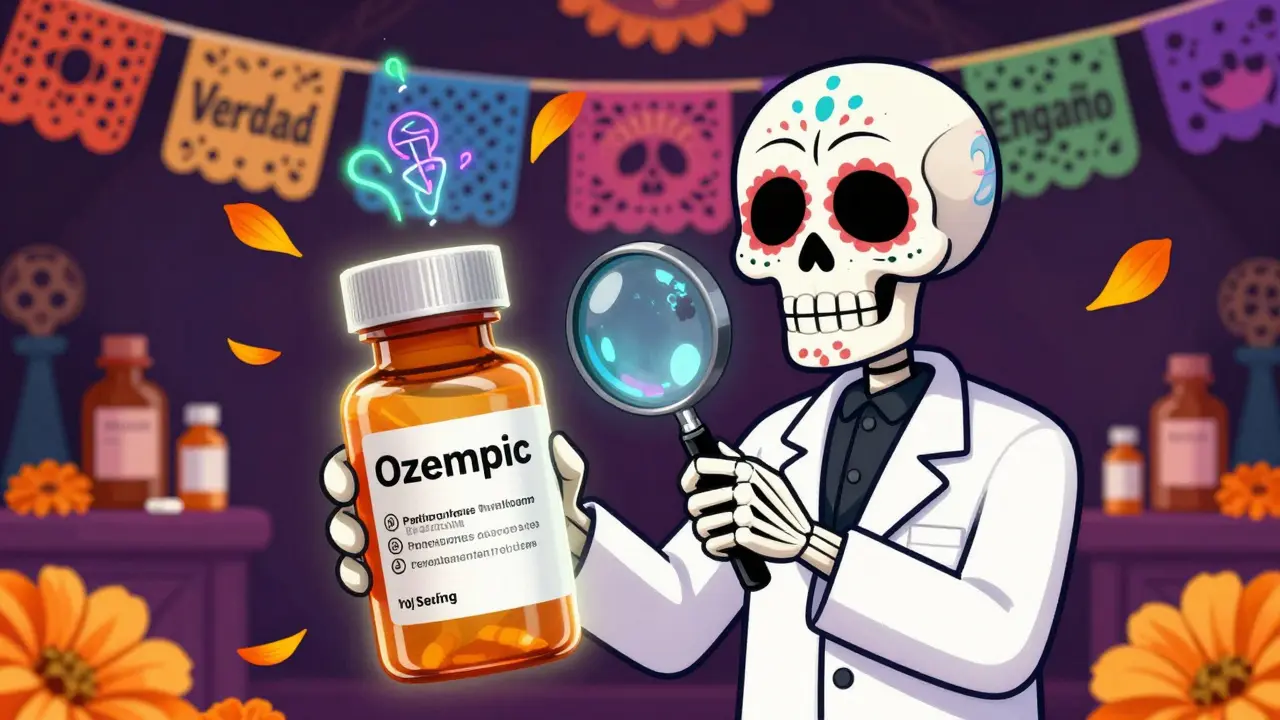
Every year, millions of people around the world take prescription meds without ever checking if the bottle or blister pack in their hand is real. It’s not paranoia-it’s necessity. Counterfeit medications aren’t just fake; they’re dangerous. Some contain no active ingredient. Others have too much, or the wrong chemical altogether. In 2023, the FDA reported over 4,800 confirmed cases of counterfeit drugs in the U.S. alone, with most originating from online pharmacies that look legitimate but aren’t.
What Makes Packaging Fake? The Subtle Signs
The best counterfeits don’t scream "fake." They whisper. A counterfeit Ozempic package might look identical to the real one-same logo, same colors, same font. But if you look closer, the lot number font is slightly bolder. The hologram doesn’t shift under light the way it should. The seal around the blister pack is thicker, stiffer, or has a faint odor. These aren’t mistakes-they’re deliberate choices by counterfeiters who copy the surface but miss the details.Real pharmaceutical packaging uses precision manufacturing. Colors are mixed to exact Pantone codes. Ink is formulated to fluoresce under UV light. Barcodes are printed with laser accuracy. Even the paper weight matters. One pharmacist in Texas found counterfeit Adderall pills in a pack that used 120gsm paper, while the genuine version was 114gsm. That 6gsm difference? Too small to notice unless you’ve handled hundreds of authentic packs.
Visual Inspection: Your First Line of Defense
You don’t need a lab to spot red flags. Start with a simple 60-second check:- Compare the packaging to an image of the real product on the manufacturer’s official website. Look for differences in logo placement, font size, or spacing.
- Check the expiration date. Is it printed cleanly, or does it look smudged or stamped on?
- Examine the seal. Does it tear cleanly? Fake seals often rip unevenly or leave residue.
- Look at the blister pack. Are the pills perfectly aligned? Are the imprints on the tablets sharp and deep? Counterfeit tablets often have shallow or uneven lettering.
- Check for misspellings. "Ozempic" misspelled as "Ozempic"? That’s a red flag.
One common trick: counterfeiters reuse old packaging designs. In 2021, a fake Lipitor package used a blue color (Pantone 286C) that the manufacturer stopped using in 2002. The color looked right to the naked eye-but under UV light, it didn’t glow the same way.
Use a Magnifying Glass or Loupe
A 10x magnifier, available for under $20 at any pharmacy supply store, reveals what your eyes can’t. Look for:- Microtext: Tiny letters or numbers printed along edges of the packaging. On real pills, these are crisp. On fakes, they’re blurry or missing.
- Alignment: Are the printed elements perfectly centered? Fake packaging often has slight shifts in text or graphics.
- Dot patterns: Real inkjet printing uses consistent dot spacing. Counterfeit printers often produce uneven or overlapping dots.
A pharmacist in Atlanta found a counterfeit version of Muro 128 eye drops because the batch code was printed 0.5mm too high. It’s that small.
UV Light and Fluorescence Tests
Many legitimate medications include hidden security features only visible under ultraviolet (UV) light. Shine a UV flashlight (365nm wavelength) on the packaging:- Real packaging often has invisible ink that glows green, blue, or yellow.
- Counterfeit versions may lack this entirely-or use the wrong color.
- Some real blister packs have UV-reactive tamper-evident strips. Fakes often skip this.
In 2022, a patient in Florida brought in a bottle of metformin that looked fine-until UV light revealed no fluorescence at all. The pills inside were sugar tablets.
Check the Barcode and QR Code
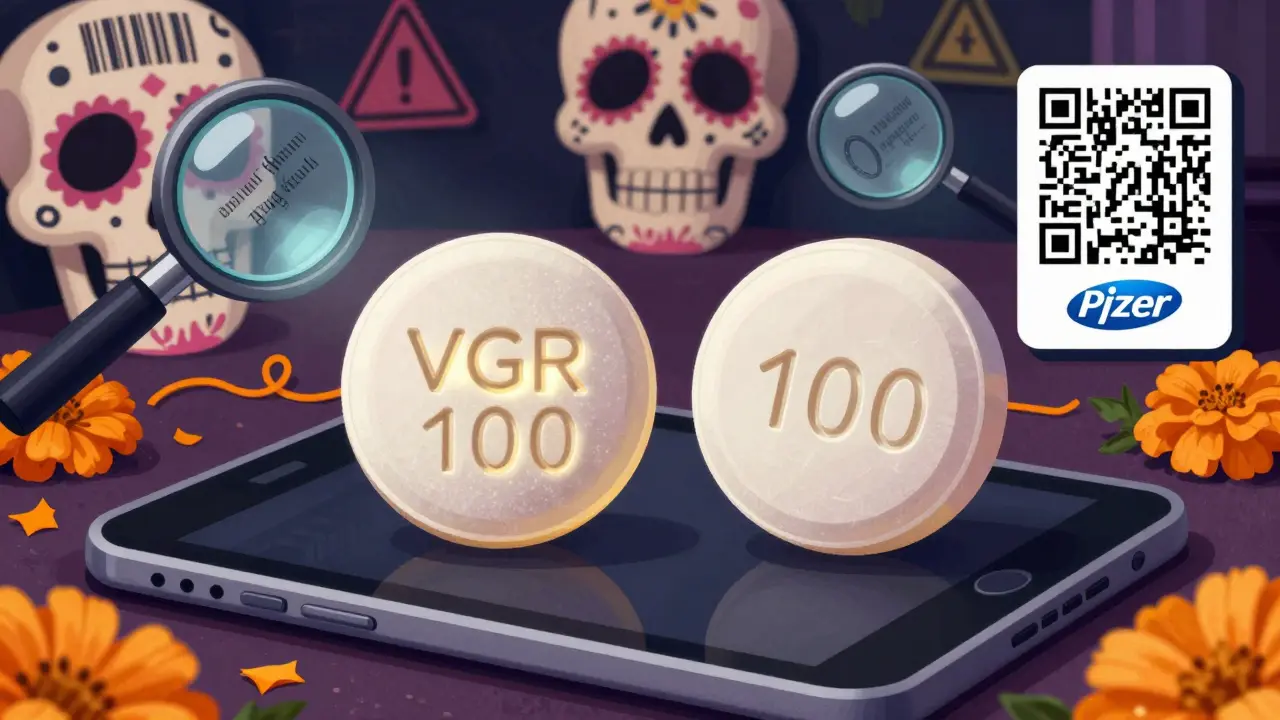
Most prescription medications now have a unique serial number encoded in a barcode or QR code. Scan it with your phone:- If it links to the manufacturer’s official site (like Pfizer.com or Novartis.com), it’s likely real.
- If it leads to a random website, a shopping page, or nothing at all-it’s fake.
- Some counterfeits use fake QR codes that look real but don’t scan. Test it with two different apps.
The U.S. Drug Supply Chain Security Act (DSCSA), fully active since 2023, requires every prescription package to have a unique identifier. If you’re buying from a licensed U.S. pharmacy, you should be able to verify the code through the manufacturer’s portal.
What About Holograms and Security Strips?
Holograms used to be a gold standard. Now? They’re easily copied. In 2018, INTERPOL found that 83% of counterfeit packages replicated holograms perfectly-with a standard printer and a heat press.Don’t rely on holograms alone. Look for:
- Color shift: Tilt the package. Does the image change from green to blue? Fake holograms often just shimmer without shifting color.
- Clarity: Real holograms have sharp, deep images. Fakes look flat or pixelated.
- Location: Is the hologram in the exact spot shown on the manufacturer’s website? Counterfeiters often misplace them.
Some newer drugs use advanced security: Edible Physical Unclonable Functions (ePUFs) create unique microscopic patterns on pills that can be verified with a smartphone app. These aren’t common yet-but they’re coming.
When to Suspect the Pills Themselves
Packaging is the first clue-but the pills tell the real story:- Size and shape: Are the pills the same size and color as before? Even a 5% difference matters.
- Texture: Real pills have a consistent feel. Fakes may feel chalky, greasy, or too hard.
- Smell: Some counterfeit pills have a chemical or plastic odor. Genuine ones usually smell like nothing.
- Imprints: Look at the letters or numbers stamped on the pill. Are they crisp? Are they centered? Fake imprints are often off-center or uneven.
One case in 2023 involved fake Viagra pills with the imprint "VGR 100"-but the "G" was slightly crooked. The real version had perfect alignment. The patient noticed because he’d taken the same pill for years.
Where Fake Drugs Come From-and How to Avoid Them
The vast majority of counterfeit medications come from unlicensed online pharmacies. Even sites that look professional-complete with fake licenses, testimonials, and SSL certificates-are often fronts.Only buy from:
- Pharmacies licensed in your state (check your state board of pharmacy website).
- Pharmacies that require a valid prescription.
- Pharmacies with a physical address and phone number you can call.
- Pharmacies verified by the National Association of Boards of Pharmacy (NABP) through their VIPPS program.
Never buy from social media ads, Instagram sellers, or websites offering "discounted" versions of brand-name drugs. If it seems too good to be true, it is.
What to Do If You Find Something Suspicious
Don’t throw it away. Don’t take it. Don’t just ignore it.Here’s what to do:
- Keep the packaging and pills exactly as they are.
- Take a clear photo of the front, back, and pills.
- Call the FDA’s MedWatch hotline at 1-800-FDA-1088.
- Report it to the manufacturer. Most have a dedicated counterfeit reporting line on their website.
- If you’ve taken the pills, contact your doctor immediately.
The FDA processed over 4,800 counterfeit reports in 2022. Your report could help stop a batch before it reaches someone else.
Why This Matters More Than You Think
Counterfeit drugs aren’t just a scam-they’re a public health crisis. A fake antibiotic might not cure your infection. A fake heart medication could cause a heart attack. A fake cancer drug might leave you with no chance of survival.In 2021, the FDA found counterfeit cancer drugs with 0% active ingredient. Patients took them for months, thinking they were getting treatment. They weren’t.
And it’s getting worse. Counterfeiters now use AI to generate fake packaging that mimics real designs with 92% accuracy, according to a 2023 SPIE study. That means even trained pharmacists can be fooled-if they only check one thing.
The solution? Layered verification. Don’t rely on one method. Combine visual checks, UV light, barcode scans, and, if possible, a magnifier. If you’re a caregiver, teach your family how to spot the signs. If you’re a pharmacist, train your staff. It’s not about paranoia. It’s about protection.
Final Tip: Trust Your Gut
If something feels off-even if you can’t explain why-trust it. You’ve handled this medication before. You know how it should look, feel, smell. That instinct is your brain recognizing a pattern mismatch.One woman in Dallas bought a bottle of insulin online. The box looked perfect. But the cap felt looser than usual. She called her pharmacist. They checked the batch number. It didn’t exist. She saved her own life by trusting a feeling.
You don’t need a degree in chemistry to protect yourself. You just need to look closely-and act when something doesn’t feel right.
Can I tell if a pill is fake just by looking at it?
Sometimes, but not always. Many counterfeit pills look identical to the real thing. Look for subtle differences like imprint depth, color shade, or packaging alignment. A 10x magnifier helps reveal microtext and printing flaws invisible to the naked eye. If you’re unsure, verify the barcode or contact the manufacturer.
Are all online pharmacies dangerous?
No-but most unlicensed ones are. Only buy from pharmacies that require a prescription, have a physical address, and are verified by the NABP’s VIPPS program. Look for the VIPPS seal on their website. If a site offers "discounted" brand-name drugs without a prescription, it’s almost certainly fake.
What should I do if I accidentally take a counterfeit pill?
Stop taking the medication immediately. Contact your doctor or go to the nearest emergency room if you feel unwell. Report the incident to the FDA at 1-800-FDA-1088. Keep the packaging and any remaining pills as evidence. Many counterfeit drugs have no active ingredients, but some contain toxic substances that can cause serious harm.
Do pharmacies test for counterfeit drugs?
Licensed U.S. pharmacies are required to source medications only from FDA-approved distributors. Most don’t test every package visually, but they rely on secure supply chains. Pharmacists are trained to spot obvious counterfeits-like wrong colors or misspellings. If you suspect a drug is fake, ask your pharmacist to verify it. They can contact the manufacturer or report it.
Is it safe to buy medication from other countries?
The FDA does not approve medications imported from outside the U.S. unless they’re part of an approved program. Medications from countries with weak regulations (like some in Southeast Asia or Latin America) have higher rates of counterfeiting. Even if the packaging looks real, there’s no guarantee the contents are safe or correct.
Candice Hartley
January 27, 2026 AT 18:17Just checked my insulin bottle after reading this-holy crap, the cap is looser than usual 😳 I thought it was just old packaging. Going to call my pharmacist right now.
Andrew Clausen
January 28, 2026 AT 21:46The entire premise of this article is dangerously naive. You're telling people to trust a 10x loupe and UV light like they're forensic scientists? Most patients don't even know what a Pantone code is. The real solution is systemic: regulate online pharmacies or shut them down. Stop putting the burden on vulnerable people trying to afford their meds.
Kirstin Santiago
January 30, 2026 AT 20:50This is such an important topic-and honestly, I'm glad someone laid it out so clearly. I work with elderly patients who buy meds online because they can't afford co-pays. I've started handing out laminated cheat sheets with the 60-second check steps. One lady found a fake metformin pack because the expiration date was printed in Times New Roman instead of Arial. She didn't know how, but she knew it 'looked wrong.' Trust that instinct.
Also, if you're reading this and you're a caregiver, please, take five minutes and show your loved one how to spot the little things. It's not paranoia. It's love in action.
April Williams
January 31, 2026 AT 11:28YOU PEOPLE ARE IDIOTS FOR BUYING MEDS ONLINE. WHY AREN'T YOU JUST GOING TO A PHARMACY? DO YOU WANT TO DIE? I SAW A WOMAN ON THE NEWS WHO TOOK A COUNTERFEIT HEART MED AND HAD A STROKE. SHE WAS 42. YOU'RE ALL BEING STUPID AND SELFISH AND I'M SO MAD.
PS: I REPORTED THREE WEBSITES TODAY. YOU'RE WELCOME.
suhail ahmed
January 31, 2026 AT 11:55Back home in Delhi, we call these "ghost pills"-they look real, taste like chalk, and vanish from your system like they were never there. I once saw a man collapse after taking fake insulin bought from a WhatsApp vendor who swore it was "original from the US."
Here’s the twist: some counterfeiters use real active ingredients but in wrong doses-like 500mg instead of 5mg. That’s not fraud, that’s a death sentence wrapped in a pretty label.
And yeah, the holograms? We’ve seen them printed on napkins with inkjet printers. The real magic? The QR code. If it doesn’t link to the manufacturer’s domain, it’s a ghost. Always check the domain. Always.
Pro tip: If the bottle smells like plasticine or has a faint metallic tang? Toss it. Real meds don’t smell like anything except… nothing.
astrid cook
February 2, 2026 AT 08:23So let me get this straight-you want us to carry a UV flashlight and a 10x loupe in our purse like we’re detectives? Meanwhile, Big Pharma charges $1,200 for a 30-day supply and expects us to become forensic chemists just to survive?
And you call this "protection"? It’s exploitation dressed up as empowerment. The system is broken. Stop blaming the patient.
Kegan Powell
February 2, 2026 AT 19:20Trust your gut is the real takeaway here. I’ve taken the same pill for 8 years and I can tell you the exact weight it feels like in my palm the second I pick it up. That’s intuition built over time. No app, no UV light, no magnifier beats lived experience.
Also-why do we treat this like a personal responsibility? Shouldn’t the system be built so you don’t have to be a detective just to get your diabetes meds?
But hey, if you’re gonna check the barcode, scan it twice. I once scanned a fake one that looked real and it took me to a Shopify store selling "discounted Viagra" with a banner that said "Buy 2 Get 1 Free 😎"
WTF is wrong with us
Harry Henderson
February 4, 2026 AT 13:05STOP WASTING TIME WITH MAGNIFIERS AND UV LIGHTS. IF YOU’RE BUYING MEDS ONLINE YOU’RE ALREADY DEAD. GO TO A PHARMACY. CALL YOUR DOCTOR. GET A PRESCRIPTION. THAT’S IT. NO EXCUSES. NO TIPS. NO HOOKS. JUST DO THE RIGHT THING. YOUR LIFE ISN’T A TIKTOK TUTORIAL.
IF YOU’RE TOO LAZY OR TOO BROKE TO DO THAT, THEN YOU DESERVE WHAT YOU GET. I’M NOT SORRY.