
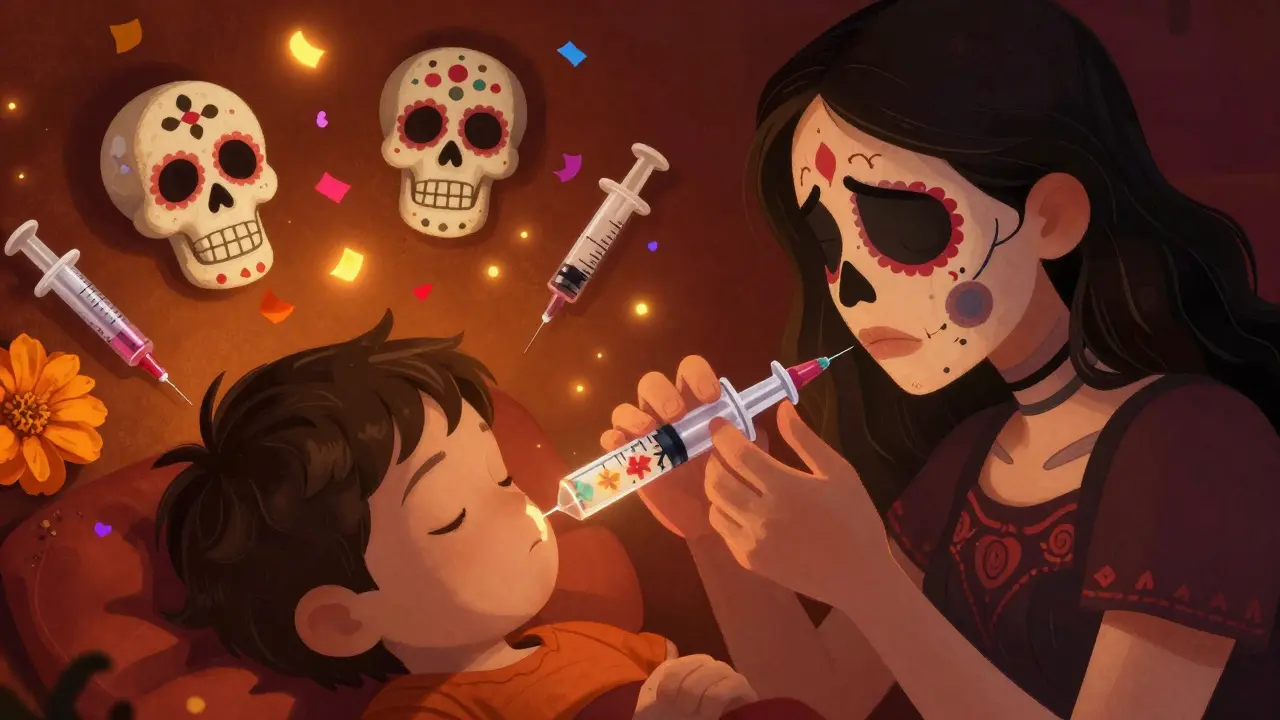
Getting the right dose of liquid medicine isn’t just about reading the label-it’s about using the right tool the right way. Too often, caregivers give too much or too little because they’re using a kitchen spoon, a dosing cup with too many markings, or a device that doesn’t match what’s written on the bottle. These aren’t small mistakes. They’re dangerous. In fact, liquid medication dosing errors are responsible for nearly one-third of all pediatric medication mistakes, and about 20% of those come directly from using the wrong device.
Why Household Spoons and Dosing Cups Fail
A teaspoon isn’t a teaspoon when it comes to medicine. A standard kitchen spoon can hold anywhere from 3 to 7 milliliters-far from the precise 5 mL needed for a child’s antibiotic. Even if you think you’re being careful, the shape of the spoon, how full you fill it, and the angle you hold it all change the amount you’re giving. Studies show that using household spoons leads to errors in about 40% of cases, especially with kids. Dosing cups are slightly better, but still problematic. Most come with too many lines-8, 10, even 15 markings-on a single cup meant for a 10 mL dose. That’s overwhelming. Caregivers get confused between 4 mL and 5 mL, or they misread the meniscus (the curved surface of the liquid) because they’re looking from above instead of eye level. One study found that 81% of dosing cups have unnecessary markings, which actually makes errors more likely. And when the cup says “5 mL” but the label says “5.0 mL,” that tiny difference in wording can cause confusion.Oral Syringes Are the Gold Standard
If you want accuracy, use an oral syringe. They’re not perfect, but they’re the most reliable tool for doses under 10 mL. Unlike cups, syringes have no parallax error-you’re reading the plunger at eye level, not trying to guess where the liquid ends on a curved surface. A 2023 study showed that for a 2.5 mL dose, only 4% of users made an error with a syringe, compared to 43% using a 15-mL cup. Syringes also let you measure in tiny increments. For a baby on a 1.6 mL dose, a syringe with 0.1 mL markings makes it possible to get it exactly right. A dosing cup? It might only have 1 mL and 2 mL lines-so you’re guessing. One parent on Amazon wrote: “The 1 mL syringe with 0.1 mL markings saved my infant from an overdose.” That’s not an exaggeration. It’s the difference between safety and harm. Yes, some people find syringes awkward at first. They’re harder to fill, and some worry about poking the child. But once you practice, it becomes second nature. And the data doesn’t lie: 76% of positive syringe reviews mention precision and no spills. The discomfort is temporary. The safety is permanent.Milliliters Only-No Teaspoons, No Tablespoons
The FDA, the American Academy of Pediatrics, and the US Pharmacopeia all agree: use milliliters (mL) only. No “tsp,” no “tbsp.” Why? Because people don’t know how much those mean. A “teaspoon” in a kitchen is not the same as a medical teaspoon. Even if you buy a “medication spoon,” it’s not calibrated the same way across brands. A 2014 study found that parents who used labels and devices marked only in milliliters made 42% fewer dosing errors. That’s huge. And it’s not just about labels-it’s about the device you’re given. If the bottle says “5 mL” but the cup says “1 tsp,” you’re already set up to fail. That mismatch happens in nearly 9 out of 10 prescriptions. The 2022 FDA guidance made it clear: “mL should be the standard unit of measure.” And starting January 1, 2025, all new liquid medications approved in the U.S. must follow this rule. But older medications? Many still use teaspoons. If you see “5 mL (1 tsp)” on the label, ignore the “1 tsp.” Focus only on the mL number. And if the device doesn’t match, ask for a syringe.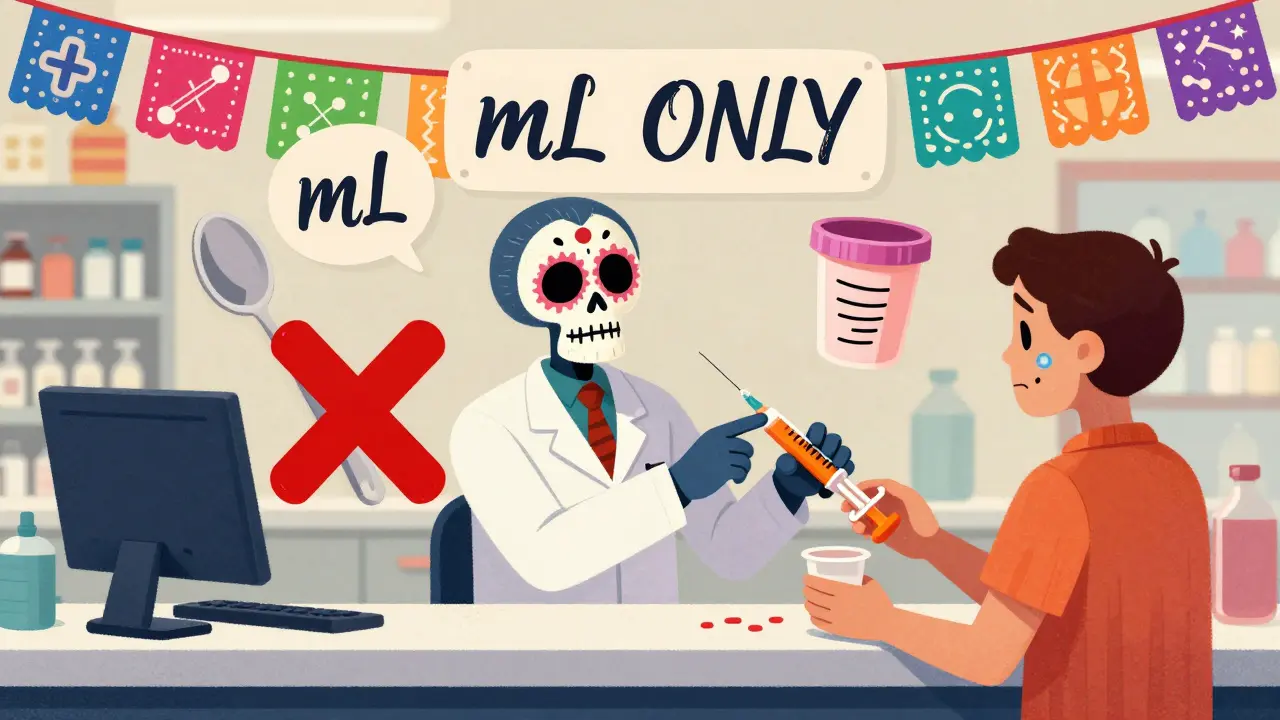
How to Use an Oral Syringe Correctly
Using a syringe isn’t hard, but it’s easy to mess up if you’ve never done it. Here’s the right way:- Wash your hands.
- Draw up a little extra liquid-about 0.5 mL more than the dose. This helps avoid air bubbles.
- Hold the syringe upright and gently tap the barrel to bring any bubbles to the top.
- Slowly push the plunger until the top edge of the plunger lines up exactly with the number on the syringe.
- Place the tip inside the child’s mouth, between the cheek and gums. Slowly push the plunger.
- Don’t force it. Let the child swallow naturally.
What Pharmacies Should Be Doing
Pharmacists are on the front lines. They’re the last checkpoint before the medicine goes home. But too often, they hand out a dosing cup without a word of instruction. That’s not enough. The American Pharmacists Association recommends giving an oral syringe for every liquid prescription under 10 mL. That’s not optional-it’s a safety standard. In a 2020 trial, pharmacies that followed this rule saw dosing errors drop by 28%. And they should be teaching, not just handing out devices. Use the “teach-back” method: show the caregiver how to use the syringe, then ask them to do it themselves. If they can’t get it right, help them again. Don’t assume they’ll figure it out. Studies show this cuts errors by 35%. Many pharmacies are now adding QR codes to prescription labels. Scan it, and you get a 60-second video showing exactly how to use the syringe for that specific medicine. CVS’s “DoseRight” and Walgreens’ “PrecisionDose” are examples of this working well. It’s simple. It’s free. And it saves lives.
What to Do If You’re Given the Wrong Device
You’re not stuck with what the pharmacy gives you. If you get a dosing cup for a 2.5 mL dose, ask for an oral syringe. Most pharmacies have them in stock. If they don’t, ask them to order one. You’re not being difficult-you’re being responsible. If you’re buying over-the-counter medicine, don’t assume the cup included is accurate. Many OTC products still don’t even include a measuring device. Antacids? Only 52% come with one. Check the label. If it says “take 5 mL,” and there’s no syringe, buy a 5 mL oral syringe separately. They cost less than $2 and are available at any pharmacy or online.Why This Matters More Than You Think
This isn’t just about avoiding a stomachache. Liquid medication errors can lead to hospital visits, organ damage, or worse. Between 2015 and 2022, pediatric emergency visits due to dosing errors dropped 37%-thanks to better labeling, better devices, and better education. But we’re not done. Low-income families are 63% more likely to get poorly made, inaccurate dosing devices. That’s not fair. And it’s not just a personal problem-it’s a systemic one. If you’re a caregiver, advocate for yourself. If you’re a healthcare provider, push for better tools. If you’re a pharmacist, don’t just hand out a cup and walk away. The tools are there. The science is clear. The standards exist. What’s missing is consistent action.Quick Checklist for Accurate Liquid Dosing
- Always use milliliters (mL)-ignore teaspoons and tablespoons.
- For doses under 10 mL, use an oral syringe-not a cup or spoon.
- Check that the device markings match the label exactly.
- Use only the device provided with the medication-or replace it with a better one.
- Practice with water before giving medicine.
- Ask the pharmacist to demonstrate proper use.
- Store syringes clean and labeled to avoid mix-ups.
Can I use a kitchen spoon if I don’t have a dosing device?
No. Kitchen spoons vary in size and are not calibrated for medicine. A teaspoon can hold 3 to 7 mL, which means you could give a child 2-3 times the intended dose-or half of it. Always use a proper measuring device like an oral syringe. If you don’t have one, ask your pharmacy for one-they’re usually free.
Why do some prescriptions still use teaspoons on the label?
Older medications, especially over-the-counter ones, still use teaspoons because the labeling hasn’t been updated. The FDA now requires milliliters only for new products, but existing stock can still be sold. If you see “1 tsp,” convert it to 5 mL in your head. But don’t rely on that. Always ask for a syringe and measure in mL.
Are all oral syringes the same?
No. Look for syringes with clear, bold markings in 0.1 mL or 0.2 mL increments for pediatric doses. Avoid syringes with extra lines or unclear numbers. The best ones are made of medical-grade plastic, have a slip-resistant tip, and are labeled with the volume (e.g., 5 mL). Don’t use syringes meant for injections-they’re not designed for oral use.
What if my child won’t take medicine from a syringe?
Try placing the tip of the syringe inside the cheek, not directly on the tongue. Gently push the plunger so the medicine flows slowly. Let your child swallow naturally. You can also mix the dose with a small amount of applesauce or juice-only if the medication allows it. Always check with your pharmacist first. If your child resists, ask for a flavored version or a different formulation.
Can I reuse an oral syringe?
Yes, if you clean it properly. After each use, rinse it with warm water, then wash with mild soap and rinse again. Let it air dry. Don’t boil it or put it in the dishwasher. Store it in a clean, dry place. If the plunger becomes sticky or the tip cracks, replace it. A damaged syringe can lead to inaccurate dosing.
How do I know if the dosing device is accurate?
Test it. Fill the syringe or cup to the exact dose, then pour it into a small measuring cup or kitchen scale that shows grams (1 mL of water = 1 gram). If the weight is off by more than 0.1 grams for a 1 mL dose, or 0.5 grams for a 5 mL dose, the device isn’t reliable. Replace it. Accuracy matters more than convenience.
sagar patel
December 26, 2025 AT 03:02Use mL only. No exceptions. Spoons are dangerous. Syringes are cheap and accurate. Done.
Bailey Adkison
December 27, 2025 AT 21:13Of course the FDA says mL only. But who actually reads the label? Most parents just eyeball it. And don’t get me started on pharmacies handing out those 15-marking cups like they’re gold. This isn’t a medical issue-it’s a behavioral one. People don’t care until their kid pukes.
Michael Dillon
December 29, 2025 AT 13:28Oral syringes are great but let’s be real-most parents are exhausted. You’re up at 3am with a feverish kid, the syringe is sticky, the medicine tastes like regret, and you’re trying to hold their head still while whispering "just a little more." Syringes aren’t the problem. The system is. Why don’t we just make all liquid meds taste like cotton candy and come in pre-filled auto-dosers? That’s the real solution.
Gary Hartung
December 29, 2025 AT 21:03Let’s not pretend this is about safety-it’s about control. The FDA, AAP, USP-they all push mL because they want to standardize, homogenize, and infantilize caregivers. Who are they to tell us how to give medicine? I used a teaspoon for my three kids and they turned out fine. Now they’re doctors. Coincidence? I think not. The real danger is trusting bureaucrats over lived experience.
Ben Harris
December 29, 2025 AT 23:47So you’re telling me I need to buy a $2 syringe because the pharmacy gave me a cup with 15 lines and a label that says 5 mL but the cup says 1 tsp? And if I don’t? My kid dies? That’s insane. This is the same logic that says we need to label water bottles with "Do Not Drink While Breathing." It’s not safety-it’s liability theater. I’m not paying for a syringe. I’m paying for medicine. Not a measuring kit.
Carlos Narvaez
December 31, 2025 AT 19:00Syringes work. Cups don’t. End of story. If you can’t measure 2.5 mL accurately, you shouldn’t be giving medicine. Simple.
Harbans Singh
January 1, 2026 AT 21:15I’m from India and we’ve always used spoons for everything-even medicine. But after reading this, I went to the pharmacy and asked for a syringe. They gave me one for free. I tested it with water and a scale. I was off by 0.6 mL with my teaspoon. That’s 12% error. For a baby? That’s scary. Thanks for the wake-up call. I’ll use the syringe now.
Justin James
January 3, 2026 AT 14:27Did you know that the entire mL push is tied to a secret WHO-Pharma alliance to sell more syringes? They’ve been lobbying since 2010. The real reason kitchen spoons are banned is because they’re made in China and the U.S. wants to force everyone to buy American-made syringes. That’s why pharmacies don’t stock them unless you ask. They’re hiding it. And don’t get me started on QR codes-those are tracking devices. Scan one and they know your child’s name, your address, your blood type. This isn’t medicine. It’s surveillance.
Rick Kimberly
January 3, 2026 AT 21:25The empirical data is unequivocal. Oral syringes reduce dosing error rates by over 90% compared to household utensils. The cognitive load imposed by multi-marked dosing cups significantly impairs decision-making under stress, particularly among caregivers with low health literacy. Therefore, institutional adoption of syringe-only distribution is not merely advisable-it is an ethical imperative.
Terry Free
January 3, 2026 AT 21:43Oh wow. You mean I’m supposed to actually measure the medicine? Like, with a tool? Not just guess? What a radical idea. Next you’ll tell me I should wash my hands before touching my kid’s mouth. Next thing you know, we’ll all be wearing gloves to feed cereal. Groundbreaking. I’m sure the CDC is proud.
Lindsay Hensel
January 5, 2026 AT 12:17This is one of the most thoughtful, life-saving pieces of public health guidance I’ve read in years. The emotional weight behind each recommendation is not lost on those of us who’ve held a trembling child while trying to measure a drop of medicine. Thank you for speaking with such clarity and compassion. You’ve given us not just instructions-but dignity.
Sophie Stallkind
January 5, 2026 AT 21:56It is imperative that healthcare providers adhere strictly to the guidelines outlined herein. The statistical significance of dosing error reduction via oral syringe utilization is not merely a clinical observation-it is a moral obligation. Failure to implement these measures constitutes a breach of the standard of care.
Katherine Blumhardt
January 6, 2026 AT 21:10im so tired of this. i just want to give my kid medicine and go back to bed. why does it have to be so hard? i used a spoon and he lived. now i have to buy a thing? and clean it? and not use the cup? and scan a qr code? i just want him to feel better. this is too much.
Linda B.
January 7, 2026 AT 04:12They say syringes are safer but what if the syringe itself is contaminated? What if the plastic leaches chemicals into the medicine? What if the 0.1 mL markings are printed with toxic ink? And who tests these syringes? Not the FDA-they’re bought and paid for. I’ve seen the documents. There’s a whole underground market for fake syringes that look real but deliver double the dose. You think you’re safe? You’re just another pawn in the pharmaceutical game.