
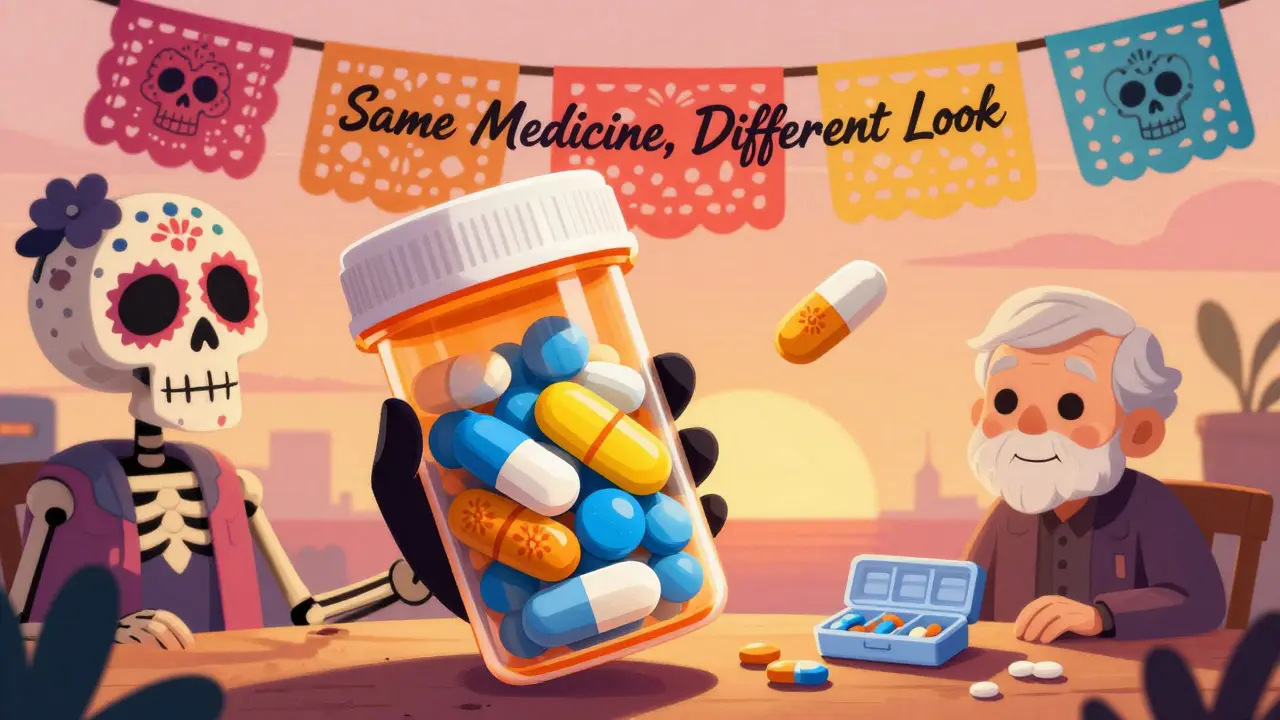
Have you ever opened a prescription bottle and stared at the pills inside, wondering if they’re the same medicine you’ve been taking for years? Maybe your blood pressure pill went from white and oval to blue and round. Or your cholesterol pill switched from pink to pale yellow. You’re not imagining things - and you’re not alone. These changes happen all the time, and they’re completely legal. But they can be confusing, scary, and even dangerous.
Why Do Generic Pills Look Different?
The reason is simple: trademark law. In the U.S., brand-name drug companies hold trademarks on the color, shape, and size of their pills. That means when a generic version is made, it can’t look exactly the same. If it did, it could be mistaken for the brand-name drug - and that’s not allowed under the law.
This rule comes from the Hatch-Waxman Act of 1984, which created the pathway for generic drugs to enter the market. The law says generics must have the same active ingredient, strength, and effect as the brand-name drug. But it doesn’t say they have to look the same. So manufacturers use different colors, shapes, and markings to avoid copying the brand’s look.
For example, Lipitor - the brand-name cholesterol pill - is a pink, oval tablet. But the generic version, atorvastatin, might be white and round, or yellow and oblong, depending on which company made it. Same medicine. Different look.
How Common Are These Changes?
Very. In fact, if you take a generic drug regularly, you’ve probably seen this happen already.
As of 2023, more than 90% of all prescriptions filled in the U.S. were for generic drugs. And with so many companies making the same generic, your pharmacy might switch suppliers without telling you. One month you get a pill from Company A. Next month, it’s Company B. And their version looks completely different.
A 2022 study in the American Journal of Managed Care found that in over one-third of refills (32.7%), patients got a generic pill that looked different from their last refill. For people on long-term medications - like those for high blood pressure, diabetes, or thyroid issues - this isn’t a rare event. It’s normal.
Why Does This Matter?
It matters because people stop taking their medicine when it looks different.
Research from Brigham and Women’s Hospital and Harvard Medical School tracked 38,507 patients taking heart medications. When their pill changed color or shape, 16.8% of them stopped taking it altogether. For patients who got the same-looking pill every time, only 12.5% stopped. That’s a 34% higher chance of quitting your meds just because the pill looked different.
Why? Because patients rely on appearance to know what they’re taking. A 68-year-old woman with five daily pills doesn’t read the label every time. She remembers: “White oval = my blood pressure pill.” If it turns blue and round, she thinks, “Did they give me the wrong thing?” And sometimes, she skips it.
Surveys back this up. In one study of 1,852 patients, 28.4% said they were “very concerned” when their pill changed. And 14.7% admitted they skipped at least one dose because they weren’t sure it was the right medicine.
Who’s Most Affected?
Older adults. People taking multiple medications. Those with memory issues.
The National Community Pharmacists Association found that 67% of complaints about pill appearance changes came from patients aged 65 and older. The AARP reported that 37% of seniors had trouble recognizing their meds after a change - compared to just 22% of younger adults.
It’s not just about memory. It’s about cognitive load. If you’re taking 8 or 10 pills a day - like many people with diabetes, heart disease, or arthritis - your brain is already overloaded. A sudden change in pill shape adds stress. One pharmacist told researchers, “I’ve had patients cry because they thought they were taking the wrong drug.”
What’s Being Done About It?
The FDA knows this is a problem. In 2016, they released official guidance called “Size, Shape, and Other Physical Attributes of Generic Tablets and Capsules.” They told manufacturers: “Think about how appearance affects whether people take their medicine.”
They’re not requiring identical looks - trademark law still blocks that. But they’re asking companies to choose shapes and colors that are easier to recognize and less likely to cause confusion.
Some progress is happening. In 2023, the FDA announced a new initiative to develop “Visual Medication Equivalence Standards” - basically, guidelines for what pill designs work best for patient safety. And by 2028, experts predict 75% of new generics for high-risk drugs (like blood thinners or seizure meds) will have standardized appearances.
In Europe, they’re already doing this. The European Medicines Agency requires generic versions of chronic disease meds to look as close as possible to the brand. Result? A 18.3% drop in appearance-related medication errors.
What Can You Do?
You can’t control which company makes your generic. But you can take steps to stay safe.
- Ask your pharmacist - every time you get a refill, ask: “Is this the same pill I got last time?” They’re trained to spot changes and can explain what’s different.
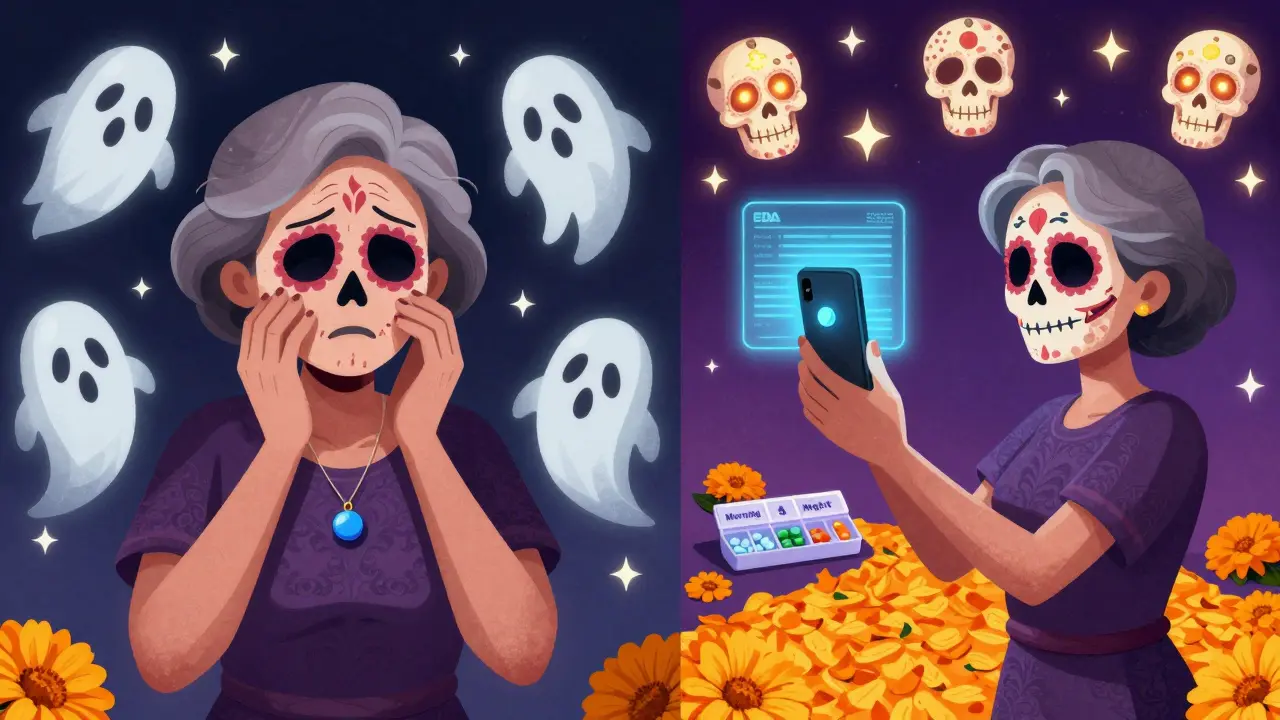
- Take a photo of each pill when you first get it. Store the photos in your phone. Next time it looks different, compare. This one simple habit reduced medication errors by 27% in a Johns Hopkins study.
- Use a pill organizer with labeled compartments (morning, afternoon, night). Even if the pill looks different, you’ll know which slot it goes in.
- Keep a written list of your meds: name, dose, appearance, and why you take it. Update it every time your pill changes.
- Request consistency - ask your insurance or pharmacy if they can stick with the same generic manufacturer. It won’t always work - 78% of pharmacy benefit managers don’t guarantee this - but it’s worth asking.
What If You’re Still Unsure?
Never guess. If you’re not sure whether the pill is right:
- Don’t take it.
- Call your pharmacy.
- Check the FDA’s online database of drug images (you can search by color, shape, and imprint).
- Use a pill identifier app - many are free and work offline.
One Reddit user wrote: “My blood pressure med changed from white oval to blue round. I almost didn’t take it. I thought I was being poisoned.” That’s not paranoia. That’s a real fear - and it’s based on experience.
The Bottom Line
Generic drugs save the U.S. healthcare system billions every year. They’re safe. They work. But their appearance changes are not a bug - they’re a feature of the system. And that feature has real consequences.
You’re not overreacting if you’re confused. You’re not being difficult if you ask questions. You’re being smart. Medication adherence isn’t just about science - it’s about trust, memory, and routine. And when the pill looks different, that trust can crack.
The system is slowly improving. But until then, your best defense is knowledge - and a photo of your pill.
Why do generic pills look different from brand-name ones?
U.S. trademark law prevents generic drugs from looking exactly like brand-name drugs. Even though generics contain the same active ingredient and work the same way, they must have different colors, shapes, or markings to avoid legal issues. This rule was established under the Hatch-Waxman Act of 1984.
Are generic pills less effective because they look different?
No. The FDA requires generic drugs to meet strict standards for bioequivalence - meaning they deliver the same amount of active ingredient into your bloodstream at the same rate as the brand-name drug. Differences in color, shape, or size don’t affect how well the medicine works. What they can affect is whether you take it.
Why do I get different-looking pills even when I refill the same generic?
Many generic drugs are made by multiple manufacturers. Your pharmacy may switch suppliers based on cost, availability, or insurance contracts. Each manufacturer uses its own color, shape, and imprint, so even though the drug is the same, the pill looks different. This happens in over 30% of refills for chronic medications.
Can changing pill appearance cause me to miss doses?
Yes. Studies show that when pill appearance changes, patients are 34% more likely to stop taking their medication. This is especially common among older adults and those taking multiple drugs. One Harvard study found 16.8% of patients discontinued their heart meds after a pill change - compared to 12.5% when the pill stayed the same.
What should I do if my pill looks different?
Don’t assume it’s wrong. Don’t assume it’s right. Call your pharmacy and ask if the manufacturer changed. Take a photo of the new pill and compare it to your old one. Use a pill identifier app or the FDA’s database. If you’re still unsure, don’t take it until you confirm it’s correct.