
Imagine this: you’re at customs in Tokyo, and the officer asks for your medication. You hand over your pills in a pill organizer, no letter, no prescription. Next thing you know, you’re being led to a holding room. This isn’t a movie. It happens to real people every week. In 2022, over 127 travelers were detained just because they didn’t have the right paperwork for their prescription drugs. And the worst part? Most of them weren’t doing anything illegal-they just didn’t know the rules.
Why You Need a Doctor’s Letter for Controlled Substances
Not all medications are treated the same around the world. Things like Adderall, Xanax, oxycodone, or even certain sleep aids are tightly controlled under international drug treaties. These rules exist to stop drug trafficking, but they also trap honest patients who need their meds to function. A doctor’s letter isn’t just a nice-to-have-it’s your legal shield. Without it, you risk having your medication seized, being fined, or worse, detained for days or even weeks.The United Nations established the framework for this back in the 1960s, and today, 186 countries follow these rules. The International Narcotics Control Board (INCB) makes it clear: if you’re carrying opioids, stimulants, benzodiazepines, or other controlled substances, you need proof you’re not smuggling drugs-you’re managing a medical condition.
What a Proper Doctor’s Letter Must Include
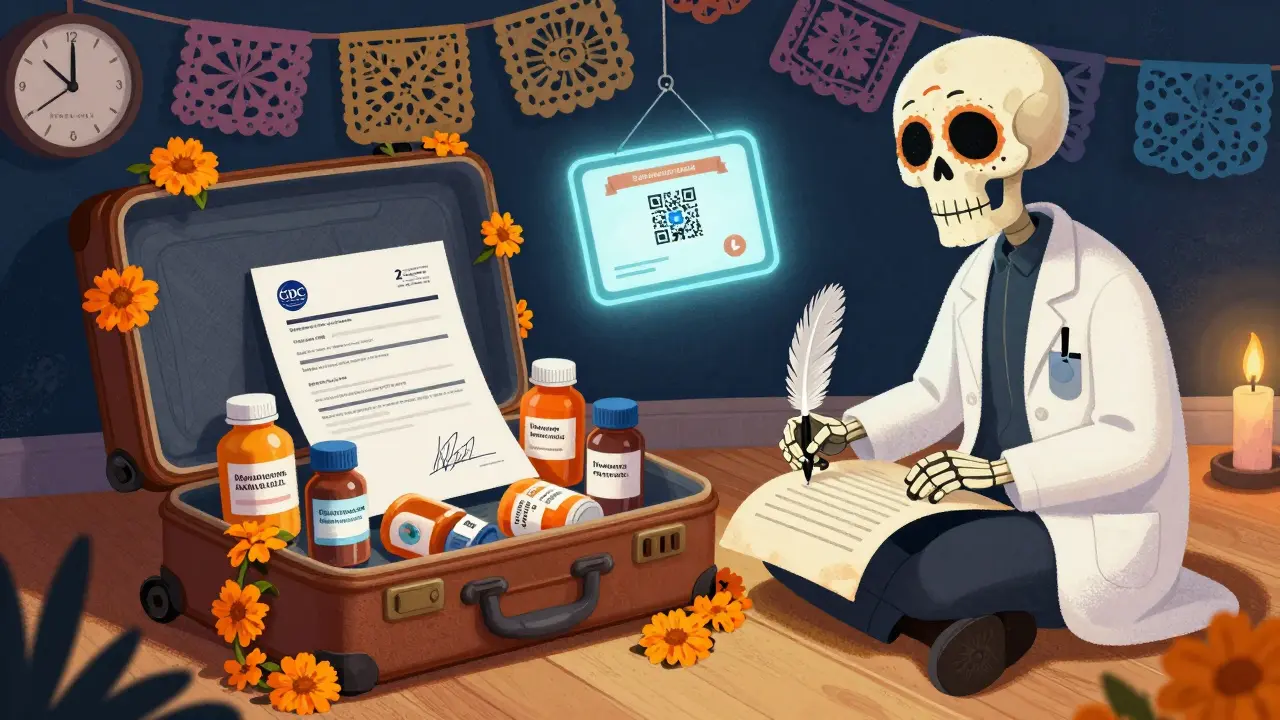
A generic note from your doctor won’t cut it. The letter must meet specific standards set by the CDC and the INCB. Here’s what it needs:- Your full name and date of birth (exactly as it appears on your passport)
- The doctor’s full name, license number, title, clinic address, and phone number
- The generic name of each medication (not the brand name-Adderall becomes amphetamine, Xanax becomes alprazolam)
- Exact dosage, frequency, and route (e.g., 10 mg once daily, oral)
- The medical condition being treated (e.g., ADHD, generalized anxiety disorder, chronic pain)
- A clear statement that the medication is necessary for your health and that you are authorized to carry it
- The doctor’s handwritten signature and official letterhead
The CDC updated its template in January 2023, and it’s free to download. Use it. Don’t improvise. Many doctors don’t know these details matter-72% of patients report their doctors don’t include the chemical names, which is the #1 reason letters get rejected abroad.
Quantity Limits and Packaging Rules
You can’t just pack a six-month supply. Most countries allow a maximum of a 90-day supply for personal use. The FDA and U.S. Customs and Border Protection (CBP) both say: stick to 90 days or less. Some countries, like Singapore and Malaysia, cap it at 30 days-even with a letter. Exceed that, and you’re in serious trouble.Keep your meds in their original, labeled bottles. The label should match the name on your prescription and the doctor’s letter. If you need to transfer pills to a pill organizer for convenience, you must carry the original bottles with you, plus the letter and prescription. CBP has detained travelers who only had organized pills-even with a letter-because the containers didn’t match.
Country-Specific Rules You Can’t Ignore
This isn’t one-size-fits-all. Some countries are lenient. Others are extreme.- Japan: Adderall, Ritalin, and other amphetamine-based ADHD meds are banned outright-even with a letter. You can’t bring them in. If you need treatment, you must find a local doctor and get a local prescription.
- United Arab Emirates: You need advance approval from the Ministry of Health before you even fly. Apply weeks in advance. No exceptions.
- European Union: Most countries accept doctor’s letters from other EU members. You’re usually fine with a 90-day supply and original packaging.
- United States: If you’re returning home, you need both the doctor’s letter and the original prescription. The DEA requires the letter to specifically mention the drug’s schedule (e.g., Schedule II).
- Canada: Accepts doctor’s letters alone for up to 100 dosage units. No prescription needed if the letter is complete.
Don’t rely on Google or travel blogs. 58% of travelers get their info from unreliable sources. Always check with the embassy or consulate of your destination country. Their website is the only trustworthy source.
What Happens If You Don’t Have a Letter?
The consequences are real-and often brutal. In 2022, the INCB reported that 68% of all medication-related travel incidents were caused by missing or incomplete documentation. People have been held for up to 14 days while officials verify their story. In some countries, you could face criminal charges. One traveler in Singapore spent 11 days in jail after carrying 45 days’ worth of oxycodone without a letter. He had a prescription from the U.S.-but no letter from his doctor.Dr. Ghada Wible from UNODC says: “The absence of appropriate medical documentation remains the single largest cause of traveler detention related to medication possession.”
How to Get the Right Letter (Step-by-Step)
Start early. Give yourself at least two months before your trip.- Make a full list of every medication you take-brand name, generic name, dosage, frequency. Use your pharmacy label or app.
- Call your doctor’s office. Ask them to prepare a letter using the CDC’s template. Emphasize: “I need the generic chemical names, not brand names.”
- Confirm they include your full legal name, DOB, condition, and their contact info.
- Ask them to sign it on official letterhead and date it within 30 days of your travel.
- Print two copies. Keep one with your passport. Put the other in your carry-on with your meds.
- Check your destination country’s official government or embassy website for any extra steps.
- If you’re flying into the U.S., bring your original prescription too. The DEA requires it for Schedule II-V drugs.
Special Cases: ADHD, Pain, and Mental Health Meds
If you take stimulants for ADHD, you’re in the highest-risk group. 89% of countries require special documentation for these drugs. The same goes for opioids for chronic pain and benzodiazepines for anxiety or insomnia. These are the most likely to be flagged.Some countries don’t recognize certain diagnoses. For example, ADHD isn’t always accepted as a legitimate medical condition abroad. That’s why the letter must clearly state the diagnosis and link it directly to the medication.
Telehealth prescriptions? They’re accepted now-if the letter comes from a licensed provider and includes all required details. The FDA updated its guidance in May 2023 to confirm this. But again: the letter must still be printed, signed, and include the doctor’s contact info.
What to Do If You’re Denied Entry
If customs refuses your meds:- Stay calm. Don’t argue.
- Ask to speak to a supervisor.
- Call your country’s embassy immediately. They can help, but they can’t override local laws.
- If your meds are confiscated, ask for a written receipt. You may be able to retrieve them later.
Never try to hide medication. That’s a felony in most countries. Even if you’re scared, honesty is your best tool.
Future Changes: Digital Letters Are Coming
The INCB is testing a digital medical certificate for travelers. It’s being piloted in 12 European countries as of mid-2023. The goal: a secure, verifiable digital document linked to your passport. The European Commission is funding a €2.4 million project to roll this out across the EU by late 2024. This will make things easier-but for now, paper is still king.Until then, follow the old rules. Don’t wait for tech to fix this. Your safety depends on what you do today.
Final Checklist Before You Fly
- ✅ Doctor’s letter printed on letterhead, signed, dated
- ✅ All generic names listed (not brand names)
- ✅ Dosage, frequency, and medical condition clearly stated
- ✅ Medications in original bottles with pharmacy labels
- ✅ Prescription copies (if required by destination or U.S. re-entry)
- ✅ 90-day supply or less (30 days for Singapore, Malaysia, etc.)
- ✅ Embassy website checked for country-specific rules
- ✅ Copies of all documents in your carry-on, not checked luggage
Traveling with controlled substances isn’t about breaking rules-it’s about following them. The system is designed to protect you as much as it is to stop traffickers. Do your homework, get the letter, pack right, and you’ll fly through customs without a second glance.
Alfred Schmidt
January 10, 2026 AT 09:45I can't believe people still don't get this. I had my Adderall confiscated in Tokyo last year. They held me for 17 hours. No lawyer, no call, just a cold room and a guard who looked like he'd seen this a thousand times. I had a prescription. I didn't have the letter. That's it. That's the whole story. And now? I carry two printed copies. Always. No excuses. Ever again.
Sean Feng
January 11, 2026 AT 13:53Priscilla Kraft
January 13, 2026 AT 03:33This is so important. I'm a nurse and I've helped three friends navigate this mess. One almost got arrested in Dubai because she thought her bottle label was enough. 😔 Please, if you're on anything controlled-ADD, anxiety, pain-don't wing it. Print the letter. Use the CDC template. Keep the original bottles. It's not that hard. And if your doctor says 'I don't do that,' find a new one. Your freedom is worth it. 💪
Vincent Clarizio
January 13, 2026 AT 10:23Let’s not pretend this is just about paperwork. This is about the global carceral state weaponizing medical necessity. The UN framework? It was built in the 1960s by men who thought addiction was a moral failing, not a neurobiological condition. And now? We’re forcing people with ADHD, PTSD, chronic pain-real, legitimate, invisible illnesses-to beg for mercy from customs agents who’ve never read a DSM-5. The letter isn’t protection. It’s a performance. A humiliating ritual where you prove your suffering is ‘legitimate’ enough to be tolerated. And if you’re lucky, you get your pills back. If you’re not? You’re labeled a smuggler. A criminal. A threat. All because the world still can’t separate medicine from menace. This isn’t regulation. It’s institutionalized stigma dressed up as policy. And until we change that? We’re all just one pill organizer away from being broken by bureaucracy.
Sam Davies
January 14, 2026 AT 23:16So let me get this straight-you're telling me I need a signed, stamped, chemically precise letter just to bring my Xanax to Bali? And the guy who flies with a kilo of cocaine in his sock? He's got a 'medical condition' too, right? 😏
Look, I get it. But this feels like overkill for the 99% who aren't trafficking. The real problem? People who think 'I'm just a patient' makes them immune to laws they didn't bother to learn. Maybe the real solution isn't more paperwork-it's not being an idiot in the first place.
Christian Basel
January 16, 2026 AT 04:04From a pharmacovigilance standpoint, the INCB’s adherence to the Single Convention on Narcotic Drugs (1961) and the Convention on Psychotropic Substances (1971) remains the only legally coherent framework for transnational pharmaceutical regulation. The absence of harmonized e-prescribing infrastructure across signatory states creates systemic compliance friction, particularly for Schedule II-V agents. The CDC’s 2023 template is a stopgap, not a solution. What’s needed is an ICD-11-integrated, blockchain-verified digital medical passport with biometric authentication tied to WHO-recognized prescriber credentials. Until then, we’re just paper-pushing through a pre-digital regulatory graveyard.
Alex Smith
January 17, 2026 AT 13:31Okay, so you’re telling me I can’t bring my 30-day supply of oxycodone to Singapore? Cool. Got it. But let’s be real-how many people actually get caught? And how many of those were just dumb? I’m not saying don’t follow the rules-I’m saying if you’re going to fly with anything that could get you locked up, maybe don’t be the person who thinks ‘I’ll figure it out when I land.’ That’s not bravery. That’s just bad planning. And if your doctor won’t write the letter? That’s not their fault. That’s yours for not asking clearly. This isn’t rocket science. It’s just… responsibility.
Roshan Joy
January 19, 2026 AT 11:13This is gold. I'm from India and I travel often for work. I carry my dad's pain meds with me-he has spinal stenosis. Last year, I almost got stopped in Thailand because I didn't know about the generic name rule. I had the bottle, but the letter said 'OxyContin'-not oxycodone. They let me go after 45 minutes of questions, but I was shaking. Since then, I use the CDC template. I even print a QR code on the back with the doctor's contact info. Small thing. Big difference. 🙏
Adewumi Gbotemi
January 19, 2026 AT 21:03My cousin was stopped in Germany with her antidepressants. She had the bottle and a note from her doctor, but no letter. They made her wait for three days. She cried. She didn't know what to do. Now she always prints two copies. I told her: 'If your medicine keeps you alive, then the paper is just as important.' We think we're safe because we're not criminals. But the world doesn't care about our intentions. Only our proof.