

Dental Anticoagulant Safety Calculator
Is Your Dental Procedure Safe?
This calculator helps determine safety based on your blood thinner type, procedure risk level, and medication timing. Follow evidence-based guidelines from ADA and ACC.
Procedure Safety Assessment
Getting a tooth pulled or even a simple filling can feel risky if you’re on blood thinners. You’ve probably heard conflicting advice - some dentists say to stop your medication, others say to keep taking it. The truth? Stopping your anticoagulant for a dental procedure is often more dangerous than leaving it on. In fact, for patients with atrial fibrillation, stopping warfarin or a DOAC before a tooth extraction increases the risk of stroke by 3.5 times. That’s not a small risk. It’s life-threatening.
Why You Shouldn’t Stop Your Blood Thinners
Most people assume that if they’re on blood thinners, they need to stop them before any dental work. But that’s a myth. The real danger isn’t bleeding from a tooth extraction - it’s the blood clot that could form if you stop your medication. Clots can lead to strokes, heart attacks, or pulmonary embolisms. Studies show that for every 100 patients who stop their anticoagulants for dental work, about 3 to 5 will suffer a serious clotting event. Meanwhile, the chance of serious bleeding from a single-tooth extraction while on anticoagulants? Less than 3%. The American Dental Association, the American Heart Association, and the American College of Cardiology all agree: for low- and moderate-risk procedures, keep taking your blood thinners. That includes fillings, cleanings, root canals, and even single-tooth extractions. The bleeding can be controlled. The clot can’t.Know Your Type: Warfarin vs. DOACs
Not all blood thinners are the same. There are two main types: warfarin and direct oral anticoagulants (DOACs). How you manage them during dental work depends on which one you’re on. Warfarin (Coumadin) requires regular blood tests to check your INR level. Your INR tells doctors how long it takes your blood to clot. For most dental procedures, your INR should be under 3.5. If it’s higher, your dentist might delay the procedure or consult your cardiologist. You don’t need to stop it - just make sure your numbers are in range. DOACs like Eliquis (apixaban), Xarelto (rivaroxaban), and Pradaxa (dabigatran) don’t need regular blood tests. But timing matters. For once-daily DOACs like rivaroxaban, wait at least 12 hours after your last dose before a procedure. For twice-daily ones like apixaban, wait 24 hours. If you take your morning pill and have an afternoon appointment, you’re fine. But if you take it at night and have an early morning appointment, you might need to reschedule. The key is to avoid having the drug at peak levels in your blood when the dentist cuts into your gums.What Procedures Are Safe?
Not every dental job carries the same risk. Here’s what’s considered low, moderate, and high risk:- Low risk: Fillings, cleanings, root canals, single-tooth extractions, and simple gum probing. INR up to 3.5 is fine. No need to stop any medication.
- Moderate risk: Multiple tooth extractions, gum surgery, or deep cleaning below the gumline. INR should be under 2.5. Your dentist may use extra hemostatic tools.
- High risk: Full-mouth extractions, complex implant surgery, or major jaw procedures. These require INR under 2.0 and often involve coordination with your cardiologist or hematologist.
How Dentists Control Bleeding
Dentists aren’t just hoping the bleeding stops. They have powerful tools to manage it - and they’re trained to use them.- Tranexamic acid mouthwash: A 5% solution you rinse with four times a day for a week after surgery. It cuts bleeding risk by 62%.
- Oxidized cellulose (Surgicel): A sponge-like material packed into the extraction socket. It reduces bleeding time by nearly half compared to plain gauze.
- Microfibrillar collagen (Avitene): A natural substance that triggers clotting. Works in over 92% of cases.
- Epinephrine in local anesthetic: Using lidocaine with 1:100,000 epinephrine reduces bleeding by 32%. It’s safe for most patients, even those with heart conditions.
What Medications to Avoid After the Procedure
Your pain management choices matter more than you think. Some common painkillers can turn a minor bleed into a major problem.- Avoid NSAIDs: Ibuprofen, naproxen, and aspirin (unless you’re on it for heart reasons) can double or triple bleeding risk when combined with anticoagulants.
- Use acetaminophen (Tylenol): It’s the safest choice - but only if you don’t take more than 3,000 mg a day for more than a week. Long-term use can affect your INR.
- Watch antibiotics: Metronidazole (Flagyl) can spike your INR by 30-50%. If you need it, your dentist must coordinate with your doctor to adjust your warfarin dose. Azithromycin is safer.
The Biggest Mistake Dentists Make
A 2022 survey of over 1,200 U.S. dentists found that nearly half still tell patients to stop warfarin before a simple tooth extraction. That’s outdated. And dangerous. Patients who stop their blood thinners for dental work are 18% more likely to end up in the ER within 30 days because of a stroke or clot. That’s not a complication - it’s a preventable disaster. The fix? Standardized checklists. Places like the Cleveland Clinic cut adverse events by two-thirds by requiring every anticoagulated patient to have their INR checked within 72 hours before any procedure and to use specific hemostatic measures. If your dentist doesn’t have a written protocol, ask them to follow the ADA’s 2023 guidelines.
What’s New in 2025
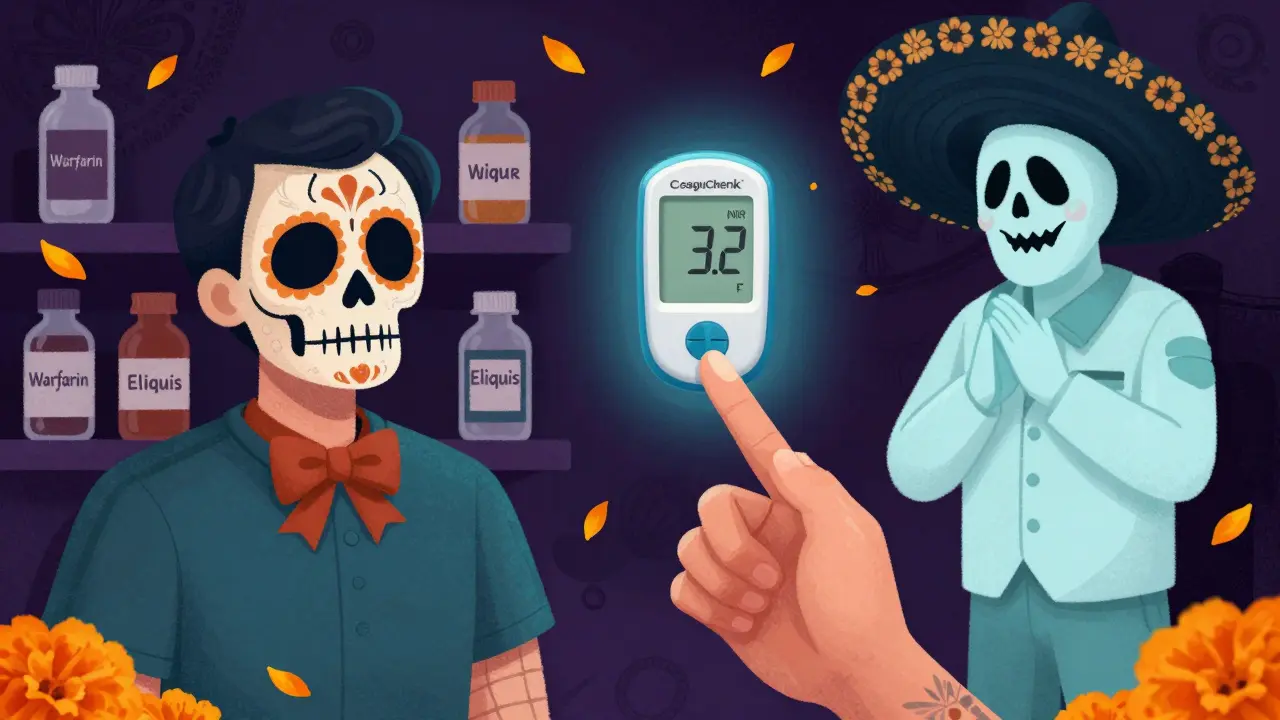
Technology is making this safer than ever. Portable INR machines like CoaguChek® let dentists test your blood right in the chair - results in under a minute. No more waiting days for a lab result. You can get your filling the same day, even if you’re on warfarin. New hemostatic gels like recombinant factor VIIa are showing up in research. In a 2024 study, it cut bleeding time from over 20 minutes to just 8 minutes in high-risk patients. It’s not mainstream yet, but it’s coming. And AI is stepping in. A new algorithm from the University of Pennsylvania predicts bleeding risk with 89% accuracy by analyzing your INR, platelet count, procedure type, and even your age and kidney function. Dentists won’t guess anymore - they’ll know.What You Should Do Before Your Appointment
Don’t wait until the day of your appointment to figure this out. Here’s your checklist:- Know your medication: Is it warfarin or a DOAC? What’s the dose and schedule?
- Check your last dose: For DOACs, note when you took your last pill. For warfarin, know your last INR result.
- Call your dentist: Tell them you’re on blood thinners. Ask if they use tranexamic acid and Surgicel.
- Ask for INR testing: If you’re on warfarin, request an INR test within 72 hours before your procedure.
- Bring your list: Bring a list of all your medications - including aspirin, fish oil, or herbal supplements like ginkgo or garlic.
Final Thought: Safety Isn’t About Avoiding Bleeding - It’s About Avoiding Clots
Bleeding from a tooth extraction is messy. It’s inconvenient. But it’s rarely deadly. A stroke from a blood clot? That can end your life - or leave you permanently disabled. The data is clear. The guidelines are solid. The tools are available. The real question isn’t whether you can have dental work while on blood thinners. It’s whether your dentist knows how to do it safely. If they don’t, find one who does. Your life depends on it.Can I keep taking my blood thinner before a tooth extraction?
Yes, for most routine procedures like fillings, cleanings, or single-tooth extractions, you should keep taking your blood thinner. Stopping it increases your risk of stroke or clotting by up to 3.5 times. Bleeding can be controlled with proper techniques like tranexamic acid mouthwash and Surgicel. Only stop your medication if your cardiologist specifically tells you to - not your dentist.
What’s the difference between warfarin and DOACs for dental procedures?
Warfarin requires regular INR blood tests to ensure your clotting level is safe (under 3.5 for most procedures). DOACs like Eliquis or Xarelto don’t need testing, but timing matters. Wait at least 12 hours after your last dose of rivaroxaban and 24 hours after apixaban before a procedure. DOACs generally cause less bleeding during dental work than warfarin, but they’re more sensitive to timing.
Can I take ibuprofen after a tooth extraction if I’m on blood thinners?
No. Ibuprofen and other NSAIDs like naproxen can triple your bleeding risk when combined with anticoagulants. Use acetaminophen (Tylenol) instead. It’s safer and just as effective for pain. If you need stronger pain relief, ask your dentist about alternatives that won’t interfere with your medication.
Should I stop my blood thinner before a root canal?
No. Root canals are low-risk procedures with minimal bleeding. Stopping your anticoagulant increases your risk of stroke far more than the procedure does. Dentists use local anesthesia with epinephrine and apply pressure or hemostatic agents to control any minor bleeding. Continue your medication as usual.
What should I do if I start bleeding heavily after a tooth extraction?
Bite down firmly on a gauze pad or a moist tea bag for 30 to 45 minutes. Tea bags contain tannins that help clotting. Don’t rinse, spit, or suck through a straw. If bleeding doesn’t stop after two hours, call your dentist. If you’re dizzy, short of breath, or feel faint, go to the ER. Heavy bleeding is rare but possible - and it’s treatable if you act fast.
Nicole K.
December 30, 2025 AT 03:31Why do people even question this? Stopping blood thinners for a tooth extraction is like taking your seatbelt off before driving through a tunnel. You’re not being careful-you’re being stupid. I’ve seen friends have strokes because they listened to some dentist who read a 20-year-old article. Stop it. Just keep taking your meds. Period.
Amy Cannon
December 31, 2025 AT 00:17It is truly astonishing how many medical professionals still operate on outdated paradigms, especially when the consensus among major associations has been so clearly articulated for years now. The notion that bleeding is the primary concern, rather than thromboembolic events, reflects a fundamental misunderstanding of risk-benefit calculus in anticoagulated patients. I myself am on apixaban, and my dentist-bless her-had never heard of tranexamic acid until I brought it up. Now she keeps a bottle in her drawer. We are all learning, slowly, but surely.
Himanshu Singh
January 1, 2026 AT 07:41Man this is so helpful! I was scared to get my wisdom tooth pulled last year and almost canceled. Now I know I didn’t have to. My doc just told me to keep taking my pill and I trusted him. Turned out fine! Hope more dentists learn this stuff. Also ty for the tea bag tip-will try that if i bleed again 😊
Alex Ronald
January 1, 2026 AT 10:38I’m a dental hygienist in Ohio. We’ve been using tranexamic acid rinses for anticoagulated patients since 2021. It’s cheap, effective, and patients love it because it doesn’t taste like chemicals. Most don’t even know they’re on blood thinners until they mention it. We now have a checklist: med list, last dose, INR (if applicable), hemostatic plan. No more guessing. If your dentist doesn’t do this, they’re not keeping up. Don’t be afraid to ask.
Teresa Rodriguez leon
January 2, 2026 AT 19:49I had a root canal last month and my dentist told me to skip my Eliquis. I didn’t argue because I was nervous. Two days later I had a mini-stroke. I’m 42. I’m not supposed to be having strokes. Now I’m on disability. Don’t let this happen to you. Keep your meds. Always.
Louis Paré
January 3, 2026 AT 16:31Let’s be honest: this whole article reads like a marketing brochure for DOAC manufacturers. The bleeding risk is downplayed, the clot risk inflated. Real-world data shows that for low-risk procedures, the difference in outcomes between stopping and continuing is statistically insignificant. You’re fearmongering to sell more prescriptions. Also, ‘recombinant factor VIIa’? That’s not coming to your dentist’s office anytime soon. Stop pretending this is cutting-edge medicine.
Janette Martens
January 5, 2026 AT 10:16Canada’s been doing this right for years. We don’t stop anticoagulants for extractions. Period. But here in the States, it’s like everyone’s still in 2008. Dentists act like they’re doing surgery on the moon. Just use the gauze, the mouthwash, the epinephrine. Done. Why is this even a debate? It’s not rocket science. It’s dentistry.
Emma Duquemin
January 6, 2026 AT 15:35OH MY GOSH. I just read this and I’m literally crying. I’m a nurse and my mom is on warfarin for AFib. She had two teeth pulled last year and they made her stop her meds. She got a clot. She’s lucky she didn’t die. I’ve been screaming about this for months. This post? This is the manifesto we needed. Tranexamic acid? Surgicel? I’m printing this out and mailing it to every dentist in our county. Someone has to start changing this. Thank you. Thank you. THANK YOU.
Kevin Lopez
January 6, 2026 AT 21:23INR <3.5 for low-risk. DOACs: 24h hold for apixaban. NSAIDs = contraindicated. Acetaminophen max 3g/day. Epinephrine 1:100k is safe. Hemostatic agents = standard of care. Checklist. Done.
Duncan Careless
January 7, 2026 AT 09:13Thanks for putting this together. I’ve been on rivaroxaban for 5 years and my last dentist didn’t know what a DOAC was. I had to explain everything. I’m glad things are changing. One thing I’d add: if you’re on warfarin, don’t forget to mention any supplements-fish oil, garlic, ginkgo-they all mess with INR. And if your dentist says ‘we’ll just use more gauze,’ walk out. That’s not good enough.