
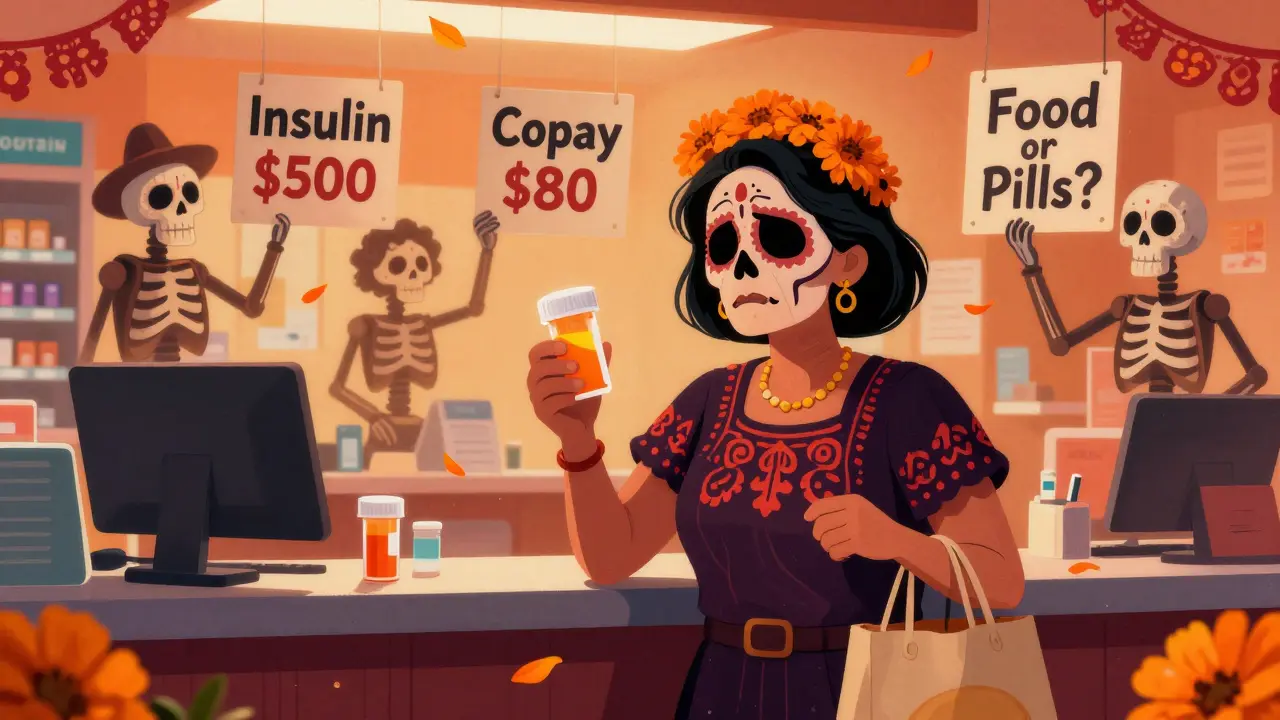
Every year, medication adherence becomes harder for millions of Americans-not because they don’t understand their treatment, but because they can’t afford it. You might be taking pills for high blood pressure, diabetes, or cholesterol, but if your copay jumps from $10 to $80, you’ll skip doses, split pills, or skip refills entirely. This isn’t just inconvenient-it’s life-threatening. Around 125,000 Americans die each year because they couldn’t afford their meds, according to the American Heart Association. And it’s not just the uninsured. Even people with Medicare or private insurance are skipping doses because their out-of-pocket costs are too high.
Why Cost Stops People From Taking Their Medicine
It’s simple: when you have to choose between medicine and groceries, you often choose groceries. In 2021, the CDC found that 8.2% of adults under 65 didn’t take their prescriptions as directed because of cost. That’s nearly 1 in 12 people. For those with chronic conditions like heart disease or diabetes, this isn’t a one-time mistake-it’s a daily struggle.
High copays, coinsurance, and deductibles are the main culprits. A 2023 study in the American Journal of Managed Care showed that when a medication’s copay went above $50, adherence dropped by 15-20% compared to $10 copays. That’s not a small difference-it’s the difference between staying healthy and ending up in the hospital.
Even with insurance, many people face tiered formularies. A drug might be covered, but if it’s on a higher tier, you pay more. Insulin, for example, can cost $500 a month even with insurance. One Reddit user shared they paid $800 monthly for insulin, despite having coverage. That’s not an outlier. A 62-year-old Medicare beneficiary told Kaiser Health News she pays $350 a month for her meds after Part D coverage, forcing her to pick between prescriptions and food.
Cost-related nonadherence is especially common among low-income households. The CDC found non-adherence rates are 3.2 times higher for people making under $25,000 a year compared to those making over $75,000. Women, younger adults, and non-white patients are more likely to cut pills or delay refills. It’s not laziness. It’s survival.
What Happens When You Skip Doses
Skipping a pill might seem harmless. But for someone with hypertension, missing even one dose can spike blood pressure. For diabetics, inconsistent insulin use can lead to dangerous highs or lows, nerve damage, or amputations. A 2022 analysis of 71 studies found that 84% showed a direct link between higher out-of-pocket costs and worse adherence. The more you pay, the less likely you are to take your medicine.
And it doesn’t stop at personal health. Non-adherence costs the U.S. healthcare system between $100 billion and $300 billion every year. That’s money spent on emergency room visits, hospitalizations, and complications that could’ve been avoided. The American Medical Association calls cost the #1 barrier to adherence-more than forgetfulness, side effects, or confusion.
How to Get Help: Real Solutions That Work
You don’t have to choose between medicine and rent. There are real, proven ways to cut costs and stay on track.
- Ask your doctor about formulary drugs. The AMA recommends asking, “Is this drug on my insurance’s list?” Many doctors don’t check this before prescribing. If your medication isn’t covered, they can switch you to a cheaper, equally effective alternative. Generic versions of brand-name drugs often work just as well-for a fraction of the price.
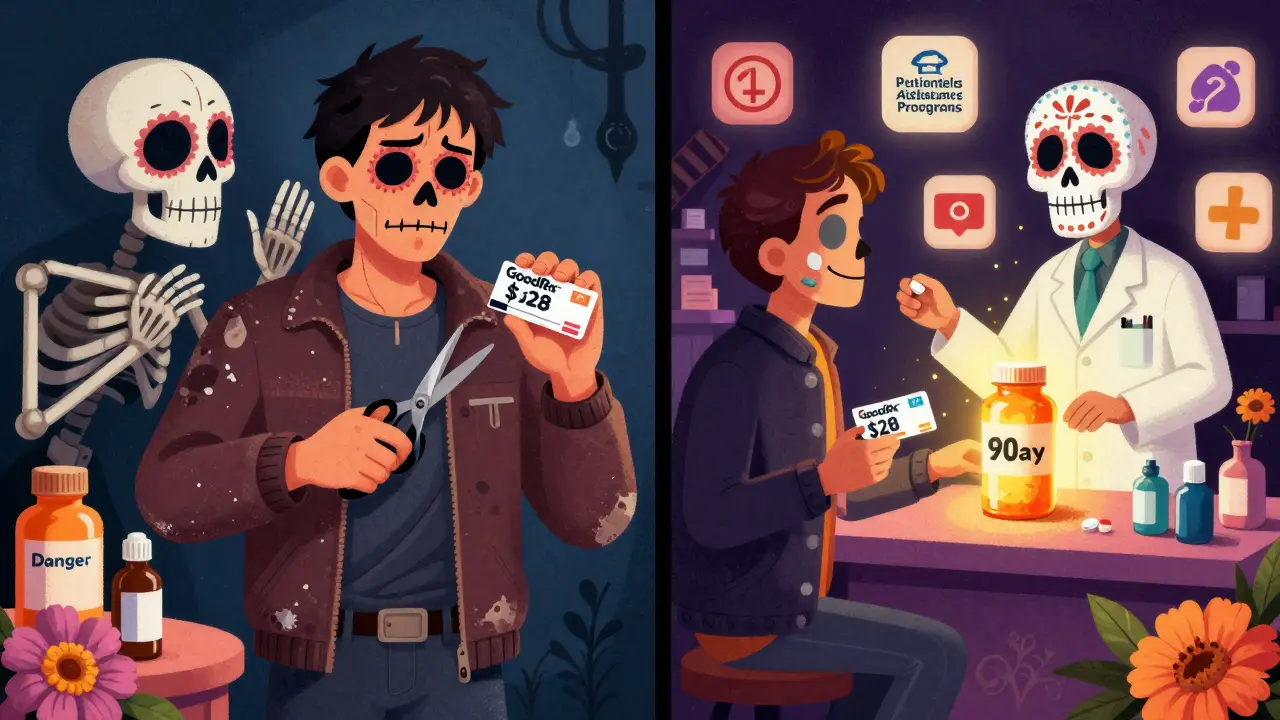
- Use GoodRx or SingleCare. These free apps compare prices at nearby pharmacies. In 2023, 35 million Americans used them to save 50-80% on prescriptions. One man paid $412 for his blood thinner at his local pharmacy. With GoodRx, he paid $28. That’s a 93% drop.
- Ask for 90-day supplies. Many insurers charge the same copay for a 30-day or 90-day supply. Getting three months’ worth at once cuts your per-pill cost by 20-30%. It also means fewer trips to the pharmacy.
- Apply for patient assistance programs. Pharmaceutical companies offer free or low-cost meds to people who qualify. In 2022, these programs helped 1.8 million Americans. Eligibility is often based on income below 400% of the federal poverty level-that’s $55,520 for a single person in 2023. Programs like Patient Services Inc. and the Partnership for Prescription Assistance can guide you through applications.
- Check if you qualify for Medicare Extra Help. If you’re on Medicare and have limited income, this program can cover up to $5,000 in annual drug costs. It’s automatic for those on Medicaid, but others must apply. The process is simple: visit SSA.gov/extra-help.
- Request samples. About 32% of patients who worry about cost ask their doctor for free samples. It’s not a handout-it’s a bridge until you find a long-term solution.
New Rules Coming in 2025
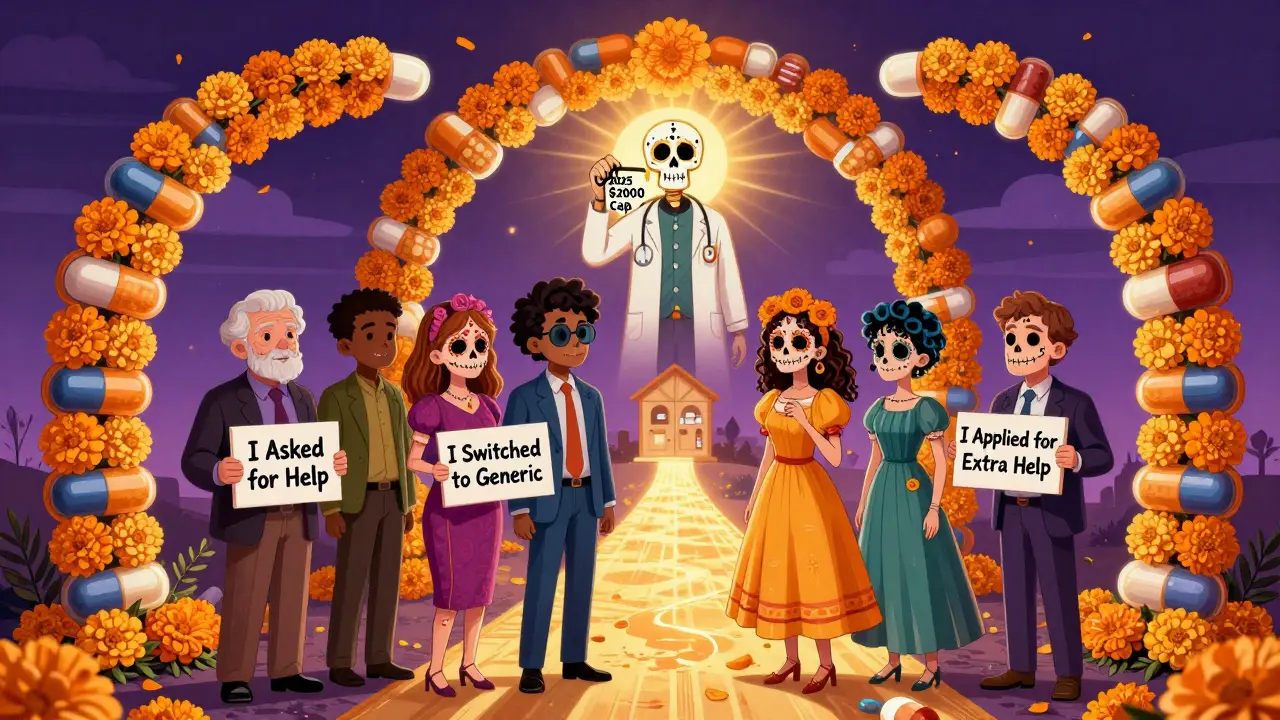
The Inflation Reduction Act is changing how seniors pay for drugs. Starting in 2024, the Medicare Part D “donut hole” is gone. In 2025, your out-of-pocket drug spending will be capped at $2,000 a year-no matter how expensive your meds are. You’ll also be able to pay for high-cost drugs in monthly installments instead of one big bill.
These changes won’t fix everything. They don’t help people under 65 or those without Medicare. But for older adults, it’s a major win. Still, experts warn: without broader pricing reforms, 1 in 5 Americans will keep skipping doses because they can’t afford their meds.
What You Can Do Right Now
If you’re struggling to afford your meds, don’t wait until you’re sick. Talk to your pharmacist. Ask your doctor. Use a price-comparison app. Apply for help. These aren’t last-resort options-they’re everyday tools.
One diabetes patient in Texas went from paying $500 a month for insulin to $25 after enrolling in a manufacturer’s program. Her adherence jumped from 60% to 95%. That’s not luck-it’s action.
Medication adherence isn’t about willpower. It’s about access. And if you’re paying too much, you’re not alone. Help exists. You just have to ask for it.
Why do I still pay so much for my meds even though I have insurance?
Insurance doesn’t mean free. Most plans have deductibles, copays, and coinsurance. If your drug is on a higher tier, you pay more. Some plans don’t cover certain brands at all. Even with coverage, your out-of-pocket cost could be $50, $100, or more per month-especially for newer or specialty drugs like insulin or biologics.
Can I get help if I make too much to qualify for Medicaid?
Yes. Many pharmaceutical patient assistance programs accept people with incomes up to 400% of the federal poverty level-$55,520 for a single person in 2023. You don’t need Medicaid. You just need to prove your income. Programs like Patient Services Inc. and NeedyMeds can help you apply.
Is it safe to split pills to make them last longer?
Sometimes, but not always. Pills designed to release medicine slowly (extended-release) shouldn’t be split. Some pills are coated or shaped so splitting changes how they work. Always ask your pharmacist before splitting any pill. If you’re considering it, talk to your doctor about switching to a lower-dose pill instead.
Do generic drugs work as well as brand-name ones?
Yes. The FDA requires generics to have the same active ingredient, strength, dosage form, and route of administration as the brand-name drug. They’re tested to be equally effective and safe. The only differences are inactive ingredients like fillers or colorants-which don’t affect how the drug works. Generics can cost 80-85% less.
How do I know if a patient assistance program is legitimate?
Stick to trusted sources: the drug manufacturer’s official website, Patient Services Inc. (PSI), the Partnership for Prescription Assistance (PPA), or NeedyMeds. Avoid websites that ask for credit card info upfront or charge application fees. Legit programs are free to apply for and won’t pressure you for payment.
Will using GoodRx affect my insurance coverage?
No. GoodRx is a discount card, not insurance. When you use it, you pay the discounted price instead of your insurance copay. It doesn’t count toward your deductible or out-of-pocket maximum. But if the GoodRx price is lower than your insurance copay, it’s still worth using-it saves you money right away.
Next Steps: What to Do Today
- Check your last prescription receipt. Was the price higher than expected? That’s your signal to act.
- Open the GoodRx or SingleCare app. Search for your medication. Compare prices at three nearby pharmacies.
- Call your doctor’s office and ask: “Is there a cheaper alternative on my insurance plan?”
- Visit NeedyMeds.org or PSI.org. Enter your drug name and income. See what programs you qualify for.
- If you’re on Medicare, go to SSA.gov/extra-help. Apply for Extra Help-it takes less than 10 minutes.
Your health isn’t a luxury. You deserve to take your medicine without choosing between it and your rent, food, or gas. Help is out there. You just have to ask.
Sneha Mahapatra
February 27, 2026 AT 18:01It breaks my heart that people have to choose between medicine and food. 🥺 I think about my grandmother in Kolkata who rationed her hypertension pills like they were gold-because she had no choice. We talk about systems and policies, but real people are just trying to survive day to day. This isn’t a political issue. It’s a human one.
Maybe if we stopped calling it ‘nonadherence’ and started calling it ‘economic violence,’ we’d finally listen.
❤️
bill cook
February 28, 2026 AT 01:40So let me get this straight-you’re saying people should just ask their doctor for cheaper meds? Like, what, they’re gonna magically wave a wand and make insulin $20? My cousin’s on SGLT2 inhibitors and pays $400/month even with insurance. You think she’s gonna get a ‘better option’? Nah. They don’t wanna fix this. They wanna keep raking in cash.
And don’t even get me started on GoodRx. That’s just a band-aid on a hemorrhage.
Katherine Farmer
March 1, 2026 AT 07:23Let’s be honest-the real issue isn’t affordability, it’s systemic incompetence. The U.S. pharmaceutical supply chain is a Rube Goldberg machine designed to maximize profit while minimizing accountability. Tiered formularies? Copay accumulator traps? Donut holes? These aren’t accidents-they’re features.
And don’t get me started on the ‘patient assistance programs.’ They’re bureaucratic labyrinths with 17-page applications and mandatory income verification. It’s like asking a starving person to fill out a tax return before you hand them bread.
Also, generics? Sure, they’re bioequivalent. But let’s not pretend that the excipients don’t affect absorption in 15% of the population. You’re not a pharmacist, so you don’t know that.
Ajay Krishna
March 2, 2026 AT 06:01Hey, I’m from India and we’ve got our own struggles with meds-but I’ve seen how this hits people in the U.S. too. I work with a nonprofit that helps low-income folks here, and I can tell you: the tools you listed? They work. A lot of people just don’t know where to start.
One woman I helped was paying $600 for her diabetes meds. We got her into a manufacturer program-now she pays $15. She cried. Not because she was grateful. Because she realized she didn’t have to suffer like this.
You’re not alone. And help isn’t magic. It’s just hidden.
Peace.
Noah Cline
March 3, 2026 AT 11:00Cost-related nonadherence is a well-documented phenomenon with a robust literature base. The economic elasticity of pharmaceutical demand is highly inelastic for chronic conditions, yet the marginal utility of expenditure on medication is inversely proportional to income quintile. In other words: when you’re at the bottom of the socioeconomic ladder, every dollar spent on meds is a dollar taken from calories.
Moreover, the current Medicare Part D cap, while a step forward, fails to address the structural asymmetry between drug manufacturers and PBMs. Until we regulate the latter, we’re just rearranging deck chairs on the Titanic.
Brandon Vasquez
March 4, 2026 AT 06:43I’ve been a nurse for 18 years. I’ve seen people skip insulin because they had to choose between that and their kid’s school lunch.
It’s not about willpower. It’s about survival.
Use GoodRx. Ask your doctor. Call Patient Services Inc. These aren’t fancy tricks. They’re lifelines.
You don’t need to be brave. You just need to ask.
Jimmy Quilty
March 5, 2026 AT 15:04GoodRx? Yeah right. That’s just Big Pharma’s way of making you think they care while they keep hiking prices. And those ‘patient assistance programs’? They’re a trap. They make you jump through hoops so they can say ‘we tried.’ Meanwhile, the CEOs are sipping champagne in Bermuda.
And don’t even mention Medicare. That’s just a Ponzi scheme for seniors. I heard a guy on YouTube who said the real reason insulin is so expensive is because the government secretly controls the patents through a shadow consortium. I don’t know if it’s true… but it makes sense.
Also, why do all the ads say ‘ask your doctor’? What if your doctor works for the pharma company? 🤔
Miranda Anderson
March 6, 2026 AT 21:33I read this whole thing and just sat there for like 10 minutes thinking about how absurd it is that in a country with so much wealth, people are dying because they can’t afford a pill.
I work in a pharmacy. I’ve had people cry in the aisle because their copay was $120 and they only had $80 in their account. One lady asked me if she could just take half the pill and stretch it to two days. I didn’t know what to say. I just handed her a tissue.
And then I went home and cried too.
It’s not just about money. It’s about dignity. And we’ve taken that away from so many people.
I wish I had better answers. But I don’t. I just know we’re failing.
Gigi Valdez
March 7, 2026 AT 02:47The data presented is accurate and aligns with peer-reviewed literature on pharmaceutical access disparities. The proposed interventions are evidence-based and clinically endorsed. However, implementation remains hindered by structural inequities in healthcare delivery systems and provider education gaps. A systemic overhaul is required, not merely individual-level solutions.
Recommendation: Advocate for policy reform at the state level to mandate transparency in PBM pricing and eliminate tiered formularies for essential medications.
Brandie Bradshaw
March 8, 2026 AT 18:04Let’s not sugarcoat this: the pharmaceutical industry is a predatory, profit-driven monster that preys on the sick, the elderly, and the poor. They don’t care if you live or die-they care if you pay. And they’ve rigged the system so that even with insurance, you’re still being gouged.
GoodRx? It’s a gimmick. A distraction. A Band-Aid on a severed artery.
And don’t you dare tell me to ‘ask my doctor’-most doctors are incentivized to prescribe the most expensive drugs because of kickbacks disguised as ‘consulting fees.’
It’s time to nationalize drug pricing. Break the patents. Let generics flood the market. And hold CEOs accountable-not with fines, but with prison sentences.
This isn’t healthcare. It’s a blood sport.
Sophia Rafiq
March 9, 2026 AT 06:29Just wanted to say I used GoodRx for my asthma inhaler and saved $180. It’s not perfect, but it’s something.
Also, 90-day supplies? Game changer. Less trips, less stress, less chance I’ll forget.
And yeah, generics work. I’ve been on generic lisinopril for 5 years. No issues. My BP is better than when I was on the brand.
Don’t let anyone tell you otherwise. You’ve got options. Just dig a little.
Martin Halpin
March 10, 2026 AT 11:44Oh wow, so we’re just supposed to ‘ask for help’? Like this is a charity bake sale and not a systemic collapse of public health? I’ve applied for 3 patient assistance programs. Two took 8 weeks. One denied me because I made $500 over the cutoff-even though I’m single, live in a studio apartment, and work two jobs.
And GoodRx? I tried it. The pharmacy said ‘we don’t accept that here.’ So I drove 12 miles. They said ‘we don’t take it for controlled substances.’
It’s not that I’m not trying. It’s that the system is designed to make you fail.
Also, why do all these ‘solutions’ assume you have a phone, internet, transportation, and the mental energy to navigate bureaucracy after working 12-hour shifts? It’s insulting.
Eimear Gilroy
March 10, 2026 AT 16:30I’m from Ireland and we have free healthcare, but even here, some meds are still expensive. I’m curious-how do people in the U.S. even know about these programs? Is it just luck? Or do hospitals train staff to explain them? I feel like this info should be handed out with prescriptions, not buried in a 10,000-word Reddit post.
Also, what about undocumented immigrants? Are they just left behind? I think we need a universal solution-not 17 different apps and websites.
Charity Hanson
March 12, 2026 AT 00:20Y’all need to stop waiting for permission to get help. I’ve helped 17 people in my community get on assistance programs. All they had to do was call one number. One call. That’s it.
I’m not a doctor. I’m not a lawyer. I’m just a girl who saw her neighbor crying over her insulin bill and said ‘I got you.’
You don’t need to be brave. You just need to pick up the phone.
And if you’re reading this and you’re scared? I’m right here. DM me. I’ll walk you through it.
You matter. Your life matters. Don’t let them make you feel like a burden.