
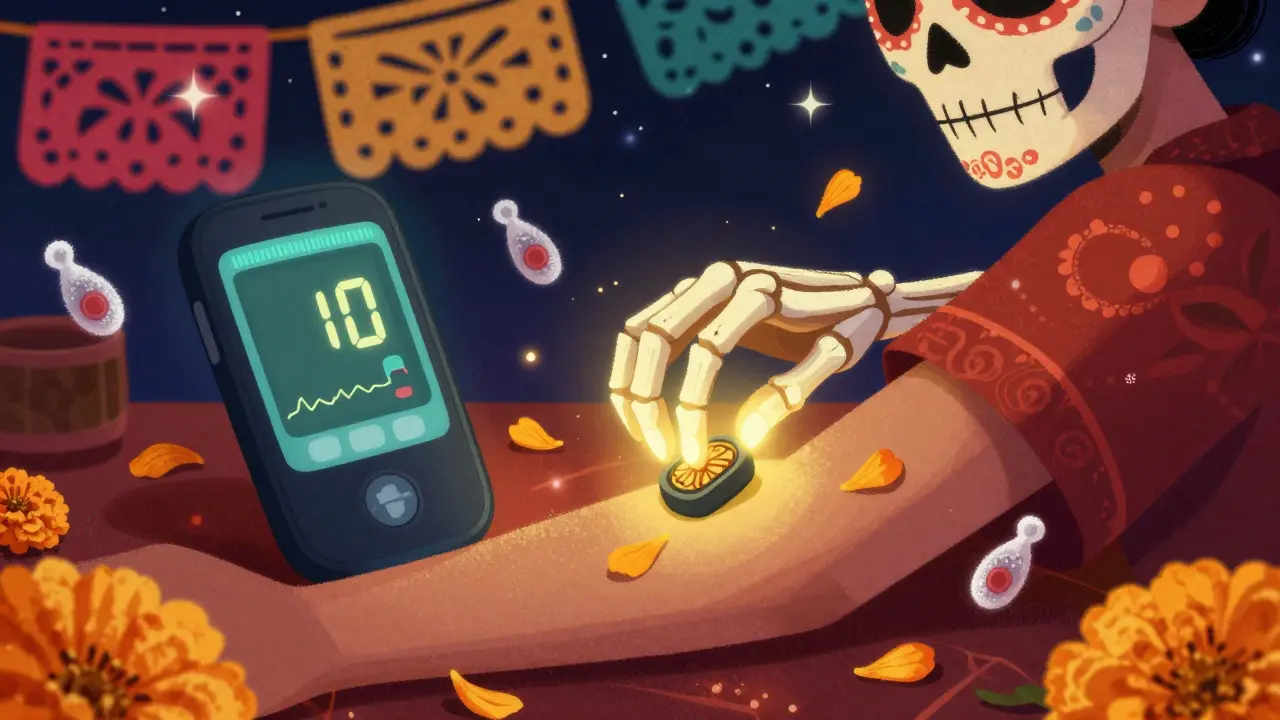
For people managing diabetes, checking blood sugar with a fingerstick can feel like a constant chore - mornings, meals, bedtime, and sometimes in the middle of the night. But what if you could see your glucose levels move in real time, not just as a single number, but as a story? That’s what continuous glucose monitors (CGMs) do. They don’t replace fingersticks entirely, but they give you a full picture of how your body responds to food, stress, sleep, and activity - day and night.
How Does a CGM Actually Work?
A CGM isn’t a magic box. It’s a small sensor, about the size of a coin, inserted just under your skin - usually on your belly or upper arm. Inside that sensor is a tiny filament coated with an enzyme that reacts with glucose in your interstitial fluid, the liquid surrounding your cells. When glucose interacts with that enzyme, it creates a tiny electric signal. That signal gets converted into a glucose reading.
That reading gets sent wirelessly every 1 to 5 minutes to your phone or a small receiver. Modern devices like the Dexcom G7 and FreeStyle Libre 3 don’t need you to scan them manually. They push updates automatically. The Libre 3 sends data every minute; the Dexcom G7 every five. And unlike older models, you don’t need to calibrate them with fingersticks anymore - they’re factory-calibrated and ready to go.
But here’s the catch: CGMs don’t measure blood sugar directly. They measure glucose in the fluid between your cells. That means there’s a delay - usually 5 to 20 minutes - between what’s happening in your blood and what the CGM shows. If your sugar drops fast during a run or spikes after a meal, the CGM might lag behind. That’s why you’re still told to check with a fingerstick if you feel symptoms but the CGM doesn’t match.
Who Actually Benefits from a CGM?
If you have type 1 diabetes, a CGM isn’t just helpful - it’s become standard care. The American Diabetes Association recommends them for everyone with type 1, no exceptions. Why? Because they cut severe low-blood-sugar events by 31%, according to a major 2022 study of 32 clinical trials. For parents of kids with type 1, nighttime alerts are life-changing. One user on Reddit said, “My Libre 3 alarm saved me from a 32 mg/dL hypo at 3 AM last week - I’d have been dead without it.”
People with type 2 diabetes who use insulin multiple times a day also benefit. Studies show CGMs help lower A1C by 0.5% to 0.8% - a meaningful drop that reduces long-term complications. Even if you’re not on insulin, if your blood sugar swings wildly or you’re struggling to understand how food affects you, a CGM can reveal patterns no fingerstick ever could.
And it’s not just diabetics anymore. More non-diabetic people are using CGMs to optimize energy, sleep, and metabolism. Companies like Zoe Health report an 18% annual increase in wellness users. Some athletes use them to time fueling during training. Others track how alcohol or stress spikes their sugar. While insurance won’t cover CGMs for this use yet, out-of-pocket costs are dropping.
CGM Brands Compared: Dexcom G7 vs. FreeStyle Libre 3 vs. Eversense E3
Not all CGMs are the same. Three systems dominate the market, each with different strengths.
| Feature | Dexcom G7 | FreeStyle Libre 3 | Eversense E3 |
|---|---|---|---|
| Measurement Frequency | Every 5 minutes | Every minute | Every 5 minutes |
| Sensor Life | 10 days | 14 days | 180 days |
| Calibration | Factory-calibrated | Factory-calibrated | Factory-calibrated |
| Alerts | Customizable highs/lows, predictive alerts | Highs/lows, but no predictive alerts | Customizable, includes vibration alerts |
| Cost (monthly, no insurance) | $399 | $110 | $1,200 (includes implant procedure) |
| Insertion Method | Manual, adhesive | Manual, adhesive | Surgical implant |
| MARD Accuracy | 9.1% | 7.9% | 8.5% |
The Dexcom G7 is the most advanced in terms of alerts and integration with insulin pumps. It’s pricier but gives you early warnings before a low hits. The FreeStyle Libre 3 is the most affordable and easiest to use - no scanning needed, just wear and go. It’s the top pick for most people who want simplicity and value. The Eversense E3 is for those who hate changing sensors every two weeks. It’s implanted under the skin and lasts six months. But you need a doctor to put it in and take it out.

What You’ll See on Your Screen - And What It Really Means
It’s not just the number that matters. The real power of a CGM is in the trend arrow. A single glucose reading of 110 mg/dL could mean you’re stable, rising fast, or dropping fast. That arrow tells you the direction and speed of change.
Dr. Anne Peters, a leading diabetes expert, says, “The trend arrow showing how quickly glucose levels are changing is arguably more important than the current number itself.” If you see your sugar dropping at a rate of -3 mg/dL per minute, you know to grab a snack - even if your number is still in the normal range. If it’s rising sharply after a meal, you might adjust your insulin or take a walk.
Most apps also show daily and weekly trends. You might notice your sugar spikes every time you eat rice, or dips after evening walks. Over time, you start to predict your body’s reactions. That’s when CGMs stop being a tool and become a conversation partner with your health.
Common Problems and How to Fix Them
CGMs are reliable, but they’re not perfect. The most common complaints? Skin irritation, false alarms, and sensor failure.
Adhesive problems happen, especially with the Dexcom G6. Many users swear by Skin Tac wipes or Opsite Flexifix tape to keep sensors stuck. If your sensor falls off early, it’s usually not the device - it’s the skin prep.
False alarms are another issue. Some users report alarms during exercise, when the lag causes a mismatch between real blood sugar and the CGM reading. If you’re active and get frequent false lows, check your fingerstick before treating. Also, avoid acetaminophen (Tylenol) while using CGMs - it can interfere with readings on most devices.
Bluetooth interference is rare but real. If your Dexcom G7 stops connecting, try restarting your phone or moving away from other wireless devices. Most issues resolve within a few days as you learn how your body and device interact.

Cost, Insurance, and Access
Cost is the biggest barrier. Without insurance, Dexcom G7 runs about $400 a month. FreeStyle Libre 3 is half that. Eversense E3 costs more upfront but lasts longer. Insurance coverage varies wildly.
In the U.S., Medicare covers CGMs for insulin users - but only certain models. Private insurers are catching up, but many still require proof of insulin use or frequent hypoglycemia. The FreeStyle Libre 3 is now covered by Medicare for both type 1 and type 2 diabetes patients on insulin, thanks to updated guidelines in 2023.
In the UK, the NHS gives FreeStyle Libre 2 to over half a million people for free. In Canada and Australia, coverage is improving but still inconsistent. If you’re uninsured, look into manufacturer savings programs. Abbott and Dexcom both offer discount cards that can bring monthly costs down to $30-$75.
What’s Next for CGMs?
The next wave of CGMs is already here. Dexcom’s G7 has a 30-minute warm-up - down from two hours for older models. FreeStyle Libre 3 Plus now tracks insulin doses right in the app. And in 2024, Tandem’s Control-IQ 3.0 will start predicting lows 30 minutes before they happen, adjusting insulin automatically.
Non-invasive CGMs are coming too. Glucowise, a device that uses radio waves to read glucose through the skin, completed Phase 2 trials in 2023. Apple is rumored to be developing a glucose-sensing smartwatch. If it works, it could bring CGM tech to millions who’ve never considered diabetes monitoring.
Long-term, CGMs are shifting from reactive tools to proactive health guardians. A 2023 study in the New England Journal of Medicine found that CGM users had 24% fewer hospital visits for diabetes-related emergencies. That’s not just better numbers - it’s better life.
Can I use a CGM if I don’t have diabetes?
Yes, but insurance won’t cover it. Many non-diabetic people use CGMs to track how food, sleep, and stress affect their energy and metabolism. Athletes, biohackers, and people with prediabetes use them to make smarter lifestyle choices. However, interpreting the data without medical guidance can lead to unnecessary anxiety. If you’re considering it for wellness, talk to a dietitian or doctor first.
Do I still need to check my blood sugar with a fingerstick?
You still need a fingerstick in certain situations: if your CGM reading doesn’t match how you feel (like dizziness or shaking), if you’re experiencing rapid glucose changes (during exercise or illness), or if your CGM alerts you to a very low or very high reading. Fingersticks are the gold standard for accuracy - CGMs are best for trends.
How long does it take to learn how to use a CGM?
Most people get comfortable in 3 to 5 days. The biggest learning curve is understanding the trend arrows and the 5-20 minute lag. Don’t panic if your first readings seem confusing. Manufacturer apps like Dexcom Clarity and LibreView have built-in tutorials. Join online communities like r/CGM on Reddit - real users share tips that no manual can.
Are CGMs accurate during exercise?
CGMs can lag during intense activity because blood flow changes how glucose moves from blood to interstitial fluid. You might see a drop during a run that isn’t real, or a rise after a workout that’s delayed. That’s why it’s smart to check with a fingerstick before treating a low during or right after exercise. Most users adapt by learning their personal patterns - for example, knowing their sugar usually drops 15 minutes after stopping a bike ride.
Can I swim or shower with a CGM?
Yes. All modern CGMs are water-resistant and safe for showers, swimming, and sweating. Dexcom G7 and FreeStyle Libre 3 are rated for up to 1 meter of water for 30 minutes. Eversense E3 is fully implantable, so it’s waterproof indefinitely. Just avoid hot tubs or saunas for long periods - extreme heat can affect sensor accuracy.
Final Thoughts
A CGM isn’t just a gadget - it’s a way to take control. It turns guesswork into insight. It helps you sleep better, eat smarter, and avoid dangerous lows. For people with diabetes, it’s one of the most powerful tools in modern medicine. For others, it’s a window into how their body truly responds to daily life. The technology is here. The question isn’t whether you need one - it’s whether you’re ready to see what it can show you.
Vinayak Naik
January 7, 2026 AT 03:15Man, I got my Libre 3 last month and it’s like having a tiny doctor in my pocket. Used to freak out during meetings when I’d feel shaky but didn’t wanna pull out a lancet. Now I see the arrow drop before I even feel it. Life changed. Also, side note: don’t sleep with your phone under your pillow if you’re on a 3am alert. My cat thought I was having a seizure.
Saylor Frye
January 7, 2026 AT 18:06It’s amusing how the wellness bros have turned a medical device into a biohacking accessory. You’re not ‘optimizing metabolism’-you’re just paying $100/month to stare at numbers you don’t understand. Next you’ll be tracking your cortisol with an Apple Watch and calling it ‘spiritual alignment.’
Jeane Hendrix
January 9, 2026 AT 05:54I’ve been using Dexcom G7 for 8 months now and the predictive alerts are game-changing-but I’ve noticed the MARD accuracy varies wildly depending on hydration levels. I’ve seen 12% error when dehydrated vs 7% when I drink 3L of water daily. Also, the adhesive fails more on my upper arm than my abdomen-anyone else experience this? I’m thinking of trying Skin Tac but worried about residue. Any tips?
Tom Swinton
January 11, 2026 AT 04:50Okay, I just want to say-this is the most important health tech breakthrough since insulin. I mean, think about it: for centuries, people with diabetes lived in the dark, guessing, fearing, panicking. Now? You see your body’s story unfold in real time. You learn that your ‘healthy’ oatmeal spikes you like a donut. You realize your 3am wake-ups aren’t stress-they’re a slow glucose crash. You start treating your body like a finely tuned engine, not a broken machine. And yes, the cost is insane, but when your kid doesn’t go to the ER because you caught the drop early? Priceless. I cried the first time my CGM saved me. I still do.
Kiran Plaha
January 12, 2026 AT 01:44My uncle in India uses Libre 3. He says it’s cheaper than buying sugar-free snacks every day. He checks it while drinking chai. He says his sugar goes up after samosas, not rice. Funny how we think tech is fancy but it just helps us listen to our own bodies.
Amy Le
January 12, 2026 AT 22:06CGMs are just another Silicon Valley scam. America turns medical devices into status symbols. Meanwhile, people in other countries die because they can’t afford insulin. You’re not ‘biohacking’-you’re performing wellness capitalism. 🤡
Pavan Vora
January 13, 2026 AT 07:18My cousin in Mumbai got a CGM after his sugar went to 420-he didn’t even know he was diabetic. Now he tracks his sugar like a cricket scorecard. He says, ‘If I eat biryani, I walk 20 minutes after.’ Simple. No apps. No alarms. Just his body and a little discipline. Technology helps, but wisdom? That’s free.
Indra Triawan
January 15, 2026 AT 01:14I just feel so sad that we’ve turned our bodies into data points. We used to listen to hunger, to fatigue, to instinct. Now we’re all staring at screens, terrified of a number. What happened to trusting ourselves? I’m not even diabetic and I’m already anxious just reading this.
Susan Arlene
January 16, 2026 AT 11:49My CGM showed I spike after avocado toast. So I stopped eating it. Then I realized I just don’t like avocado toast. Maybe the device didn’t change my health… maybe it just helped me quit something I didn’t enjoy. 🤷♀️
Joann Absi
January 18, 2026 AT 09:24OMG I just found out my sugar spikes when I watch Netflix after 10pm. I thought it was stress but no-it’s the blue light + carbs + emotional eating. I’m deleting my Netflix account. This is a spiritual awakening. 🌙💔 #CGMLife #NoMoreMidnightBinging
Mukesh Pareek
January 18, 2026 AT 11:20Let’s be real: if you’re not using Dexcom G7 with predictive alerts and integrated pump therapy, you’re not doing it right. Libre 3 is for hobbyists. Eversense? Too expensive for the average person who doesn’t understand glycemic variability. You need real-time insulin titration, not just trend arrows. This isn’t a wellness fad-it’s clinical-grade data. If you’re not optimizing your insulin-to-carb ratios with CGM trends, you’re just gambling with your pancreas.
Gabrielle Panchev
January 20, 2026 AT 09:11Wait-so you’re telling me that a device that measures glucose in interstitial fluid, which lags behind blood glucose by 5-20 minutes, and has a MARD of 7-9%, is somehow more accurate than a fingerstick? And that’s why we’re replacing gold-standard testing with… this? And now people are using it to ‘optimize their energy’? What happened to basic nutrition and exercise? We’ve outsourced common sense to a sensor. And we call this progress. I’m not even diabetic, and I’m terrified.