

Colchicine-Macrolide Safety Checker
This tool helps you determine if your macrolide antibiotic is safe to take with colchicine. Based on the latest medical evidence, only azithromycin is safe when taking colchicine.
⚠️ Important: Colchicine has a very narrow safety margin. Even small increases in blood levels can cause life-threatening toxicity when combined with certain macrolides.
Select an antibiotic to check safety
Colchicine is one of the oldest drugs still in use today-dating back to ancient Egypt for treating swelling and pain. Today, it’s a go-to for gout flares, pericarditis, and even heart attack recovery. But here’s the catch: if you’re taking colchicine and your doctor prescribes a common antibiotic like clarithromycin or erythromycin, you could be walking into a silent, deadly trap.
Why This Interaction Isn’t Just a Warning-It’s a Red Flag
Colchicine doesn’t just sit in your bloodstream. It’s actively pushed out of your cells by a transporter called P-glycoprotein (P-gp) and broken down by an enzyme called CYP3A4 in your liver and gut. Both of these systems act like safety valves to keep colchicine levels from climbing too high. But when you add a macrolide antibiotic like clarithromycin, those valves shut down. Clarithromycin doesn’t just inhibit CYP3A4-it also blocks P-gp. That means colchicine can’t be cleared properly. It builds up. And because colchicine has a razor-thin safety margin, even a small increase can trigger toxicity. A plasma level above 3.3 ng/mL in someone with kidney problems can cause organ failure. In healthy people, levels above 2.5 ng/mL are already considered risky. The FDA issued a black box warning in 2010 for this exact reason. That’s the strongest warning they give. It’s not a footnote. It’s not a suggestion. It’s a legal requirement for prescribers to acknowledge the risk.Not All Macrolides Are Created Equal
It’s easy to assume all macrolides behave the same. They’re all antibiotics with a similar ring structure, after all. But that’s where the danger lies-in assuming similarity means equal risk. Clarithromycin is the worst offender. It’s a potent dual inhibitor of both CYP3A4 and P-gp. Studies show it can raise colchicine levels by up to four times. In real-world data from the FDA’s adverse event database, 63% of colchicine toxicity cases linked to macrolides involved clarithromycin. Erythromycin is less dangerous, but still risky. It’s a moderate CYP3A4 inhibitor with weaker P-gp blocking. It’s not safe, but it’s not as bad as clarithromycin. Then there’s azithromycin. It barely touches CYP3A4. It doesn’t inhibit P-gp at all. In a 2022 study of over 12,000 patients, azithromycin showed no increased risk of colchicine toxicity. Zero. That’s not a coincidence. That’s a clinical lifeline. If you need an antibiotic while on colchicine, azithromycin is your only safe choice among macrolides. Everything else? Avoid it.What Happens When Toxicity Strikes
Colchicine toxicity doesn’t sneak up slowly. It hits fast-and hard. Symptoms usually appear within 24 to 72 hours after starting the combination. First, you’ll see nausea, vomiting, diarrhea. Easy to dismiss as a stomach bug. But then comes the real danger: muscle pain, weakness, dark urine-signs of rhabdomyolysis, where muscle tissue breaks down and floods your kidneys with toxins. Next, your blood counts crash. Neutropenia. Thrombocytopenia. Pancytopenia. Your body can’t fight infection. Can’t stop bleeding. Can’t carry oxygen. In severe cases, multi-organ failure follows. The 2019 case series in the Journal of Clinical Pharmacy and Therapeutics documented 12 patients who developed this cascade after taking colchicine with clarithromycin. Three died. And it’s not just hospitalized patients. Emergency room doctors report seeing these cases more often than you’d think. A 2023 survey of 245 physicians found 68% had treated at least one patient with this interaction. Emergency medicine physicians saw it nearly twice as often as rheumatologists.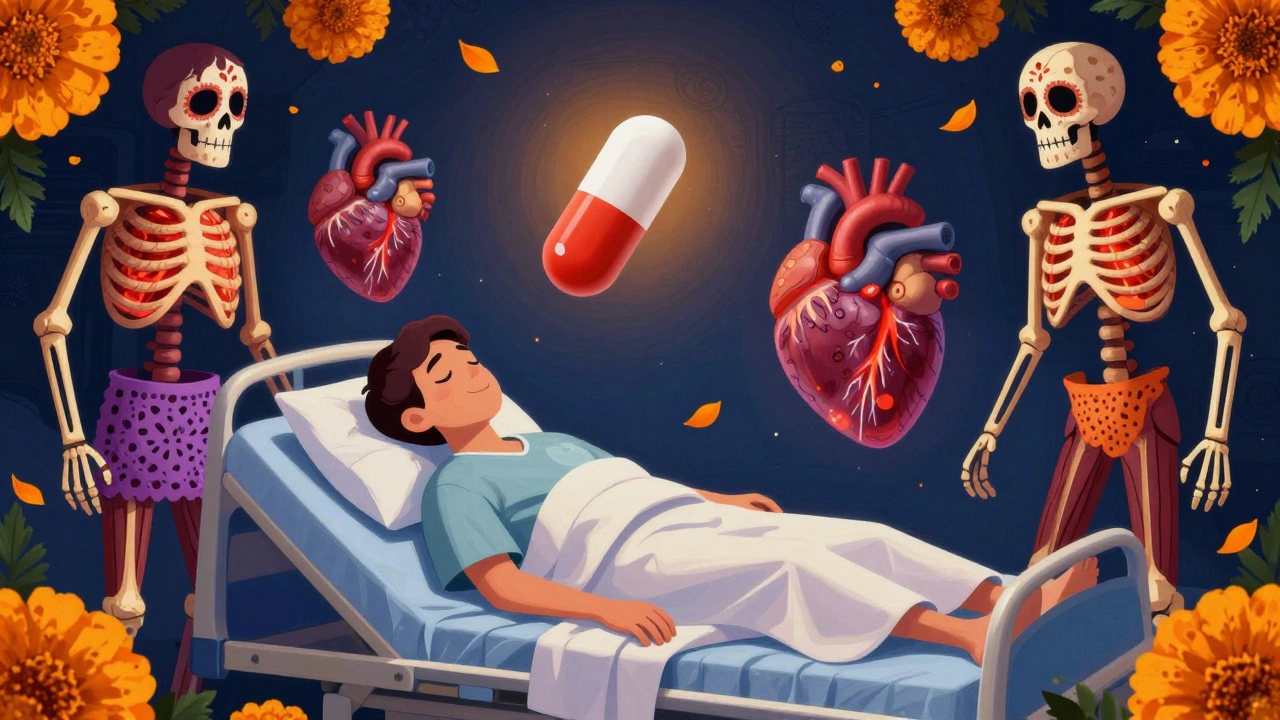
Why Do Doctors Keep Getting This Wrong?
You’d think with a black box warning and decades of evidence, this wouldn’t happen anymore. But it does. Part of the problem is electronic health records. Most systems still don’t flag this interaction properly. Some only warn about strong CYP3A4 inhibitors and miss the P-gp component. Others don’t distinguish between macrolides-so if a patient is on colchicine, the system might warn against all macrolides, leading to unnecessary avoidance of azithromycin, which is safe. Another issue? Patients don’t tell their doctors about over-the-counter supplements. St. John’s wort, grapefruit juice, even some turmeric extracts can inhibit CYP3A4. Combine those with colchicine and a macrolide? You’ve got a perfect storm. A 2021 study found 43% of internal medicine residents couldn’t identify high-risk combinations on a test. After a 30-minute training module, that jumped to 87%. The problem isn’t ignorance-it’s lack of awareness and poor decision support.What Should You Do If You’re on Colchicine?
If you’re taking colchicine for gout, pericarditis, or heart disease, here’s what you need to know:- Avoid clarithromycin and erythromycin at all costs. Even a single dose can be dangerous.
- Azithromycin is your safe alternative. It’s just as effective for most infections and doesn’t interfere with colchicine.
- If you’re prescribed a macrolide, ask: Is this clarithromycin or erythromycin? If yes, ask for azithromycin instead.
- Check all your other meds. Verapamil, diltiazem, ketoconazole, itraconazole, and even some statins like simvastatin can also interact. Don’t assume antibiotics are the only risk.
- Know your kidney function. Colchicine toxicity is far more likely if your eGFR is below 60 mL/min. Your doctor should check this before prescribing.
Lynn Steiner
December 2, 2025 AT 09:27My uncle died from this. They gave him clarithromycin for a 'bad cough' while he was on colchicine for gout. He was 68, healthy otherwise. Three days later, he was in the ICU with rhabdo and kidney failure. No one warned him. No one warned the ER doc. Now I scream at every pharmacist I see. 😭
Alicia Marks
December 3, 2025 AT 18:36You’re not alone. This is why we need better alerts. Azithromycin is the answer. Simple. Safe. Effective. 💪
Paul Keller
December 3, 2025 AT 18:49It’s profoundly troubling that a drug with such a well-documented, lethal interaction remains under-flagged in EHR systems across the United States. The fact that 68% of emergency physicians have encountered this scenario suggests a systemic failure in clinical decision support infrastructure. Moreover, the assumption that all macrolides are pharmacologically equivalent is not merely a lapse in knowledge-it’s a structural flaw in medical education. Azithromycin’s lack of CYP3A4 or P-gp inhibition is not an accident of chemistry; it’s a therapeutic opportunity that has been tragically underutilized. We must demand better from our vendors, our regulators, and our teaching hospitals.
Jay Everett
December 5, 2025 AT 07:47Bro, this is the kind of post that makes me love Reddit. 🙌 Colchicine is basically a ninja-quiet, ancient, deadly if you mess with it. And clarithromycin? That’s the clown who walks in wearing a red suit and juggling grenades. Azithromycin? The chill guy in the hoodie who just nods and passes the salt. 🌿💊
And honestly? The fact that Takeda’s building COL-098 is like the universe finally saying, ‘Okay, we’re fixing this.’ Genetic testing for CYP3A5 and ABCB1? That’s next-level precision medicine. Soon, your pharmacist might know your DNA better than your ex. 😎
Rebecca M.
December 7, 2025 AT 07:02Oh wow, another ‘you’re all idiots’ lecture from a doctor who probably thinks grapefruit juice is a conspiracy. 🙄 I’m sure the 43% of residents who failed the test just didn’t try hard enough. Meanwhile, my 72-year-old mom got this combo because her doctor ‘didn’t think it mattered.’ Guess what? She’s fine. Maybe the real danger is overhyping things for clicks?
Roger Leiton
December 8, 2025 AT 03:21Wait, so azithromycin is safe? 🤯 That’s wild. I’ve been avoiding all antibiotics for years because I’m on colchicine. Now I’m gonna ask for it every time. Also, St. John’s wort? I take that for anxiety. Should I stop? 🤔
Laura Baur
December 9, 2025 AT 04:59It is not merely concerning, but morally indefensible, that the medical establishment continues to permit the conflation of macrolide pharmacokinetics under the reductive umbrella of ‘antibiotic class.’ The cognitive laziness inherent in this practice-particularly among clinicians who rely on EHR alerts without understanding the underlying molecular mechanisms-is symptomatic of a broader erosion of pharmacological literacy in modern medicine. One cannot substitute algorithmic warnings for genuine comprehension. The fact that 78% of toxicity cases are genetically predictable renders the current reactive paradigm not just inadequate, but negligent. We are not merely failing patients-we are failing the scientific method itself. The introduction of COL-098 is a necessary evolution, yet it remains a Band-Aid on a hemorrhage. The solution lies not in new drugs, but in the rigorous, non-negotiable re-education of prescribers. This is not a suggestion. It is an imperative.
Jack Dao
December 11, 2025 AT 04:51People who take colchicine are either gout sufferers or elderly heart patients. Both groups are already too old to be taking risky meds. If you can’t manage your diet or your meds, maybe you shouldn’t be on life-saving drugs at all. Azithromycin? Sure, but why not just avoid the whole mess? Stop being lazy. 😒