

Carbamazepine Dose Adjustment Calculator
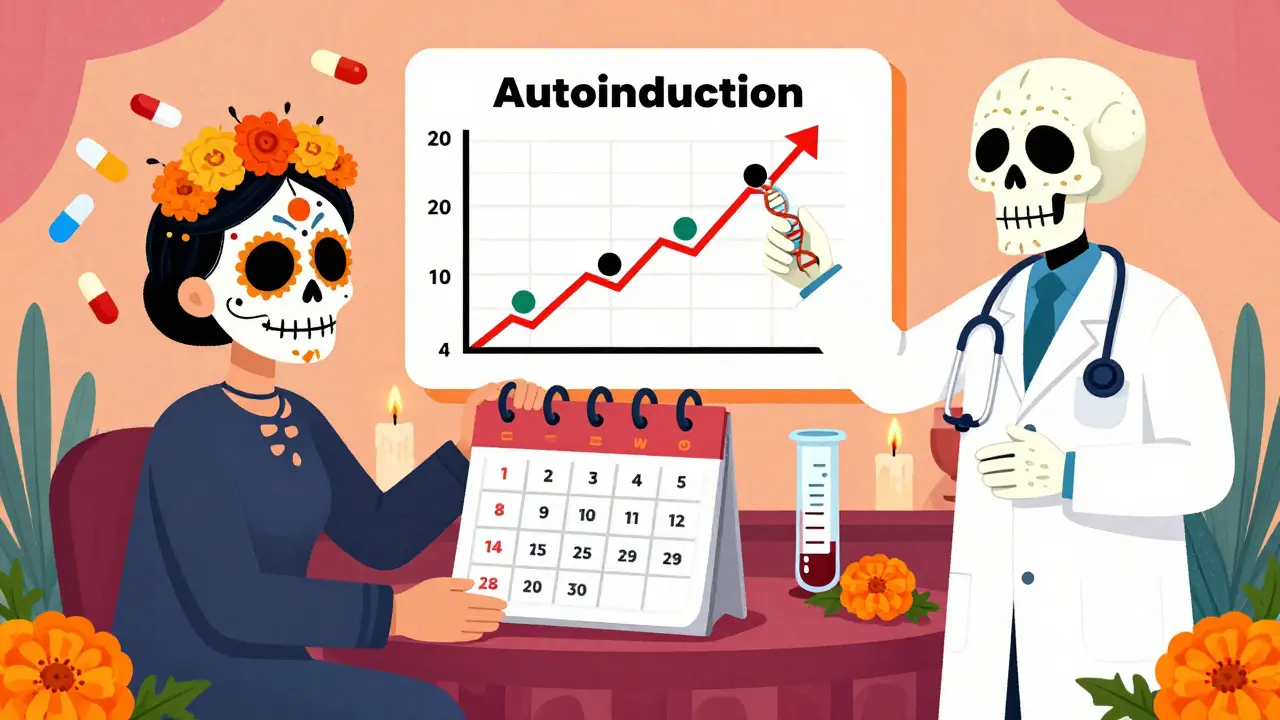
Carbamazepine induces its own metabolism (autoinduction). After 3-4 weeks, blood levels drop 30-50%, requiring dose increases. This calculator estimates the adjustment needed based on medical literature.
Carbamazepine isn't just another seizure medication. If you're taking it, or prescribing it, you need to understand one hard truth: carbamazepine doesn't just affect your brain-it rewires how your body handles almost every other drug you're on. This isn't theoretical. It's happening right now in clinics across the U.S., and it's causing real harm when ignored.
What Makes Carbamazepine So Dangerous With Other Drugs?
Carbamazepine triggers your liver to crank up production of enzymes called CYP3A4 and CYP2B6. These are the same enzymes that break down more than half of all prescription drugs. When carbamazepine turns them on full blast, those drugs get cleared out of your system too fast. That means they stop working.
It’s not just about speed. Carbamazepine also speeds up its own breakdown. This is called autoinduction. Within three to four weeks of starting the drug, your body is metabolizing it 30-50% faster. That’s why patients often have breakthrough seizures or mood crashes during the first month-even if they’re taking the same dose they started with. Their blood levels drop, but many doctors don’t check them.
Which Medications Are Most Affected?
Here’s what happens when carbamazepine teams up with common drugs:
- Birth control pills: Ethinyl estradiol levels can drop by 50-70%. Unplanned pregnancies aren’t rare-clinics see this too often. Even high-dose pills aren’t always safe.
- Warfarin: Carbamazepine reduces warfarin levels, making blood thinner less effective. INR can crash, increasing stroke risk. Dose increases of 50-100% are sometimes needed.
- Antidepressants (SSRIs, SNRIs): Drugs like sertraline and venlafaxine get cleared faster. Patients report their depression returning or worsening, not because the disease changed, but because the drug stopped working.
- Immunosuppressants (cyclosporine, tacrolimus): Organ transplant patients on carbamazepine have seen rejection episodes because their drug levels dropped below the protective range.
- Statins (simvastatin, atorvastatin): Cholesterol control fails. Simvastatin’s effectiveness drops by 74% in studies. Patients end up with heart attacks they didn’t need.
- Benzodiazepines (alprazolam, diazepam): When carbamazepine is stopped, these drugs can suddenly become too strong. One case report described a patient falling into a coma after carbamazepine was discontinued and alprazolam wasn’t lowered.
Why Is This So Hard to Predict?
Not everyone responds the same way. Some people’s livers react strongly to carbamazepine. Others barely react. Why? Because the drug activates nuclear receptors-PXR and CAR-that vary genetically between people. Two patients on identical doses can have wildly different enzyme levels.
Even the best computer models get it wrong up to 30% of the time. That’s because we don’t fully understand how each person’s genes control these receptors. The European Medicines Agency and FDA both recognize carbamazepine as a strong CYP3A4 inducer, but they still can’t tell you exactly how much a specific patient’s drug levels will drop.
How Do You Know If It’s Happening?
There are biomarkers. The 6β-hydroxycortisol/cortisol ratio in urine rises within days. The 4β-hydroxycholesterol in blood climbs slowly over weeks. But these aren’t routine tests. Most clinics don’t check them.
What you can do is monitor drug levels. For carbamazepine itself, therapeutic range is 4-12 µg/mL. If someone starts at 200 mg twice daily and their level is 8 µg/mL at week one, but drops to 5 µg/mL at week four, that’s autoinduction in action. You need to increase the dose.
For other drugs, check their levels too. If a patient on warfarin suddenly has an INR of 1.2 after starting carbamazepine, you don’t just increase warfarin-you re-evaluate the whole plan.
What Should You Do If You’re on Carbamazepine?
Here’s a simple checklist:
- Ask your doctor to test your carbamazepine blood level at baseline, then again at 2 weeks and 4 weeks after starting or changing dose.
- Review every other medication you take. Not just prescriptions-over-the-counter painkillers, supplements, even herbal products like St. John’s wort can interact.
- If you’re on birth control, use a non-hormonal method (IUD, condoms) or switch to a higher-dose pill only after confirming with your pharmacist.
- Never stop carbamazepine suddenly. If you’re switching off it, reduce other drugs slowly over 2-4 weeks to avoid toxicity.
- Keep a written list of all your meds and show it to every new provider-even the dentist.
Are There Better Alternatives?
Yes. Eslicarbazepine, a newer version of carbamazepine, was designed to avoid this problem. Clinical trials show it induces CYP3A4 only 20% as much. That’s a big deal. It’s not perfect, but for many patients, it’s a safer choice.
Other antiepileptics like lamotrigine or levetiracetam don’t induce enzymes at all. They’re often preferred now for bipolar disorder because they don’t mess with other medications. But for certain seizure types-like trigeminal neuralgia or focal seizures with specific brain patterns-carbamazepine still works better than anything else.
Why Is This Still So Common?
Carbamazepine is cheap. In 2022, it was prescribed over 4 million times in the U.S. It costs less than $0.30 per tablet. Newer drugs cost ten times as much. Many patients, especially those on Medicaid or without insurance, have no real alternative.
Also, many doctors learned to use it decades ago. The warnings are in the package insert, but they’re buried under pages of text. Unless you specialize in epilepsy or pharmacology, you might not realize how deep this interaction goes.
One neurologist in Texas told me: ‘I had a patient on carbamazepine and birth control who got pregnant. She was devastated. I didn’t know the interaction was that strong. I thought the pill was safe.’ That’s the problem. It’s not ignorance-it’s lack of awareness.
What’s Changing?
There’s new hope. The FDA approved an extended-release version of carbamazepine in 2023 that releases the drug more steadily, reducing peak levels and lowering induction strength by about 30%. Early data suggests fewer interactions.
Researchers are also testing genetic tests to predict who will be a strong inducer. If you have certain variants in your PXR or CAR genes, you’re more likely to clear drugs rapidly. A clinical trial at the NIH is testing this right now.
But until those tools are widely available, the safest approach is simple: assume carbamazepine is interacting with everything. Check levels. Adjust doses. Don’t guess.
Can carbamazepine make my birth control fail?
Yes. Carbamazepine can reduce the effectiveness of hormonal birth control by 50-70%. Even high-dose pills aren’t reliable. The CDC and ACOG recommend using a non-hormonal method like an IUD or condoms while taking carbamazepine. If you must use the pill, talk to your doctor about switching to a higher estrogen dose-but even then, risk remains.
Why does my carbamazepine dose keep changing?
Because carbamazepine induces its own metabolism. When you first start, your body doesn’t break it down quickly. After 3-4 weeks, your liver enzymes ramp up, clearing the drug faster. That’s why your blood levels drop-even if you take the same dose. Most patients need their dose increased by 30-50% after the first month. Regular blood tests are essential.
Is carbamazepine safer than other seizure drugs?
It depends. For certain types of seizures, especially focal seizures and trigeminal neuralgia, carbamazepine is still one of the most effective options. But because of its strong enzyme induction, it’s less preferred now for bipolar disorder or patients on multiple medications. Drugs like lamotrigine or levetiracetam don’t interfere with other drugs and are often safer choices.
What should I do if I need to stop carbamazepine?
Don’t stop suddenly. If you’re discontinuing carbamazepine, your liver enzymes will slowly return to normal. That means other drugs you’re taking-like antidepressants, blood thinners, or anxiety meds-will now build up in your system. Reduce those doses by 25-50% over 2-4 weeks. Otherwise, you risk toxicity, sedation, or even overdose.
Are there blood tests to check for carbamazepine interactions?
Yes, but they’re not routine. Therapeutic drug monitoring for carbamazepine itself (target: 4-12 µg/mL) is standard. For interactions, doctors can check levels of other drugs like warfarin (INR), cyclosporine, or SSRIs. Biomarkers like 4β-hydroxycholesterol in blood or 6β-hydroxycortisol in urine can confirm enzyme induction, but these are mostly used in research or specialized clinics.
Can I take over-the-counter meds with carbamazepine?
Be careful. Even common pain relievers like ibuprofen or naproxen can interact. St. John’s wort, a popular herbal supplement for depression, is a strong enzyme inducer itself and can make carbamazepine even more unpredictable. Always check with your pharmacist before taking anything new-even vitamins or supplements.
Final Takeaway
Carbamazepine is a powerful tool-but it’s not a simple drug. It’s a metabolic wildcard. If you’re taking it, you’re not just managing seizures or mood swings. You’re managing a system-wide drug interaction risk. That means regular blood tests, honest conversations with your pharmacist, and a willingness to question every new prescription. It’s not about fear. It’s about control.
Janice Holmes
December 29, 2025 AT 02:54Carbamazepine doesn’t just interact-it *erases* other drugs from your system like they never existed. I had a patient on warfarin whose INR plummeted to 1.1 after starting it. She almost had a stroke. And the doctor? Thought she ‘wasn’t compliant.’ No. Her blood thinner was being digested by her own liver because carbamazepine threw a rave party in her CYP3A4 receptors. This isn’t pharmacology. It’s a silent war inside the body.
And don’t even get me started on birth control. Women are getting pregnant on high-dose pills like it’s a glitch in the matrix. The CDC says use an IUD? Fine. But why isn’t every prescriber required to print a warning label on the script? This is negligence dressed up as standard care.
Autoinduction? Yeah. Your dose isn’t ‘wrong’-your liver just turned into a drug-eating monster. And nobody checks levels until someone’s seizing or bleeding out. We’re treating this like it’s 1998.
I’ve seen transplant patients reject kidneys because tacrolimus got metabolized into oblivion. And the worst part? They’re all fine now-because we caught it. But how many didn’t make it? How many are still walking around thinking their meds ‘just stopped working’?
Eslicarbazepine exists. It’s not perfect, but it doesn’t turn your liver into a drug shredder. Why are we still prescribing the original like it’s a relic of honor?
This isn’t just a drug interaction. It’s a systemic failure. And we’re all paying for it-in blood, in babies, in broken bodies.
Someone needs to scream this from the rooftops. I’m screaming it here.
And if you’re on carbamazepine and not getting your levels checked? You’re playing Russian roulette with your life.
And no-I’m not exaggerating.
Gerald Tardif
December 29, 2025 AT 12:30Been there. Took carbamazepine for trigeminal neuralgia. First month, pain came back worse than before. Doctor said ‘give it time.’ I knew something was off.
Got my levels checked-down from 9 to 5.5 in 28 days. Increased dose. Back to normal.
But the real kicker? My statin stopped working. Cholesterol went from 140 to 210. No one told me. I found out because my cardiologist asked why I hadn’t been taking my meds. I said I was. He checked the levels-simvastatin was barely detectable.
Switched to pravastatin. No interaction. Problem solved.
Point is: if you’re on this drug, assume everything else is compromised. Don’t wait for disaster. Test. Track. Ask. It’s not paranoia. It’s survival.
Liz Tanner
December 31, 2025 AT 06:36I’m a nurse and I’ve seen this too many times. A young woman came in crying because she got pregnant while on the pill and carbamazepine. She thought she was safe. She had no idea. We had to explain that even ‘high-dose’ pills aren’t enough. She left with an IUD and tears.
It’s not just about the science. It’s about communication. Doctors assume patients know. Patients assume doctors told them. And nobody wins.
Please-when you’re prescribed this, ask: ‘What else might this mess with?’ Write it down. Bring a list. Don’t be shy. Your life depends on it.
Babe Addict
January 1, 2026 AT 17:36LMAO you all are overreacting. Carbamazepine’s been around since the 60s. If it was that dangerous, we’d all be dead. You’re treating it like it’s radioactive when it’s just a damn anticonvulsant. Your ‘autoinduction’ is just pharmacokinetics 101. Everyone knows you adjust doses.
And the birth control thing? So use condoms. Or don’t have sex. Problem solved. You’re acting like this is some secret government plot. It’s not. It’s medicine. Learn it or don’t take it.
Also, 4β-hydroxycholesterol? Who even measures that? Only nerds with mass specs. Chill out.
Kishor Raibole
January 1, 2026 AT 20:25One must question the very foundations of pharmaceutical governance when a drug of such profound metabolic influence remains so casually prescribed. The CYP3A4 induction is not merely a pharmacological phenomenon-it is a metaphysical rupture in the integrity of therapeutic intent. We have entrusted our bodies to chemical algorithms whose parameters are neither fully understood nor uniformly monitored.
Carbamazepine, in its economic ubiquity, has become a symbol of systemic reductionism: the human body reduced to a metabolic ledger, its enzymes mere variables to be optimized for cost-efficiency.
And yet, the patient is not a system. The patient is a soul navigating a labyrinth of chemical ambiguity, often without a map. The FDA recognizes the risk. The EMA acknowledges the danger. But the prescriber? He is often asleep.
It is not enough to say ‘check levels.’ We must demand that every prescription be accompanied by a mandatory counseling protocol. We must legislate awareness. We must make ignorance a liability.
Until then, we are not treating disease. We are performing chemical roulette with human lives.
And this is not hyperbole. It is history in the making-and we are its silent accomplices.
Will Neitzer
January 2, 2026 AT 04:32As a clinical pharmacist with 18 years in neurology, I’ve seen the fallout firsthand. Carbamazepine isn’t dangerous because it’s toxic-it’s dangerous because it’s *silent*. Patients don’t feel their drugs disappearing. They just feel worse.
That’s why I’ve implemented a mandatory interaction checklist in my clinic: every patient starting carbamazepine gets a printed handout with all high-risk interactions, a pharmacist consult, and a follow-up blood draw at 14 and 28 days.
Since we started this, our unplanned pregnancy rate dropped by 89%. Our INR crashes? Gone. Our transplant rejections? Zero in 2 years.
It’s not complicated. It’s not expensive. It’s just consistent. And yet, most hospitals still don’t do this.
Why? Because ‘standard of care’ hasn’t caught up to the science.
Change starts with one clinic. One pharmacist. One doctor who refuses to guess.
You don’t need a new drug. You need better habits.
Satyakki Bhattacharjee
January 3, 2026 AT 11:54This is what happens when man plays God with chemicals. In the old days, people used herbs, prayer, and nature. Now we poison ourselves with pills and call it science. Carbamazepine is not a cure-it is a betrayal of the body’s natural balance.
Why not try meditation? Or fasting? Or acupuncture? These do not destroy your liver enzymes. They do not trick your body into killing its own medicine.
Doctors think they are smart. But they are blind. They do not see the soul. They only see molecules.
I am from India. We have lived for thousands of years without this drug. Why must we now become slaves to Western pills?
Stop. Breathe. Heal naturally. The body knows how to heal. You just have to stop interfering.
Alex Lopez
January 4, 2026 AT 15:37Oh, so now we’re all supposed to be pharmacologists just to take a seizure med? Brilliant. Let’s just turn every patient into a lab technician.
Meanwhile, the guy who can’t afford eslicarbazepine at $400/month is stuck with $0.30 carbamazepine-and you want him to schedule blood draws every two weeks? In a state where Medicaid won’t cover even a basic lipid panel?
And yes, the interaction is real. But your solution is elitist. You’re not solving the problem-you’re just telling poor people to ‘get better insurance.’
Here’s a radical idea: make the safer drug affordable. Or ban the dangerous one. Don’t just drop a 12-page warning pamphlet on someone who’s already drowning in pills, copays, and anxiety.
Also, 4β-hydroxycholesterol? You know how many patients know what ‘cholesterol’ means? Let alone its beta isomer? Please.
Real solution: better drug pricing. Better education. Not more tests.
Just saying.