

When you’re taking a biologic for rheumatoid arthritis, psoriasis, or inflammatory bowel disease, you’re not just managing inflammation-you’re changing how your immune system works. That’s powerful. But it also means your body is less able to fight off infections. And that’s not a small risk. People on biologics are more than twice as likely to get hospitalized from an infection compared to those on other treatments. The good news? This risk isn’t random. It’s predictable. And it’s preventable-if you know what to look for, when to act, and how to prepare.
Why Biologics Increase Infection Risk
Biologics are made from living cells. They target specific parts of the immune system-like TNF-alpha, IL-17, or IL-23-to calm down autoimmune attacks. But those same pathways help protect you from bacteria, viruses, and fungi. Blocking them leaves gaps in your defenses.Not all biologics are the same. TNF inhibitors like adalimumab and infliximab carry the highest infection risk, accounting for nearly 70% of all biologic prescriptions. Studies show they raise the chance of serious infections by 1.6 to 1.9 times compared to non-TNF biologics like ustekinumab or secukinumab. Why? Because TNF is a key early warning signal in your immune system. Knock it out, and infections like tuberculosis or fungal lung infections can slip through unnoticed.
But even within this group, there are differences. Certolizumab pegol, for example, has a lower risk of respiratory infections because it lacks the Fc region that helps immune cells latch onto pathogens. Meanwhile, IL-17 inhibitors like secukinumab may increase your risk of candidiasis-yeast infections in the mouth or genital area. And JAK inhibitors like tofacitinib? They raise the risk of shingles more than any biologic class.
Who’s at Highest Risk?
It’s not just the drug. It’s you. Your personal risk factors stack up like building blocks.- Age over 50: Each decade past 50 increases infection risk by 37%. Your immune system naturally weakens over time.
- High-dose steroids: Taking more than 10 mg of prednisone daily multiplies your infection risk by 2.3 times. Many patients don’t realize how dangerous this combo can be.
- Chronic conditions: Diabetes? Your risk jumps 89%. Chronic kidney disease? 2.15 times higher. COPD? 2.41 times higher. These aren’t just background details-they’re red flags.
- Latent infections: You might not feel sick, but a hidden TB infection or hepatitis B can explode once your immune system is suppressed.
One 2023 meta-analysis found that patients with two or more of these risk factors had a 5.6x higher chance of hospitalization from infection than those with none. Screening isn’t optional. It’s your first line of defense.
Screening Before You Start: The Must-Do Checklist
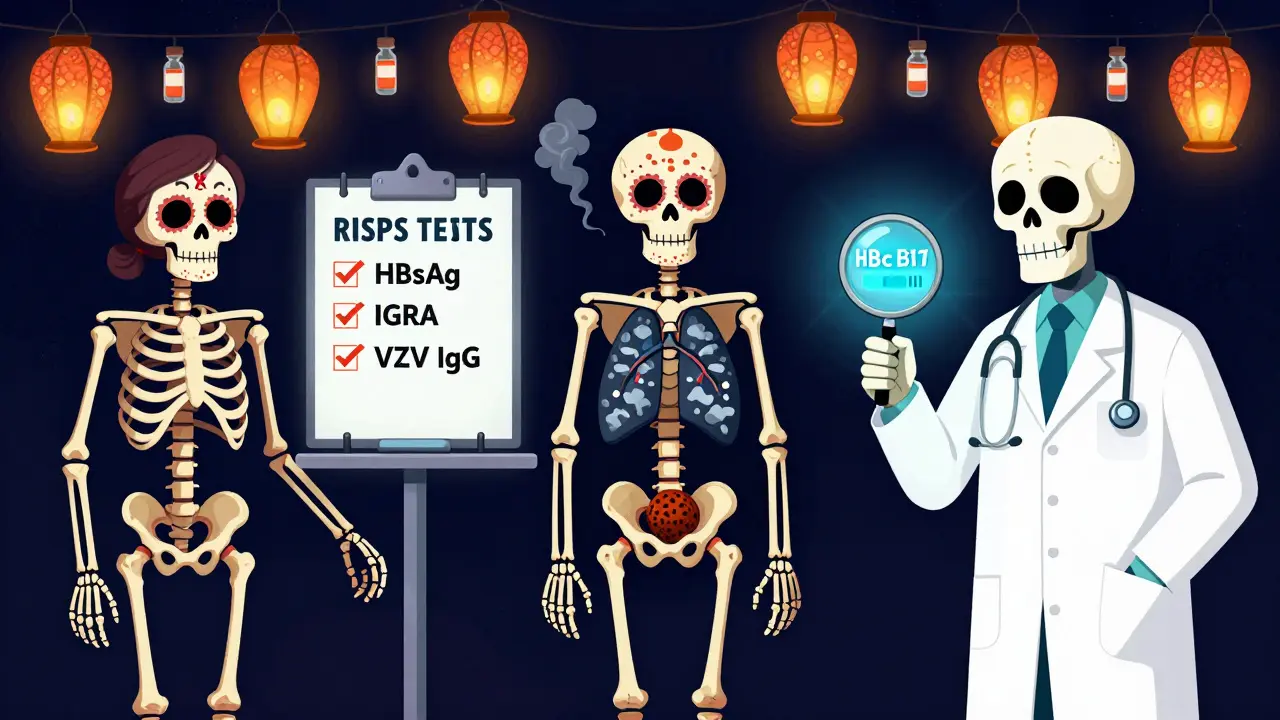
Before your first biologic shot, you need three critical tests. Skip one, and you’re gambling with your health.- HBV screening: Test for HBsAg (hepatitis B surface antigen), HBsAb (antibody), and HBcAb (core antibody). Why all three? Because 8.7% of people with HBcAb+ have hidden (occult) hepatitis B-even if they’ve never been sick. Without treatment, 27.6% will reactivate hepatitis B after starting a biologic. That’s not rare. That’s predictable.
- TB screening: Use an interferon-gamma release assay (IGRA), not the old skin test. IGRA is more accurate and doesn’t give false positives from BCG vaccines. But here’s the catch: in low-prevalence areas, some experts argue we overtest. Still, the ACR recommends it for everyone. Don’t skip it.
- Varicella-zoster virus (VZV) serology: If you don’t remember having chickenpox or the vaccine, get your IgG level checked. Below 140 mIU/mL? You’re unprotected. And shingles isn’t just a rash-it can lead to nerve damage, vision loss, or long-term pain.
Real-world data from patient forums shows that 41% of screening failures involve missing HBcAb testing. That’s not a glitch. That’s a system flaw. Make sure your doctor orders all three HBV markers-not just one.
Vaccination: Timing Is Everything
Vaccines are your best tool. But they only work if given at the right time.- Live vaccines (MMR, varicella): Must be given at least 4 weeks before starting a biologic. Once you begin treatment, you can’t get them anymore. If you’re unsure if you had chickenpox or the vaccine, test your VZV IgG first. If it’s low, get the vaccine-before the biologic.
- Inactivated vaccines (flu, pneumococcal, COVID-19, tetanus): These are safe to give anytime, but ideally 2 weeks before starting treatment. If you’ve already started, get them anyway. You still get protection.
- Hepatitis B vaccine: If you’re not immune, get the full 3-shot series before treatment. Confirm immunity with an anti-HBs titer of at least 10 mIU/mL. If you’re not protected, you’re at risk.
One patient on HealthUnlocked shared: “My GI doctor started Stelara without checking my vaccines. I got shingles four months later.” That could’ve been avoided. Vaccines aren’t optional add-ons-they’re part of the treatment plan.
What Happens After You Start?
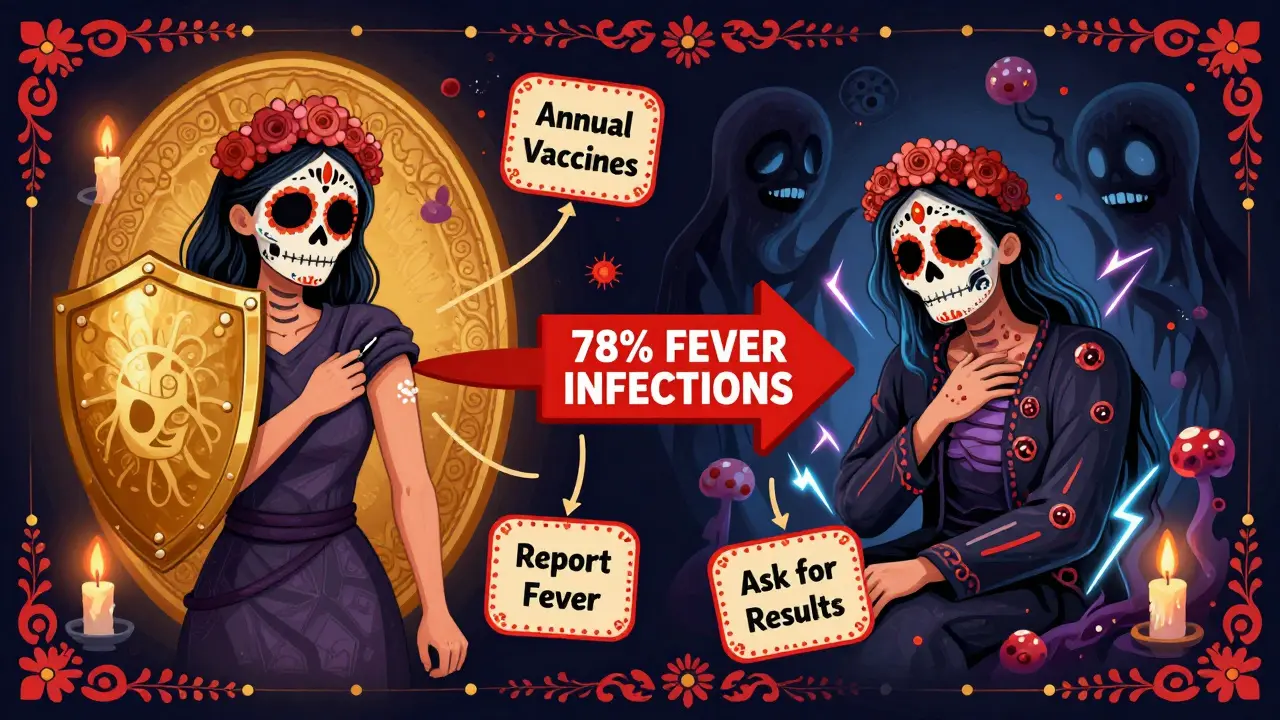
The work doesn’t stop after your first dose. You still need to stay alert.- Watch for fever, cough, night sweats, or unexplained fatigue. These aren’t “just a cold.” They could be early signs of TB, fungal infection, or sepsis.
- Don’t ignore skin changes. Red, painful, or oozing patches? Could be fungal. Cold sores that won’t heal? Could be herpes.
- Annual flu and pneumococcal vaccines are non-negotiable. Even if you got them last year, get them again. Immunity fades.
- Ask for your lab results. If your doctor says “you’re good to go,” ask: “Can I see my HBcAb and VZV IgG results?” Knowledge is power.
Patients who received full education-including the CDC’s 12-point infection prevention checklist-had 78% fewer serious infections than those who didn’t. That’s not magic. That’s structure.
What About Newer Biologics and Future Trends?
The field is moving fast. In 2025, the FDA will require real-world evidence of infection risk reduction before approving new uses for biologics. AI tools like the Cerner Biologics Safety Algorithm are already being used to predict individual risk by analyzing 87 clinical variables-from your BMI to your last flu shot date.Some patients in clinical trials are now taking antivirals like valacyclovir before starting TNF inhibitors. Early results show a 63% drop in viral infections. This might become standard for high-risk groups.
But the biggest gap? Access. In rural U.S. counties, only 28% of patients get all required screenings. That’s not just a healthcare issue-it’s an equity issue. Telehealth platforms are being rolled out in 2025 to bridge this gap, but until then, you need to be your own advocate.
Final Checklist: What You Need to Do
Before your first biologic dose:- Get tested for HBsAg, HBsAb, and HBcAb.
- Do an IGRA for TB.
- Check your VZV IgG level. If below 140 mIU/mL, get the varicella vaccine.
- Get flu, pneumococcal, and COVID-19 vaccines (inactivated) at least 2 weeks before starting.
- Get MMR or varicella vaccine (live) at least 4 weeks before starting-if you’re not immune.
- Confirm your hepatitis B immunity: anti-HBs ≥10 mIU/mL.
- Ask for copies of all test results. Keep them.
After starting:
- Get flu and pneumococcal vaccines every year.
- Report any fever, cough, rash, or fatigue immediately.
- Don’t skip follow-up labs.
- Stay up to date on all recommended vaccines-even if you think you’re “fine.”
Biologics changed the game for autoimmune diseases. But they didn’t remove risk-they just moved it. The risk isn’t in the drug. It’s in the gaps between care. Fill those gaps. Protect yourself. Your immune system is counting on it.
Do I need to get tested for hepatitis B even if I had the vaccine as a child?
Yes. Vaccine immunity can fade over time. You need to check your HBsAb level. If it’s below 10 mIU/mL, you’re no longer protected and need a booster. Even if you think you’re immune, a simple blood test is the only way to know for sure.
Can I get the shingles vaccine after starting a biologic?
No. The shingles vaccine (Shingrix) is not live, so it’s safe to give after starting biologics. But the older Zostavax vaccine (live) is not. Always confirm which version you’re getting. Shingrix is now the standard and can be given at any time-even after starting treatment.
What if I test positive for latent TB?
You’ll need to take antibiotics for 3 to 9 months to clear the infection before starting the biologic. This isn’t optional-it’s life-saving. Most patients complete treatment without side effects. Once cleared, you can safely begin biologic therapy. Skipping this step can lead to active, deadly TB.
Are there biologics with lower infection risk?
Yes. Non-TNF biologics like ustekinumab (IL-12/23 inhibitor) and secukinumab (IL-17 inhibitor) generally carry lower infection risk than adalimumab or infliximab. Certolizumab pegol also shows lower respiratory infection rates. But no biologic is risk-free. Your personal risk factors matter more than the drug class alone.
Why do some doctors skip HBcAb testing?
Some doctors think HBsAg alone is enough. But that misses 8.7% of people with hidden hepatitis B-those who are HBcAb+ but HBsAg-negative. These patients can still reactivate hepatitis B when starting biologics. The American Association for the Study of Liver Diseases (AASLD) now requires all three tests. If your doctor skips HBcAb, ask why.
How do I know if my vaccines worked?
For hepatitis B, get a blood test for anti-HBs. If it’s above 10 mIU/mL, you’re protected. For varicella, check your IgG level-it should be ≥140 mIU/mL. For pneumococcal and flu, no blood test is needed-you just need to have received the vaccine. Keep your vaccination records in your personal health file.
Can I travel while on biologics?
Yes, but be cautious. Avoid live vaccines for travel (like yellow fever) while on biologics. Stick to inactivated options. Bring hand sanitizer, avoid undercooked food, and steer clear of areas with high TB rates. Talk to your doctor before international trips. Some destinations require special precautions.
Johny Prayogi
March 21, 2026 AT 05:20Everyone on biologics needs to bookmark this. Seriously.
Bryan Woody
March 21, 2026 AT 21:37Meanwhile, I got shingles last winter. Not fun. Not worth the 'I'm fine' attitude.
Stop treating patients like robots. We're not widgets. We're people with lives. And yeah, I'm mad. But I'm alive because I asked for my lab results. You should too.
shannon kozee
March 23, 2026 AT 09:00Paul Cuccurullo
March 24, 2026 AT 15:23Patients shouldn't have to become experts just to stay safe. We owe you better.
Sandy Wells
March 25, 2026 AT 10:07So yeah. I'm scared. And I'm not going to pretend I'm not. But I'm also not going to let fear stop me from living. I got my shots. I got my tests. I'm doing what I can. That's enough.
Shaun Wakashige
March 26, 2026 AT 17:40Guess what happened?
Latent TB.
Now I'm on 9 months of antibiotics.
Thanks, doctor.
matthew runcie
March 28, 2026 AT 01:23Turns out I'm not alone.
Thanks for the clarity. I feel less stupid now.
Thomas Jensen
March 29, 2026 AT 04:52Big Pharma knows biologics increase infection risk.
They don't care.
They make billions.
And you? You're just a statistic.
Don't trust them.
Don't trust the system.
Trust your gut.
And get those tests.
Because if you don't... who will?
Timothy Olcott
March 30, 2026 AT 10:42Why is this so hard?